"Don't Have a House," "I'm Also a Commoner" Why Do Politicians Obsess Over a 'Commoner Image'?
To Give Voters a Simple and Friendly Impression
"I am a Tenant" Yoon Hee-sook, "I am Also a Monthly Rent Tenant" Yoon Jun-byung
Experts: "Using a Commoner's Image as a Strategy to Win Votes"

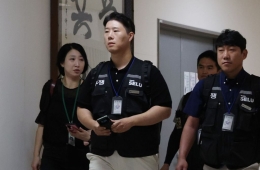
Former Future United Party (predecessor of the People Power Party) lawmaker Lee Hye-hoon is seen moving while attending the 4th private seminar hosted by Better World on the afternoon of August 25 at Mapo Hyundai Building in Seoul. Photo by Yonhap News
View original image[Asia Economy Reporter Kim Suwan] Recently, among politicians, statements claiming to be "also a non-homeowner" or "a tenant paying monthly rent" have been emerging to portray themselves as common people. However, some criticize these remarks, suggesting that politicians with assets worth hundreds of millions are making such statements to cultivate a 'commoner' image. Experts analyze this phenomenon as politicians adopting a commoner image because the majority of voters belong to the common class.
Former Future United Party (predecessor of the People Power Party) lawmaker Lee Hye-hoon expressed the hardships of living in a rented home during an interview with a media outlet on the 5th, saying, "I have been a non-homeowner for 15 years," and "On days when the landlord calls, I can't even eat."
Lee said, "Housing is the most important issue in people's lives. When housing is unstable, everything becomes unstable," adding, "But the Moon Jae-in administration has driven up housing prices like this. It's so despairing that with my salary, I can never buy my first home in life."
However, controversy arose when it was revealed that Lee currently lives in a jeonse (long-term lease) apartment worth 2.6 billion won in Seocho-gu under his spouse's name.
Earlier, People Power Party lawmaker Yoon Hee-sook, who gained attention for her 'tenant' speech, also faced criticism after it was revealed that she rents out a house she owns in Seongbuk-gu.
On July 30, Yoon drew attention by criticizing the government's and ruling party's amendment to the Housing Lease Protection Act during a five-minute free speech at the National Assembly plenary session. She began her speech with "I am a tenant," and shared the tenant's hardships, saying, "I moved in May, and since the moment I moved, I have been living with the worry of what to do if the landlord tells me to leave after two years."

On July 30th, Yoon Hee-sook, a member of the People Power Party, is giving a speech at the National Assembly plenary session. Photo by Yonhap News
View original imageHowever, civic groups such as the Citizens' Coalition for Economic Justice pointed out that Yoon was also a 'landlord' owning one house each in Seongbuk-gu, Seoul, and Sejong City until recently, leading to criticism of her 'tenant cosplay.'
Moreover, Yoon Jun-byung of the Democratic Party, who claimed to be a monthly rent tenant, was revealed to own a multi-family house (386 million won) in Gugidong, Jongno-gu, Seoul, and an officetel (190 million won) in Gongdeok-dong, Mapo-gu, sparking public outrage.
Yoon stated on his Facebook in August, "I have lived in a multi-family house at the foot of Bukhansan for over 30 years for actual residence purposes, without considering the house as a speculative or investment object and without apartment speculation," adding, "I am currently living on monthly rent as well. I am practicing monthly rent living myself."
In this way, politicians portray themselves as commoners to give voters a simple and friendly impression. Most make commoner-oriented remarks or visit markets and slums.
However, some criticize these politicians' appearances as mere commoner cosplay. Cosplay is a performance that imitates characters appearing in famous games, comics, or movies by wearing the same costumes and makeup and mimicking their behavior. Ultimately, the clumsy imitation of commoners is pointed out as an artificial performance.
As a result, citizens raise critical voices about these politicians, saying, "Is it fun to play commoner when you have tens of billions in assets?", "Who are you fooling by pretending to be poor when you are rich?", and "How can people who are always accompanied by lifelong aides be commoners?"
There are also criticisms that poverty is being used as a political tool. Kim (27), an office worker, said, "I just laugh in disbelief when I see politicians who are not commoners claiming to be commoners," adding, "The rich who have assets that commoners can never have even if they work their whole lives are now even exploiting poverty." He continued, "The people are not fools; stop mocking us."
Hot Picks Today
 "Samsung and Hynix Were Once for the Underachievers"... Hyundai Motor Employee's Lament
- Samsung Enterprise Labor Union: "We Respect Court’s Injunction Decision... General Strike to Proceed on the 21st as Planned"
- "Was This Delicious Treat Enjoyed Only by Koreans?"... The K-Dessert Captivating Japan
- U.S. Treasury Yields Surge Amid Iran War Uncertainty... Warning Signs for AI Tech Stock Rally
- "That? It's Already Stashed" Nightlife Scene Crosses the Line [ChwiYak Nation] ③
Experts evaluate politicians' use of a commoner image as a strategic move to gain votes. Political commentator Lee Jong-hoon said, "It is to gain favor and votes from commoners," but added, "However, such actions are hard to be free from criticism as commoner cosplay." He further analyzed, "Since the common class is the absolute majority, politicians have no choice but to dilute their image. Election season 'mukbang' (eating broadcasts) is in a similar context. Because the number of commoners' votes is greater than that of the rich, politicians make commoner-oriented remarks or actions as a voting strategy."
© The Asia Business Daily(www.asiae.co.kr). All rights reserved.