Worsening Business Environment for SMEs Accelerates Factory Relocation Abroad
SME Overseas Investment Doubles in 2 Years to 16.7461 Trillion Won
Domestic Facility Investment Stands at 14.5 Trillion Won
Overseas Investment Surpasses Domestic Facility Investment, Realizing 'Dead Cross' Reality

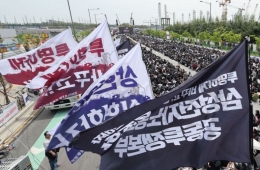
Due to the deterioration of the domestic business environment, including the 52-hour workweek system, small and medium-sized manufacturing enterprises are increasing overseas manufacturing volumes or relocating factories, effectively leaving Korea. Photo by Asia Economy DB
View original image[Asia Economy Reporter Kim Heeyoon] "Is the introduction of the 52-hour workweek system the only reason? But I can't say that it wasn't a reason at all."
Company B, an automobile parts manufacturer in Siheung-si, Gyeonggi-do, is relocating its domestic production base to Vietnam ahead of the introduction (end of grace period) of the 52-hour workweek system for workplaces with 50 to 299 employees. The company plans to establish a subsidiary in the Bac Ninh Industrial Park in Hanoi, Vietnam, to manufacture automobile parts and also produce components for mobile phones as a new business. Although not everything is smooth, at least according to CEO Park Sang-hoon (pseudonym), the company does not expect to have delivery issues due to the 52-hour workweek system.
Seeking Tax Benefits and Stable Environment Overseas
The Vietnam plant has been under consideration for five years. The project officially started in 2017. There are several reasons, including minimum wage increases, the introduction of the 52-hour workweek system, and rising wages for foreign workers. CEO Park added that the decisive factors were tax benefits and a stable environment including labor costs.
C Tongsang, which established itself in Vietnam 10 years ago, employs 3,700 people locally. The company, once a leading domestic shoe manufacturer, relocated its factory overseas because it was impossible to balance costs domestically due to labor expenses. In Busan, where the headquarters was located, only design, research and development facilities, and about 100 manufacturing process employees were retained.
In the case of Company B in Siheung, it is a rare recent example. Entrepreneurs in manufacturing sites that have entered Southeast Asia said the reason is "because all the places worth going have already been gone." They said, "The environment for small and medium-sized enterprises (SMEs) to do business in Korea is becoming increasingly difficult, and government initiatives like reshoring (return of manufacturing to the home country) are unrealistic and hollow talk."

Over the past five years, overseas direct investment by domestic small and medium-sized enterprises (SMEs) has more than tripled, reaching 16.7461 trillion won last year. In contrast, domestic facility investment has been halved from 33.4 trillion won five years ago to 14.5 trillion won this year. This marks the realization of a 'dead cross,' where the overseas investment amount of SMEs surpasses domestic facility investment. Data = Korea Eximbank Overseas Direct Investment Statistics, Korea Development Bank Facility Investment Plan Survey.
View original imageBy the end of this year, overseas factory relocations will surpass domestic new investment amounts. This rush began in earnest in 2018. With rising domestic wages and the establishment of overseas production bases, companies are setting up production bases in local markets with large scale and clear growth trends to pioneer markets or accompany large corporations' overseas investments. This trend is also confirmed by statistics. According to the Korea Eximbank's report on overseas investment by purpose, the proportion of investment aimed at local market entry increased from 35.6% in 2012 to 65.5% in 2018. The amount of direct overseas investment by SMEs also surged more than twice in two years, from $7.713 billion (about 8.3748 trillion KRW) in 2017 to $10.428 billion (about 11.3248 trillion KRW) in 2018, and $15.42 billion (about 16.7461 trillion KRW) last year.
On the other hand, domestic facility investment has steadily but sharply declined. According to the Korea Development Bank's 2020 first half facility investment plan survey, manufacturing facility investment was 79.5 trillion KRW, down 11.2% from the previous year, and SMEs' facility investment plans were 14.5 trillion KRW, down 19.5% from the previous year. Facility investment, which was 33.4 trillion KRW in 2015, has decreased by more than half over five years, dropping 2 to 5 trillion KRW annually. The so-called 'dead cross,' where SME overseas investment exceeds domestic facility investment, is approaching.
'Dead Cross' Approaching... No Change Despite Complaints
Recently, there are more cases where excellent partner companies follow large corporations' production bases that have entered local markets. For example, Rozain, a road paving material manufacturer, established a local corporation in Vietnam this year to expand its business and is about to complete its factory. Initially, the company entered the Southeast Asian market by exporting its main product, smart road paving materials, but according to CEO Shin Sung-chul, local demand for infrastructure expansion such as roads was greater, so they established a production base in Vietnam to build a system for producing and supplying general-purpose products.
Industries that can relocate production bases overseas, such as Southeast Asia, are still enviable. Among families of employees at subcontractors of Ulsan shipyards, a signature campaign is underway opposing the indiscriminate introduction of the 52-hour workweek system to workplaces with fewer than 300 employees, arguing that wages will decrease. This situation was already anticipated. The subcontractor alliance has continuously appealed to the government and the National Assembly, but they say the response was only temporary and nothing has changed.
Hot Picks Today
 "Buy on Black Monday"... Japan's Nomura Forecasts 590,000 for Samsung, 4 Million for SK hynix
- "Plunged During the War, Now Surging Again"... The Real Reason Behind the 6% One-Day Silver Market Rally [Weekend Money]
- [Good Morning Market] Tech Stocks Plunge on New York Exchange... KOSPI Expected to See Volatile Session
- "Samsung and Hynix Were Once for the Underachievers"... Hyundai Motor Employee's Lament
- "That? It's Already Stashed" Nightlife Scene Crosses the Line [ChwiYak Nation] ③
Joy Hyun, senior expert at the Korea Small and Medium Business Institute, pointed out, "With factors such as minimum wage increases, the introduction of the 52-hour workweek system, various regulations, and strong labor unions, the domestic business environment for SMEs has deteriorated, leading to increased overseas expansion and a hit to the domestic job market." He explained, "The overseas expansion of manufacturing SMEs is diversifying from low-wage labor to local market development."
© The Asia Business Daily(www.asiae.co.kr). All rights reserved.