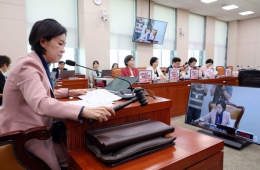
Jeong Eun-kyung "Cumulative Asymptomatic and Mild Cases... Large-Scale Outbreak Risk if Contacts Don't Decrease" (Summary)
COVID-19 Central Disease Control Headquarters Regular Briefing
Authorities: "New Cases, 99.4 in Seoul Metropolitan Area, 13.9 in Gangwon"

On the 16th, as the number of confirmed cases of the novel coronavirus infection continues to rise in the 200s for the third consecutive day, citizens visiting the screening clinic set up at the National Medical Center in Jung-gu, Seoul, are waiting for their tests. Photo by Kang Jin-hyung aymsdream@
View original image[Asia Economy Reporter Choi Dae-yeol] Jeong Eun-kyung, head of the Central Disease Control Headquarters, announced on the 16th that the government and local governments are in discussions about adjusting social distancing levels in the Seoul metropolitan area and Gangwon region, where COVID-19 cluster outbreaks have increased the number of patients. This is because the main indicator for determining social distancing levels, the number of new confirmed cases, has either exceeded or approached the threshold.
According to the Central Disease Control Headquarters, the average daily number of new confirmed cases over the past week (November 10?16) was 99.4 in the Seoul metropolitan area and 13.9 in the Gangwon region. The criteria for raising social distancing to level 1.5 when regional outbreaks begin are 100 new daily cases in the Seoul metropolitan area and 10 in the Gangwon region. During this period, the nationwide average daily confirmed cases were 144.1. At the briefing, Head Jeong said, "We are currently in discussions between the central government and local governments regarding whether to adjust social distancing levels by region in the Seoul metropolitan area and Gangwon."
Although small-scale sporadic cluster outbreaks have been confirmed in regions other than the Seoul metropolitan area and Gangwon, the numbers are still in the low double digits or single digits. Authorities believe that other regions, where the threshold for raising social distancing to level 1.5 is 30 cases, are not yet at the stage to consider changing social distancing levels.

Jung Eun-kyung, Director of the Central Disease Control Headquarters (Director of the Korea Disease Control and Prevention Agency)
Young Patients, Increased Risk of Transmission Due to Asymptomatic and Mild Cases
Face-to-Face Contact Increases After Social Distancing Eases
Winter Conditions Favor Virus Transmission
Unlike past outbreaks that spread within the Seoul metropolitan area or specific groups, recent transmission has expanded nationwide in everyday settings. Moreover, the proportion of confirmed cases among young people in their 20s and 30s who are asymptomatic or have mild symptoms has increased, raising the possibility of large-scale community spread, according to health authorities.
Head Jeong stated, "Young people often have asymptomatic or mild cases and have fewer opportunities to visit medical institutions or get tested, so they were less frequently detected in the past. Recently, with increased testing and a rise in total infections, more young people are being diagnosed, and through contact tracing and family transmission investigations, more cases are being identified."

If infection sources are not blocked in a timely manner, the average daily number of new confirmed cases could increase to 300?400 within 2 to 4 weeks. This is because the current reproduction number is about 1.12, which is above 1, and negative factors such as the year-end winter season are likely to have an impact.
Head Jeong said, "The recent increase in cases can be attributed to increased face-to-face contact and environmental factors. Since social distancing was eased last month, travel, events, and gatherings have increased, leading to more cluster outbreaks among families and acquaintances, and asymptomatic and mild infections have continued to accumulate, raising the risk of community transmission more than ever."
She added, "With more indoor activities during winter, poor ventilation, and conditions favorable for virus survival, these are ongoing risk factors that require continuous attention. In a situation where asymptomatic and mild infections are accumulating and interpersonal contact is increasing, we are at a pre-stage of a large-scale outbreak crisis where confirmed cases could increase exponentially."
Currently, the healthcare system, including treatment beds, is manageable, but Head Jeong emphasized the need to prepare in advance as a large-scale outbreak could occur at any time. She said, "As seen in other countries, there is a possibility of a very rapid increase in new confirmed cases. If this trend continues for about 1 to 2 weeks, the healthcare system could become overwhelmed."
Hot Picks Today
 "Now Our Salaries Are 10 Million Won a Month" Record High... Semiconductor Boom Drives Performance Bonuses at Major Electronic Component Firms
- Experts Already Watching Closely..."Target Price Set at 970,000 Won" Only Upward Momentum Remains [Weekend Money]
- "Heading for 2 Million Won": The Company the Securities Industry Says Not to Doubt [Weekend Money]
- Did Samsung and SK hynix Rise Too Much?... Foreign Assets Grow Despite Selling [Weekend Money]
- "Chanel Open Run? I Get a Free Pass"... The World of the Top 0.1% That Money Alone Can't Enter [Luxury World]
© The Asia Business Daily(www.asiae.co.kr). All rights reserved.