In the Past 30 Years, 'Non-Gangnam Apartment Land Prices' Rose the Most Under Moon Jae-in Government
Kyungsillyeon Survey on 17 Complexes in 22 Districts of Seoul... "Market Price Reflection Rate Declines"

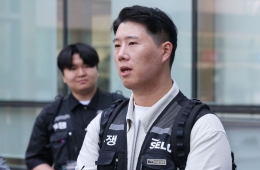
On the 16th, Yoon Soon-chul, Secretary General, and others at the Citizens' Coalition for Economic Justice in Jongno-gu announced the actual situation of land price increases for non-Gangnam apartments. From the left, Kim Seong-dal, Director of the Real Estate Construction Reform Headquarters at the Citizens' Coalition for Economic Justice, Secretary General Yoon, Kim Heon-dong, Head of the Real Estate Construction Reform Headquarters, and Team Leader Jeong Taek-su. (Photo by Citizens' Coalition for Economic Justice)
View original image[Asia Economy Reporter Onyu Lim] Over the past 30 years, land prices of major non-Gangnam apartment complexes in Seoul have risen the most during the Moon Jae-in administration, but the official land prices have not kept pace, resulting in a lower market price reflection rate, according to an analysis.
The Citizens' Coalition for Economic Justice (CCEJ) held a press conference on the 16th at the CCEJ auditorium in Jongno-gu, Seoul, announcing the results of a survey conducted on about 30,000 households in 17 apartment complexes across 22 districts excluding the three Gangnam districts (Seocho, Gangnam, Songpa) based on market prices every January from 1990 to this year.
The survey used real estate market price information from KB Kookmin Bank and others, as well as official land prices and official property prices announced by the government. It calculated land price market values by subtracting construction costs from apartment prices and considering floor area ratios, then compared these with official land prices.
According to this analysis, land prices of major non-Gangnam apartments increased 8.7 times over 30 years, from 6.87 million KRW per 3.3㎡ in 1990 to 59.95 million KRW in 2020. Among these, during the three years of the Moon Jae-in administration, prices rose from 37.06 million KRW to 59.95 million KRW, an increase of 22.89 million KRW (62%), the largest rise.
On the other hand, during this period, official land prices for non-Gangnam apartments rose only 5.11 million KRW (32%) from 15.77 million KRW to 20.88 million KRW per pyeong. The market price reflection rate was 35%, down 8 percentage points compared to the Park Geun-hye administration (43%).
CCEJ pointed out, "The steep rise in land prices was not matched by official land prices, causing the market price reflection rate to decline during the Moon Jae-in administration compared to previous governments."

Looking at individual complexes, Gireum Raemian 1 Complex in Seongbuk-gu, Lotte Castle Park in Seongsu, Seongdong-gu, and Gongdeok Raemian 2 Complex in Mapo-gu had the lowest market price reflection rate at 25%, while eight complexes including Heukseok Hangang in Dongjak-gu and Namgajwa Hyundai in Seodaemun-gu showed varying rates in the 30% range depending on the site.
Only one complex, Walkerhill in Gwangjang-dong, Gwangjin-gu, met the market price reflection rate level (65.5%) announced by the Ministry of Land, Infrastructure and Transport, with 69%.
CCEJ stated, "The average market price reflection rate for major non-Gangnam complexes in 2020 was 35%, with the lowest as low as 25%. This is about half the level of the market price reflection rate announced by the government."
Hot Picks Today
![Did Samsung and SK hynix Rise Too Much?... Foreign Assets Grow Despite Selling [Weekend Money]](https://cwcontent.asiae.co.kr/asiaresize/93/2026051416161763554_1778742977.png) Did Samsung and SK hynix Rise Too Much?... Foreign Assets Grow Despite Selling [Weekend Money]
Did Samsung and SK hynix Rise Too Much?... Foreign Assets Grow Despite Selling [Weekend Money]
- Samsung Electronics Replaces Chief Negotiator; Labor-Management Talks Resume (Update)
- "Wearing a Leather Jacket in 30-Degree Heat, Jensen Huang Enjoys Street Food as Beijing's 'Mukbang Star': 'It's Delicious'"
- "Drink Three Cups of Coffee and Stay Up All Night Before the Test"... Manual of Insurance Planner Who Collected 1 Billion Won in Payouts
- "Heading for 2 Million Won": The Company the Securities Industry Says Not to Doubt [Weekend Money]
They added, "If official land prices remain low, only a few wealthy real estate owners benefit unfairly. To achieve fair taxation, official land prices must be raised more than twice to increase the market price reflection rate to over 80%."
© The Asia Business Daily(www.asiae.co.kr). All rights reserved.