'Muin→Sondojang' 'Subong→Jingsu'... Revision of Difficult Legal Terms
National Assembly Legislative Office, Ministry of Government Legislation, and National Institute of Korean Language
Proposal of the 'Comprehensive Amendment Bill for Easy-to-Understand Laws'
To be delivered to each standing committee from the 8th
[Asia Economy Reporter Moon Chaeseok] On the 7th, the National Assembly Legislative Office, the Ministry of Government Legislation, and the National Institute of the Korean Language announced that they will jointly promote a project to simplify legal terms in celebration of the first Hangul Day of the 21st National Assembly.
Earlier, the three institutions signed a "Business Agreement for Creating Easy-to-Understand Laws" in October last year.
They have established standards and shared necessary information to simplify difficult legal terms and expressions such as Japanese-style terms, technical terms, and foreign words, building a continuous cooperation system.
The three institutions identified difficult legal terms and expressions, including Japanese-style terms, and prepared a revision plan. They plan to promote legal amendments by collectively revising 663 laws containing the 416 selected legal terms according to the 16 standing committees of the National Assembly.
The revision plan includes ▲ purifying difficult Sino-Korean words or technical terms into native Korean words, ▲ revising them into easier Korean words when appropriate native words do not exist, ▲ correcting unnatural Japanese-style terms or Japanese-influenced expressions based on Japanese vocabulary materials published by the National Institute of the Korean Language in 2005 and 2012 to conform to Korean grammar, and ▲ revising authoritative terms or unclear expressions that do not conform to grammar.
The joint revision plan by the National Assembly Legislative Office, the Ministry of Government Legislation, and the National Institute of the Korean Language will be delivered to each standing committee starting from the 8th. The three institutions expect that each standing committee will propose a collective amendment based on this and that it will be processed in the plenary session.
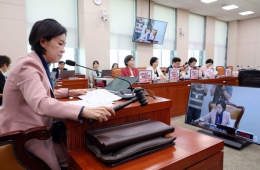
On the 8th, Speaker of the National Assembly Park Byeong-seok plans to send letters to the chairpersons of each standing committee, requesting cooperation by saying, "Please complete the revision of legal terms as soon as possible to contribute to enhancing the public's understanding and trust in the law."
Speaker Park previously led the first National Assembly rule amendment to replace the Chinese character 'Guk (國)' meaning 'nation' in the National Assembly symbol with Hangul in 2004. During his tenure as the Deputy Speaker of the 19th National Assembly in 2014, he led the plenary approval of the related amendment. He is recognized as a 'protector of the Korean language' among lawmakers.
Kim Young-chun, Secretary General of the National Assembly, said, "Although individual lawmakers have continuously tried to simplify difficult or Japanese-influenced legal terms, if related institutions such as the National Assembly Legislative Office cooperate to establish a system for collectively revising legal terms, efficiency and consistency will improve."
Secretary General Kim also stated that he will actively strive to create laws that anyone can easily read and understand.
Lee Kang-seop, Director of the Ministry of Government Legislation, said, "I am pleased that the three institutions have united to lay the groundwork for legal revision," adding, "We will actively participate to ensure the amendments are promptly processed in the National Assembly and continue to create laws that meet the public's level through easy-to-understand legislation."
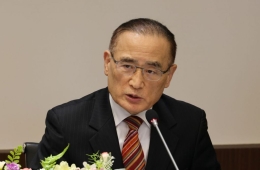
So Kang-chun, Director of the National Institute of the Korean Language, said, "I am very honored that the basic research results of the National Institute of the Korean Language have served as a foundation for actual legal amendments," and added, "We will continue to carry out effective terminology revision projects."
In the 20th National Assembly, the National Assembly Legislative Office identified legal terms subject to revision in consultation with the Ministry of Government Legislation and the National Institute of the Korean Language and presented a collective revision plan, achieving results by processing the revision plan in six standing committees.
Hot Picks Today
 "Now Our Salaries Are 10 Million Won a Month" Record High... Semiconductor Boom Drives Performance Bonuses at Major Electronic Component Firms
- Living the Homebody Dream? "I Was Shocked by My Spending" How to Cut Costs to 5,000 Won for Essentials [The Principles of Benefits]
- Is It Really Like an Illness? "I Can't Wait to Go Again"—Over 1 Million Visited in Q1, Now 'Busanbyeong' Takes Hold [K-Holic]
- "Heading for 2 Million Won": The Company the Securities Industry Says Not to Doubt [Weekend Money]
- Experts Already Watching Closely..."Target Price Set at 970,000 Won" Only Upward Momentum Remains [Weekend Money]

Cases of Major Terminology Maintenance. (Source: Ministry of Government Legislation)
View original image© The Asia Business Daily(www.asiae.co.kr). All rights reserved.