'Mun Shinbal Tuchok' Contempt Crime?…Fist Fight Leads to Arrest, Vehicle Ramming Without Detention Sparks 'Legal Sentiment' Controversy [Han Seung-gon's 'Let's Play Law']
Jeong Chang-ok, who threw a shoe at President Moon, finally arrested on charges of assaulting police
Man who rammed vehicle into police officer at Liberation Day rally denied warrant
"Arrested on spite charges?" Some citizens see a gap between court's warrant issuance and public sentiment
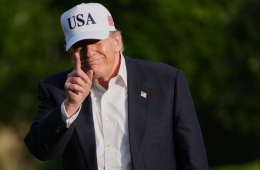
![Jeong Chang-ok (57), who threw a shoe at President Moon Jae-in during his visit to the National Assembly, is having a conversation with citizens in front of Donghwa Duty Free Shop in Seoul on the afternoon of the 20th of last month. [Image source=Yonhap News]](http://www.asiae.co.kr/news/img_view.htm?img=2020082220013638839_1598094096.png)
Jeong Chang-ok (57), who threw a shoe at President Moon Jae-in during his visit to the National Assembly, is having a conversation with citizens in front of Donghwa Duty Free Shop in Seoul on the afternoon of the 20th of last month. [Image source=Yonhap News]
View original image[Asia Economy Reporter Han Seung-gon] Jeong Chang-ok (57), who was nearly arrested for throwing a shoe at President Moon Jae-in, was finally detained on the 18th on charges of assaulting police officers at the Liberation Day rally held on the 15th. However, opinions among citizens are divided over this. This is because Lee, who was also subject to an arrest warrant application for allegedly driving a vehicle into the police at the same rally, was not detained.
Some have immediately mocked whether Jeong’s charges are more dangerous than the vehicle ramming. As a result, there is a view that Jeong was ultimately detained due to a kind of grudge crime for having thrown a shoe at President Moon earlier. Although the Constitution clearly states that "Judges shall be independent in their decisions according to their conscience in conformity with the Constitution and laws" (Article 103 of the Constitution), there are criticisms that this court decision is out of touch with public sentiment.

◆ Assault on police leads to detention... Vehicle ramming amid crowds does not
According to the legal community, Choi Chang-hoon, the chief judge in charge of warrants at the Seoul Central District Court, held a detention hearing for Jeong on the 18th and issued the arrest warrant, stating, "There is sufficient evidence to suspect the commission of a crime, and there is a risk of evidence destruction," as requested by the police.
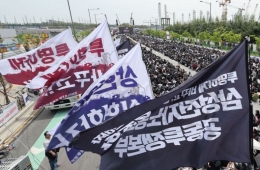
Jeong is accused of assaulting police officers who were blocking his movement toward the Blue House during the Liberation Day rally held at Gwanghwamun Square in Seoul on the 15th.
Previously, Jeong was arrested on charges of obstructing official duties, among others, for throwing a shoe at President Moon as he was leaving after delivering a speech at the opening ceremony of the 21st National Assembly on the 16th of last month. Although the police applied for an arrest warrant, the court dismissed it, allowing Jeong to avoid detention at that time, but this time he could not avoid it.
Coincidentally, Lee, who was also subject to an arrest warrant application for allegedly driving a vehicle into the police at the same rally, was not detained.
Won Jeong-sook, the chief judge in charge of warrants at the Seoul Central District Court, held a detention hearing for Lee on the same day and dismissed the arrest warrant application, stating, "At this stage, it is difficult to recognize the grounds and appropriateness for detention," as requested by the police.
The court explained the reason for dismissing the warrant, saying, "Although it is acknowledged that the suspect obstructed the police officers' official duties, all evidence has been secured, and considering the suspect’s fixed residence, occupation, family relations, and social ties, it is unlikely that he would flee."
Lee is accused of driving a van and charging toward police and protesters near Gyeongbokgung Station in Jongno-gu at around 8:30 p.m. on the 15th. At the time of the incident, police officers avoided the vehicle, and there were no casualties or injuries.
![Office workers are hurrying home after work at the Euljiro 1(il)-ga Station intersection in Jung-gu, Seoul. <br>[Photo by Yonhap News]](http://www.asiae.co.kr/news/img_view.htm?img=2020082220042238841_1598094262.png)
Office workers are hurrying home after work at the Euljiro 1(il)-ga Station intersection in Jung-gu, Seoul.
[Photo by Yonhap News]
◆ Citizens divided, some say "a kind of grudge crime applied"
However, with Lee’s arrest warrant dismissed, citizens are expressing confusion over the differing decisions by the respective courts. The charge of vehicle ramming, which could have caused serious casualties, was dismissed, while the relatively less harmful charge of assault against Jeong resulted in detention.
Citizens immediately expressed that they could not understand the relative severity of the two charges. Kim, a company employee in his 30s who said he watched the news, commented, "In Jeong’s case, it’s practically like a 'grudge crime' was applied. Otherwise, Lee, who rammed a vehicle, would not be released, and Jeong, who threw punches, would be detained. It’s hard to understand, and I think many citizens feel the same."
Another office worker in his 40s, Lee, shared a similar opinion. He said, "Fortunately, there were no casualties in the vehicle ramming incident, but if it had led to an accident, wouldn’t many more people have been injured? Although Jeong caused harm by using violence, comparing the two cases, the charge of vehicle ramming seems more serious."
Meanwhile, some in the legal community suggest that Jeong’s reoffending while under investigation for throwing a shoe at President Moon could have been a decisive factor in issuing the arrest warrant.
![Court [Image source=Yonhap News]](http://www.asiae.co.kr/news/img_view.htm?img=2020082220052238842_1598094323.png)
◆ Constitutional Court: "Public sentiment is a matter of legislative discretion decided by lawmakers"
Summarizing the situation, there is no legal problem, but from the perspective of public sentiment or popular legal sentiment, the court’s decision is difficult to understand.
Such public sentiment is sometimes mentioned unexpectedly. On February 12, 2018, at the first preparatory hearing of former President Park Geun-hye’s trial on charges of receiving special activity funds from the National Intelligence Service, Park’s court-appointed defense attorney raised issues with the prosecution’s indictment and mentioned public sentiment.
This was interpreted as an argument that the prosecution’s indictment, unrelated to the facts of the case, emphasized Park’s moral controversies and incompetence, thereby provoking public sentiment.
Public sentiment is not a law in South Korea, a country governed by statutory law (laws enacted and promulgated by the legislative body in written form), but it is sometimes used as a means to appeal to public opinion, both among citizens and occasionally in court.
However, courts are not obligated to reflect public sentiment in their rulings. In March 1997, the Constitutional Court (Constitutional Court 1997.3.27. 95HeonBa50/Full Bench Ruling) ruled on public sentiment, stating, "Issues of balance in the penal system belong to the legislative discretion decided by lawmakers, considering not only the nature of the crime but also the era at the time of legislation, general public values or legal sentiment, and criminal policy aspects for crime prevention."
The court explained that the judiciary rules based on laws created by the legislative body, the National Assembly, which considers public sentiment when making laws, but the judiciary itself cannot consider public opinion in its rulings. Moreover, there is no legal provision stating "consider public sentiment in rulings."
Meanwhile, experts emphasize that while recognizing public sentiment is a good attitude, the ruling itself is the court’s authority.
Hot Picks Today
 "Buy on Black Monday"... Japan's Nomura Forecasts 590,000 for Samsung, 4 Million for SK hynix
- "Plunged During the War, Now Surging Again"... The Real Reason Behind the 6% One-Day Silver Market Rally [Weekend Money]
- [Good Morning Market] Tech Stocks Plunge on New York Exchange... KOSPI Expected to See Volatile Session
- "Samsung and Hynix Were Once for the Underachievers"... Hyundai Motor Employee's Lament
- "That? It's Already Stashed" Nightlife Scene Crosses the Line [ChwiYak Nation] ③
A legal community official stated, "The establishment of a crime and sentencing are the exclusive rights of judges," adding, "Issuing rulings based on public opinion is not legally sound."
© The Asia Business Daily(www.asiae.co.kr). All rights reserved.