"Accident Repeated After 6 Years... Backward Country-Type Disaster" Busan Dong-gu Underpass Tragedy, Foreseen Man-Made Disaster
Chronic Flooding Area... No Control or Manual Compliance
Local Government Late to Confirm Facts, Only Sends Disaster Alerts
Repeating Same Accident on Ujangchun-ro from 6 Years Ago
Civic Group Claims "Choryang Underpass Accident Is a Man-Made Disaster"

On the 23rd, a heavy rain exceeding 80mm per hour caused flooding in an underpass in the Busan area, resulting in the deaths of three people.
/Photo by Yonhap News
[Asia Economy reporters Seunggon Han, interns Yeonju Kim and Juhee Kang] On the 23rd, a tragic accident occurred in Busan where three people died after an underpass was flooded by heavy rain exceeding 80mm per hour. Criticism is mounting that the local governments’ inadequate initial response failed to prevent the loss of life. It is being pointed out that this was not an accident caused by heavy rain but a man-made disaster.
In Busan, there have been previous casualties due to flooding, and although various measures were introduced to prevent recurrence, experts say these measures have not functioned properly, calling for more practical countermeasures.
The police plan to focus their investigation on whether there was negligence in duty by officials from Busan City and Dong-gu Office, who are responsible for managing the underpass.
Due to the heavy rain at the time, the 'Choryang No.1 Underpass,' a 175-meter-long, two-lane road connecting Jungang-daero and Chungjang-daero in Choryang-dong, Dong-gu, was flooded. Two men in their 50s and 60s and a woman in her 20s who were inside vehicles entering the underpass died.
On that day, a heavy rain advisory was issued around 2 p.m. in the Busan area, and by 8 p.m., the advisory was upgraded to a heavy rain warning as concentrated rainfall exceeded 80mm per hour. The heavy rain coincided with high tide, causing water levels to rise rapidly and submerge about 2.5 meters of the underpass.
The police, who responded to the report, began vehicle control around 9:40 p.m. on their own. However, many vehicles had already entered the underpass, and casualties occurred around 10:18 p.m. It was confirmed that the electronic display board at the underpass entrance did not provide any information about flooding.
Until the flooding, there was no vehicle control at the underpass level by the local government. Dong-gu Office, which has jurisdiction over the underpass, sent a disaster alert text message around 9:43 p.m. warning of the risk of flooding from Sujeongcheon and Dongcheon rivers, and Busan City only sent a 'underpass entry control message' to residents at 10:53 p.m., after the accident occurred.

Control standards for underpasses implemented by the Ministry of the Interior and Safety since February last year. / Photo by Busan City
View original image◆ Control Manual for Flooding Existed but Was Practically Useless
Earlier, the Ministry of the Interior and Safety established the 'Control and Grading Management Standards for Underpasses at Risk of Flooding' in February last year. This guideline was created to prevent casualties by preemptively controlling underpasses at risk of flooding based on weather alerts.
The guideline classifies 145 underpasses nationwide into three risk levels (1 to 3) and prescribes control measures accordingly. The core principle is that when a preliminary warning (level 1), heavy rain advisory (level 2), or heavy rain warning (level 3) is issued, local governments must immediately control the underpasses to prevent casualties.
In Busan, there are three level 2 underpasses and 29 level 3 underpasses, including the Choryang No.1 Underpass where the accident occurred. According to the standards, the Choryang No.1 Underpass, classified as level 3 flood risk, should have been controlled around 8 p.m. on the 23rd when the heavy rain warning was issued.
However, it was confirmed that Busan City did not control the Choryang No.1 Underpass or any of the other 29 underpasses at all.
According to media reports, Dong-gu Office, the responsible local government, was not even aware that the guideline should be implemented upon issuance of a heavy rain warning. A Busan City official avoided answering when contacted by Asia Economy, stating that they were not directly responsible for managing the underpass where the accident occurred.
The government has taken measures to prevent recurrence, but criticism is growing that these are after-the-fact responses following the fatal accident. Moreover, the underpass where the accident occurred has had frequent accidents in the past, raising concerns that the current measures may be practically ineffective.
On the 24th, Jin Young, Minister of the Ministry of the Interior and Safety, who visited the disaster site, said, "We classify underpasses by risk level and manage them thoroughly according to weather alerts, but such an accident still happened. We will establish measures to prevent recurrence by communicating in real time with the Meteorological Administration, local governments, and police."
However, the Choryang No.1 Underpass has been a habitual flooding area whenever there was heavy rain, and despite the heavy rain warning and the foreseeable risk of flooding, the lack of prior control failed to prevent the tragedy, and criticism is expected to continue.

Minister of the Interior and Safety Jin Young is visiting Choryang No.1 Underpass in Dong-gu, Busan on the afternoon of the 24th to hear an explanation of the situation at the time of the accident. Photo by Yonhap News
View original image◆ Repeat of the 6-Year-Old Ujangchun-ro Underpass Accident, Insufficient Drainage Pump Capacity... Countermeasures Were Ineffective
Four years ago, a similar fatal accident occurred in Busan. On August 25, 2014, the Ujangchun-ro underpass in Dongnae-gu was flooded by heavy rain reaching up to 130mm per hour, resulting in the deaths of a grandmother in her 70s and her teenage granddaughter. Although there was a drainage pump in the underpass at the time, the power distribution panel (a device that receives power from power plants and controls operation) was submerged and did not operate.
Since then, Busan City has taken measures to prevent such flooding accidents by relocating most electrical facilities of 35 underpasses across the city above ground and increasing the capacity of drainage pumps.
However, these measures were insufficient to prevent concentrated heavy rain. Busan has 59 drainage pump stations in total, with 29 installed specifically in underpasses, but flooding and inundation due to heavy rain continue.
The Choryang No.1 Underpass, where the accident occurred, had three drainage pumps installed, but their capacity was only 20 tons per minute, insufficient to handle the sudden influx of rainwater.
The situation is similar for other underpasses. Busan has seven underpasses longer than 100 meters, but the drainage pump capacity is inadequate, raising concerns that they cannot cope with increasingly frequent summer heavy rains.
Dongcheon, which has two drainage pump stations, flooded twice on the 10th and 23rd, but the electrical equipment was submerged, preventing operation due to risks such as electric shock. This highlights the risk that large-scale casualties could recur in unexpected locations during sudden natural disasters like heavy rain.

On the morning of the 27th, former National Assembly member Lee Eon-ju and civic groups held a press conference in front of Busan City Hall demanding a thorough investigation and measures regarding the underpass disaster.
Photo by Yonhap News
◆ "A Third-World Type Disaster... A Man-Made Disaster Due to Administrative Incompetence"
Civil society groups are criticizing the local governments, calling this tragedy "a man-made disaster caused by administrative incompetence."
Busan-Gyeongnam Future Policy, a civic group active in Busan and Gyeongnam, stated on the 26th, "The deaths of three people due to vehicle flooding in the Choryang-dong No.1 Underpass in Dong-gu during the heavy rain on the 23rd and 24th were caused by the local government's fault," and urged, "Busan City and the 16 districts and counties must fundamentally reform the drainage structures of roads and underpasses and immediately block roads and underpasses with high risk during heavy rain warnings."
Former National Assembly member Eonju Lee and about ten women's organizations in Busan also held a press conference at Busan City Hall plaza on the 27th, stating, "The Choryang-dong No.1 Underpass in Dong-gu, Busan, has a very steep slope descending from the main road and is long, making flooding inevitable during heavy rain and prone to major accidents," and criticized, "The damage caused by heavy rain is a third-world type disaster caused by poor drainage, safety facilities, and control measures."
They added, "Regardless of the reasons, the city, district offices, police, fire departments, and related agencies must feel an immense sense of responsibility for the casualties."
Experts suggest that thorough on-site management during heavy rain is necessary to prevent recurrence.
Wonchul Cho, emeritus professor of Civil and Environmental Engineering at Yonsei University, analyzed, "The fundamental problems of the flooding accident are twofold: poor road plan design and management issues. Most underpasses in Korea have small drainage inlet holes. The design should vary depending on the number of lanes, but this is often done incorrectly, resulting in low rainwater inflow rates during heavy rain, causing water to not drain and flow into the underpass, leading to flooding accidents."
He continued, "When heavy rain is forecast, on-site staff should immediately test the operation of drainage pumps to pump out water, but due to poor management, this accident occurred. Flooding accidents happen every year during heavy rain, so to prevent them, proper stormwater management and thorough preemptive management on days expected to have heavy rainfall are essential."

CCTV footage showing the flooding of Choryang No.1 Underpass in Dong-gu, Busan due to heavy rain on the 23rd./Photo by Dong-gu Office, Busan City
View original imageMeanwhile, the Busan Police Agency announced on the 28th that it has formed a dedicated investigation team for the Choryang No.1 Underpass accident and officially started the investigation.
The dedicated investigation team consists of 71 members, including the head of the Busan Police Criminal Division as team leader, the Metropolitan Investigation Unit, victim protection team, legal review team, forensic investigation team, and the Dongbu Police Station criminal team.
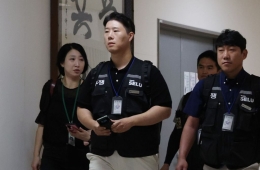
The police will focus their investigation on whether there was negligence in duty by administrative bodies such as Dong-gu Office, which is responsible for managing the underpass. It is known that the police have found indications that officials from Dong-gu Office did not properly follow the Ministry of the Interior and Safety guidelines related to underpass control.
The police also plan to request a detailed forensic examination from the National Forensic Service to verify whether the drainage pumps in the underpass were operating normally according to their design capacity at the time of the accident.
Hot Picks Today
 "Samsung and Hynix Were Once for the Underachievers"... Hyundai Motor Employee's Lament
- "Was This Delicious Treat Enjoyed Only by Koreans?"... The K-Dessert Captivating Japan
- Despite Captivating the Nation for Over a Month... "Timmy" the Whale Ultimately Found Dead
- "Record Heat Expected"...Warning of the Strongest 'Super El Nino' Since 1877
- "That? It's Already Stashed" Nightlife Scene Crosses the Line [ChwiYak Nation] ③
Regarding this tragedy, President Moon Jae-in said at a senior secretaries meeting held at the Blue House on the 27th, "I offer my deepest condolences to those who lost their lives and their families due to the heavy rain during the monsoon season," and instructed, "Let us take the Busan underpass accident as a serious lesson and make every effort to prevent further casualties."
© The Asia Business Daily(www.asiae.co.kr). All rights reserved.