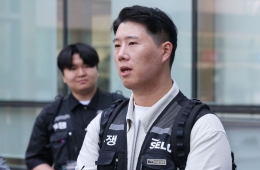
Choi Cheol, Samsung Electronics Vice President, "The Era of Eco-Friendly Low-Power Memory Has Arrived"

Choi Cheol, Vice President and Head of Strategy Marketing Office, Memory Business Division, Samsung Electronics
View original image[Asia Economy Reporter Changhwan Lee] In the era of eco-friendliness, the value of Samsung Electronics' low-power memory technology is growing even more significant.
Choi Cheol, Vice President and Head of Strategic Marketing at Samsung Electronics' Memory Business Division, presented Samsung Electronics' eco-friendly efforts and vision through a guest article titled "The Eco-Friendly Future Offered by Low-Power Memory Technology" on the Samsung Newsroom on the 29th.
Choi stated, "Market research firms predict that the total global data volume in 2025 will reach 163 zettabytes (ZB), meaning that humanity's data will increase tenfold in just 10 years," adding, "This implies that the amount of data generated in the next 2 to 3 years will be much larger than the amount accumulated over several decades."
He emphasized, "Online data is stored in data centers, often called humanity's knowledge libraries," and added, "Operating these data centers requires an enormous amount of electricity, which is where the future vision of low-power memory technology can be found."
Choi explained, "The components where actual data is stored in server data centers are HDDs (hard disk drives) or SSDs (solid-state drives). SSDs, based on NAND flash storage, offer superior performance compared to HDDs that store data on disks, while consuming about half the power. Additionally, DRAM, which is necessary for data processing, also improves in performance and reduces power consumption as technology advances."
He continued, "Replacing HDDs used in data center servers produced in 2020 with SSDs can save 3 TWh (terawatt-hours) annually, and switching server DRAM from DDR4 to the latest DDR5 can save 1 TWh of power. The total saved power of 4 TWh is enough to keep streetlights across the country on for a year or to supply electricity to all households in South Korea for a month," he explained.
Moreover, he highlighted that electricity used to cool the tremendous heat generated by tens of thousands of servers can also be saved.
He said, "Many data centers are located in Ireland, Finland, and Sweden to utilize the cold air and seawater there," adding, "Reducing power consumption in data centers also lowers heat generation, which in turn reduces the power needed for cooling. This saved power amounts to about 3 TWh annually."
Choi predicted, "The total saved power of 7 TWh can replace 2.5 coal-fired power plants. As data usage increases, the number of servers grows every year, and semiconductor technology continues to advance, the value of low-power memory will increase year by year."
He also introduced Samsung Electronics' efforts to protect the environment. He said, "Samsung Electronics launched the 'Green Memory Campaign' in 2009 and has introduced memory solutions that maximize low-power characteristics every year, striving to ensure that IT industry development benefits the global environment. We have obtained various eco-friendly certifications for the first time in the semiconductor industry, such as carbon footprint and water footprint certifications, and Gold certification for zero landfill waste, and we are working to operate semiconductor manufacturing sites in an eco-friendly manner."
Hot Picks Today
!["Heading for 2 Million Won": The Company the Securities Industry Says Not to Doubt [Weekend Money]](https://cwcontent.asiae.co.kr/asiaresize/93/2025061015355092669_1749537351.jpg) "Heading for 2 Million Won": The Company the Securities Industry Says Not to Doubt [Weekend Money]
"Heading for 2 Million Won": The Company the Securities Industry Says Not to Doubt [Weekend Money]
- "Anyone Who Visited the Room Salon, Come Forward"… Gangnam Police Station Launches Full Staff Investigation After New Scandal
- Michelin 2-Star Restaurant Owner Faces Trial Over "Ant Topping Dessert"
- "Drink Three Cups of Coffee and Stay Up All Night Before the Test"... Manual of Insurance Planner Who Collected 1 Billion Won in Payouts
- Did Samsung and SK hynix Rise Too Much?... Foreign Assets Grow Despite Selling [Weekend Money]
Choi concluded, "The direction Samsung Electronics Memory will take is clear: to provide products with excellent performance and low-power characteristics so that all customers using them can participate in preserving the global environment." He added, "Samsung Electronics, which has maintained its position as a global market leader for decades, will continuously strive to create sustainable development through new and creative methods only it can achieve."
© The Asia Business Daily(www.asiae.co.kr). All rights reserved.