[The Editors' Verdict] Real Estate Policy Should Not Be Used as a Political Tool
![[The Editors' Verdict] Real Estate Policy Should Not Be Used as a Political Tool](http://www.asiae.co.kr/news/img_view.htm?img=2020072306235975669_1595453039.jpg)
It feels like more than two months have passed even though it has been less than two weeks since the government announced the July 10 real estate measures to stabilize the housing market, due to the numerous controversies surrounding it. It has only fueled doubts about whether "housing market stabilization" was a sincere goal. The recent measures mainly focus on strengthening real estate taxation on multi-homeowners and short-term transactions, reforming the registered rental business system for rental apartments, reducing the burden on low-income genuine buyers, and expanding housing supply for genuine buyers. However, the core is the "heavy taxation on multi-homeowners." By imposing heavy taxes that prevent buying, selling, or holding houses, the government aims to fundamentally eliminate unearned income for speculative forces, including multi-homeowners.
Such heavy taxation not only harms multi-homeowners and owners of high-priced homes but also becomes a tax bomb for ordinary citizens who have struggled to secure their own homes. The comprehensive real estate tax collected from homeowners with houses valued over 900 million won increased by 42.6% last year and is expected to rise even more sharply this year. With 84% of homeowners owning just one house, the rapid rise in housing prices and the over 14% increase in official housing prices in Seoul have increased the tax burden on the majority of genuine homeowners.
The real estate tax reform, which shifts the tax burden onto the majority of ordinary citizens, will provoke tax resistance. Due to the soon-to-be-passed three lease laws in the National Assembly, jeonse (long-term deposit lease) prices have suddenly skyrocketed and listings have disappeared, leaving many ordinary citizens with nowhere to go. Since punitive demand suppression measures were introduced without addressing the supply that housing demanders want, there was no chance for the policy to be effective.
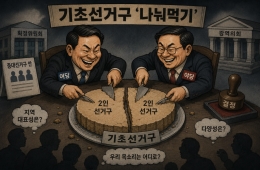
It is also becoming clear that real estate has become a political arena, not just rhetoric. From the Minister of Land, Infrastructure and Transport to the Blue House policy chief, Deputy Prime Minister for Economy, Prime Minister, and even the Governor of Gyeonggi Province and influential politicians, everyone has weighed in on real estate measures including the lifting of development restrictions (Greenbelt), exacerbating market confusion. Meanwhile, the Minister of Justice oddly mentioned the need to separate finance and real estate, referring to "financial separation."
The floor leader of the Democratic Party suddenly proposed a "comprehensive administrative capital relocation," claiming it was for balanced national development rather than housing price stability. With ruling party leadership candidates and even the Speaker of the National Assembly mentioning the completion of the administrative capital, apartment prices in Sejong are fluctuating. The president’s single remark about "considering development of the Taereung golf course" has also caused apartment prices in that area to surge. While they say they will catch speculative forces, statements that actually encourage speculation abound, so hardly anyone believes the real estate measures are for the housing stability of ordinary citizens. Targeted regulations have ultimately caused targeted price surges. Punitive taxation and inconsistent, regulation-heavy real estate policies have degenerated into political tools for dividing people to maintain long-term power. It seems that securing homes and housing stability for ordinary citizens is no longer a priority. The most affected group in the fragile real estate market, which fluctuates with every word from influential figures, is ordinary citizens who lack money, information, and even access to loans.
According to statistics from the International Finance Institute, Korea’s household debt to GDP ratio in the first quarter was 97.9%, the highest among 39 surveyed countries. The household debt has exceeded 1,600 trillion won and is growing much faster than income. The proportion of mortgage loans within this debt is overwhelmingly large. It is a ticking time bomb that could explode at any time. This is not a problem that can be overlooked due to the COVID-19 pandemic. It is time to recognize the seriousness of the situation, stop using real estate policy as a political tool, and show sincerity that ordinary citizens can feel.
Hot Picks Today
 No Bacteria Detected in Arisu After 24 Hours of Repeated Drinking from a Tumbler
- [U.S.-China Summit] "If Taiwan Is Mishandled, Collision May Occur"... Xi Jinping Delivers Stern Warning to Trump
- "We Can't Just Let Them Be Damaged Inside"... Samsung Electronics Removes 360,000 Wafers in Preparation for Strike
- Wife in $6.7 Million Debt Took Out $3 Million in Husband's Life Insurance, Poisoned Him... US Court: "She Can Never Be Released"
- "He's Handsome, It's Such a Pity?"... Lawyer Responds to Bizarre 'Appearance Evaluation' of High School Girl Murder Suspect
Professor Insoo Kang, Department of Economics, Sookmyung Women’s University
© The Asia Business Daily(www.asiae.co.kr). All rights reserved.