Preventing Secondary Harm from Digital Sex Crimes... 'LavaWave' Deletion Technology
Digital Sexual Crime Response Specialist Company
'Right to Be Forgotten' for Victims
Also Introducing Bodycam Phishing Countermeasures

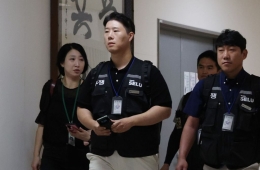
A Labawave employee is conducting network searching work related to the deletion of posts for the 'right to be forgotten' of digital sex crime victims.
View original image[Asia Economy Reporter Kim Daeseop] LavaWave, a company specializing in digital sex crime response, is expanding its post deletion service to uphold victims' 'right to be forgotten.' Utilizing proprietary crawling technology and big data, the company provides solutions to alleviate the suffering of digital sex crime victims.
On the 22nd, LavaWave held a technical briefing on the 'Digital Sex Crime, Post Deletion Service' at the Korea Federation of SMEs in Yeouido, Seoul. The briefing introduced LavaWave's crawling technology (software that navigates the web to find useful information and collects it into a specific database) and big data utilization, highlighting that technical services and deletion services through networks can be conducted simultaneously.
LavaWave asserts that although digital sex crimes have emerged as a social issue and government and local authorities continue efforts to support victims and assist youth, awareness of victims' 'right to be forgotten' remains insufficient.
The right to be forgotten refers to the right to strengthen ownership of various internet-related information about oneself and to request corrections or permanent deletion. LavaWave explains that posts involving digital sex crime victims, such as bodycam phishing videos and deepfake photos, spread instantly, causing irreparable damage, yet deletion remains solely the victims' responsibility in reality.

LavaWave particularly emphasized the dangers and countermeasures of so-called 'bodycam phishing,' where perpetrators lure victims into obscene chats via smartphones and then extort money using this as leverage. Bodycam phishing refers to crimes where perpetrators obtain videos showing victims naked or partially nude during video chats and threaten to distribute them unless paid.
Blackmailers send hacking files such as APK files during video chats, causing them to be installed on victims' smartphones. Through this, they obtain necessary contacts and threaten to distribute recorded videos to demand money.
Bodycam phishing crimes have been increasing annually, becoming a social problem. According to the '2019 Cyber Threat Analysis Report' released by the National Police Agency, bodycam phishing cases numbered 102 in 2015, 1,193 in 2016, 1,234 in 2017, 1,406 in 2018, and 1,824 in 2019, showing steady growth over the past five years.
According to LavaWave, many crimes go unreported, and the related industry estimates that there are over 10,000 bodycam phishing victims annually, with actual damages exceeding 30 billion KRW. The number of cases where LavaWave has provided technical support to bodycam phishing victims over the past five years were 875 in 2015, 1,570 in 2016, 2,345 in 2017, 3,764 in 2018, and 3,977 in 2019.
As the digital environment evolves, bodycam phishing methods are also advancing. LavaWave introduced countermeasures against bodycam phishing. First, never execute files from unknown sources. Files sent during video calls are APK files that hack smartphone information. Therefore, to prevent victimization, unknown apps should not be installed.

Especially, never send money to blackmailers. Once money is given, repeated demands for transfers follow, and if money cannot be sent, videos may be distributed. Giving money is never a solution. Advise family and acquaintances to delete any unfamiliar videos immediately. Victims should be urged not to watch videos sent by strangers immediately. If one worries alone, emotional isolation may occur.
Collect as much information about the blackmailer as possible and report it. When blackmail begins, gather evidence such as blackmailers' text messages, phone numbers, recorded calls, and account information, then report to the police. Also, seek help from specialized companies that block video distribution. Since threats to distribute videos continue during investigations, victims should receive assistance from specialized companies capable of blocking video distribution alongside police reports.
Hot Picks Today
 "Samsung and Hynix Were Once for the Underachievers"... Hyundai Motor Employee's Lament
- "Was This Delicious Treat Enjoyed Only by Koreans?"... The K-Dessert Captivating Japan
- Despite Captivating the Nation for Over a Month... "Timmy" the Whale Ultimately Found Dead
- "Record Heat Expected"...Warning of the Strongest 'Super El Nino' Since 1877
- "That? It's Already Stashed" Nightlife Scene Crosses the Line [ChwiYak Nation] ③
Kim Junyeop, CEO of LavaWave, said, "We plan to target the market by providing services and supporting victim relief based on our proprietary technology for both bodycam phishing and the right to be forgotten," adding, "We are currently in the process of signing business agreements with Seoul City and Gangwon Province regarding this matter."
© The Asia Business Daily(www.asiae.co.kr). All rights reserved.