Government Provides Indirect Tuition Support... Students 'Frustrated' Asking "What Are Universities Doing?"
Ministry of Education Decides Indirect Support for University Tuition Refunds
3,500 University Students Participate in Tuition Refund Class Action
"Student Demands Excluded, Universities and Ministry of Education Consistently Uncommunicative"

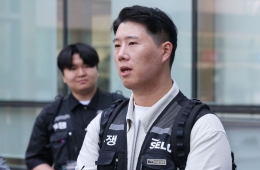
The Tuition Refund Movement Headquarters, composed of university student organizations including the National University Student Council Network, held a press conference on the 1st in front of the Seoul Central District Court in Seocho-gu, Seoul, to announce a class-action lawsuit for tuition refunds.
Photo by Yonhap News
[Asia Economy Reporter Han Seung-gon, Intern Reporter Kang Joo-hee] The government has settled on providing 'indirect support' only to universities that have devised self-help measures for tuition refunds amid the aftermath of the novel coronavirus disease (COVID-19), but controversies surrounding this issue have not easily subsided.
While some argue that using tax money to address university tuition refund issues is inappropriate, others criticize universities for hiding behind government policies and showing no willingness to resolve the tuition issue independently.
Some also express concerns that with COVID-19 expected to prolong, one-time government support cannot fundamentally solve the problem.
The Ministry of Education stated that the tuition refund issue is a matter for universities to decide on their own but acknowledged the need for government financial support to prevent prolonged conflicts.
On the 29th, the National Assembly's Education Committee resolved to increase the Ministry of Education's budget by 271.8 billion won in the third supplementary budget to address tuition refund issues caused by COVID-19.
The Education Committee plans to allocate government funds to universities up to 400,000 won per student if universities make efforts to provide tangible benefits to students, such as increasing scholarship payment rates or reducing tuition for the second semester.
However, public opinion on using tax money for university tuition refunds appears largely negative.
According to a survey conducted by polling agency Realmeter on behalf of TBS on the 25th of last month targeting 500 adults, 62.7% opposed government tuition support, while only 25.1% supported it.

Students from the National University Student Council Network are making a disaster declaration regarding COVID-19 on the 6th in front of the Government Seoul Office in Jongno-gu, Seoul. They urged for tuition refunds and measures for remote lectures. Photo by Moon Honam munonam@
View original imageSome university students also express that the government's support decision is insufficient. They point out that universities have remained silent on students' demands, citing financial difficulties, without presenting clear grounds for non-refundability.
A 20-something student, A, attending a university in Seoul, said, "Since the tuition issue arose, the university has consistently remained silent on students' demands, citing financial constraints," adding, "If there is no financial leeway, shouldn't they at least disclose how the tuition I paid was used? Tuition is not a trivial amount, and no one can accept a blanket refusal to refund without any basis."
A said, "The primary responsibility for tuition refunds lies with the universities, not the government. Yet, no university has properly responded to students' demands so far," urging, "Universities should transparently disclose tuition collection details and school operation expenditure records even now."
According to a survey conducted by the National University Student Council Network (Jeondaenet) from the 24th to the 28th of last month targeting 11,105 students from 198 universities nationwide, more than half of the students responded that 'actual tuition usage costs should be disclosed and the difference refunded' (68.6%).
The proportion of students who considered the amount of tuition refund appropriate for the first half of the year was 59%, indicating that they believe more than half of the tuition should be refunded. Responsibility for tuition refunds was attributed to universities (51.6%), the Ministry of Education (2.91%), and the National Assembly (19.3%).
This explains why there are criticisms that the demands of students, who are the direct parties in the tuition refund issue, have not been properly accepted.

The Tuition Refund Movement Headquarters, composed of university student organizations including the National University Student Council Network, held a press conference on the 1st in front of the Seoul Central District Court in Seocho-gu, Seoul, and announced that they will file a lawsuit against universities and the government. Photo by Yonhap News
View original imageWith the prolonged COVID-19 situation, there is a high possibility that non-face-to-face online lectures will continue in the second semester, leading to criticisms that short-term government support cannot fundamentally solve the problem. There are concerns that the same situation will recur if online lectures continue in the second semester.
The Ministry of Education maintains that the tuition refund issue is a matter for universities to decide independently but acknowledges the need for government financial support to prevent prolonged conflicts over tuition refunds.
On the 30th, at the plenary meeting of the Budget and Accounts Special Committee held at the National Assembly, Deputy Prime Minister and Minister of Education Yoo Eun-hye said, "We believe that universities should first devise self-help measures through consultations with students regarding the tuition refund issue," but added, "However, due to financial difficulties caused by COVID-19, we will strive to review and allocate the increased budget as approved by the standing committee."
Park Chan-dae, the ruling party's secretary of the Education Committee and a member of the Democratic Party of Korea, explained the reason for the budget increase, saying, "The state cannot do nothing about the students' tuition refund demands."
Park added, "If there is no support for universities that are making self-help efforts, there is a concern about non-registration in the second semester," and said, "If the conflict over tuition refunds between students and universities prolongs, it will be undesirable for the future of our university education, so this issue must be resolved by the Education Committee."
Meanwhile, the Tuition Refund Movement Headquarters, composed of university student organizations including Jeondaenet, filed a collective lawsuit for tuition refunds against about 40 universities on the 1st.
They held a press conference in front of the Seoul Central District Court in Seocho-gu, Seoul, stating, "Students have demanded tuition refunds from universities after COVID-19, but universities shifted the responsibility for financial losses to students, citing financial difficulties," and announced, "More than 3,500 students from 42 universities nationwide are filing lawsuits against universities and the state for tuition refunds."
Hot Picks Today
!["Heading for 2 Million Won": The Company the Securities Industry Says Not to Doubt [Weekend Money]](https://cwcontent.asiae.co.kr/asiaresize/93/2025061015355092669_1749537351.jpg) "Heading for 2 Million Won": The Company the Securities Industry Says Not to Doubt [Weekend Money]
"Heading for 2 Million Won": The Company the Securities Industry Says Not to Doubt [Weekend Money]
- "Anyone Who Visited the Room Salon, Come Forward"… Gangnam Police Station Launches Full Staff Investigation After New Scandal
- "Envious of Korean Daily Life"...Foreign Tourists Line Up in Central Myeongdong from Early Morning [Reportage]
- "Can't Even Turn On a Fan? How Will They Endure the Heat?"... Massive Blackout Hits the Philippines Amid Scorching Heat
- Did Samsung and SK hynix Rise Too Much?... Foreign Assets Grow Despite Selling [Weekend Money]
The headquarters also criticized the education authorities, saying, "The Ministry of Education, which should manage and supervise educational institutions, avoids resolving the issue by saying 'tuition refunds are matters to be resolved between students and universities,'" and added, "The 271.8 billion won supplementary budget passed by the National Assembly's Education Committee was calculated assuming a 10% tuition refund, but given the uncooperative attitudes of universities and the Ministry of Education, it is uncertain whether even this will be refunded."
© The Asia Business Daily(www.asiae.co.kr). All rights reserved.