Managing the Situation Between China and Korea Amid US-China Conflict
![[Image source=Yonhap News]](http://www.asiae.co.kr/news/img_view.htm?img=2020052514215656169_1590384116.jpg)
[Asia Economy Yang Nak-gyu Reporter] As tensions between China and the United States escalate, China appears to be shifting the blame for the conflict over the Terminal High Altitude Area Defense (THAAD) system toward the U.S. Unlike the economic retaliation measures China took against South Korea after the deployment of THAAD by U.S. forces in Korea in 2017, the intensifying U.S.-China conflict suggests that China is managing the situation with South Korea.
On the night of the 28th of last month, when U.S. forces in Korea suddenly replaced outdated missiles and equipment at the THAAD base in Seongju-gun, Gyeongsangbuk-do, China expressed dissatisfaction toward the U.S. instead of South Korea. On the 29th, Zhao Lijian, spokesperson for the Chinese Ministry of Foreign Affairs, urged at a regular briefing, "The United States should not harm China's interests or interfere with China-South Korea relations." He also stated, "China and South Korea have a clear mutual understanding on the phased handling of the THAAD issue," adding, "We hope South Korea strictly adheres to this mutual understanding, properly handles the THAAD issue, and safeguards the development of China-South Korea relations as well as regional peace and stability."
The "phased handling" mentioned by China refers to the "2017 China-South Korea THAAD Agreement" made in October 2017. At that time, China and South Korea agreed on the so-called "Three No's" principle: no additional THAAD deployment, no participation in the U.S. missile defense (MD) system, and no trilateral military alliance among South Korea, the U.S., and Japan. China merely reiterated its warning based on these principles, hoping South Korea would strictly comply. The intensity of the pressure was not sharp.
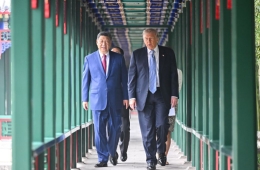
Attention has also been drawn to the recent remarks by Xing Haiming, the Chinese Ambassador to South Korea, in an interview with Weekly Dong-A, where he emphasized the significance of Chinese President Xi Jinping's visit to South Korea. Ambassador Xing mentioned regarding the Hanhanryeong (Korean Wave ban) that "If President Xi visits South Korea, significant achievements will follow." His reference to "significant achievements" is interpreted as the possibility that various restrictions on the Korean Wave, which were effectively imposed after the THAAD conflict, could be lifted following President Xi's visit. It appears that China is managing the situation with South Korea by using President Xi's visit as a turning point.
Instead, the arrow of China's criticism has shifted toward the United States. The very mention of not interfering with China-South Korea relations is interpreted as a signal that both countries do not want to revert to the worst relations seen in 2017. Some evaluations suggest that this reflects the fact that South Korea's Ministry of National Defense had prior communication with China regarding the recent THAAD equipment replacement. However, room for conflict remains, as the 2017 agreement between China and South Korea could become a constraint at any time.
Hot Picks Today
!["Heading for 2 Million Won": The Company the Securities Industry Says Not to Doubt [Weekend Money]](https://cwcontent.asiae.co.kr/asiaresize/93/2025050713592847164_1746593968.jpg) "Heading for 2 Million Won": The Company the Securities Industry Says Not to Doubt [Weekend Money]
"Heading for 2 Million Won": The Company the Securities Industry Says Not to Doubt [Weekend Money]
- "Do We Need to Panic Buy Again?" War Drives 30% Price Surge... Even the Bedroom Feels the Impact
- "Student ID Rentals Reach 500,000 Won... Black Market and Line-holding Services Surge"
- "Anyone Who Visited the Room Salon, Come Forward"… Gangnam Police Station Launches Full Staff Investigation After New Scandal
- Jay Y. Lee Bows His Head: "I Will Take All the Blame"... Apologizes for Samsung Labor-Management Conflict
In particular, the U.S. stance on strengthening the THAAD system remains unchanged. On the 1st (local time), David Eastburn, spokesperson for the U.S. Department of Defense, appeared on Radio Free Asia (RFA) and, when asked about the types of equipment brought into the THAAD base and the reasons for their introduction, replied, "The United States continues to enhance its ability to respond to any threats not only to itself but also to its allies, and to fight alongside its allies at any time." According to RFA, Tom Karako, Director of the Missile Defense Project at the Center for Strategic and International Studies (CSIS), said regarding the THAAD equipment introduction, "This was something that should have been done a long time ago," adding, "It is well known that the integrated operation of the Patriot and THAAD systems improves missile defense capabilities."
© The Asia Business Daily(www.asiae.co.kr). All rights reserved.