End of False Hope for Powell... US Government Urged to Provide Financial Support
Economic Recovery to Remain Slow Even After COVID-19 Ends
Continuous Calls for Active Fiscal Spending
WSJ Survey 2Q Growth Rate -32%
Market Reflects Harsh Reality Evaluation
![[Image source=Reuters Yonhap News]](http://www.asiae.co.kr/news/img_view.htm?img=2020051411255236618_1589423153.jpg)
[Asia Economy New York=Correspondent Baek Jong-min] It was unexpected that Jerome Powell, chairman of the U.S. Federal Reserve (Fed), known as the "world economic president," expressed concerns about the possibility of a U.S. economic recovery. Earlier last month, at a seminar hosted by the Brookings Institution, he mentioned the possibility of recovery, stating that there would be no "'L-shaped' long-term recession." His remarks changed 180 degrees in just one month. Amid growing economic damage, such as the U.S. unemployment rate soaring from 3.5% to 14.7% in just seven weeks due to the COVID-19 pandemic, his comments reminded us anew that hopes for an early economic recovery may be nothing more than "false hope."
On the 13th (local time), Powell's remarks were clearly different from his previous statements. He said, "There is a serious risk of an economic downturn. A deep and prolonged shock could have a lasting impact on the economy's productive capacity," expressing concerns that "low growth and income decline could be prolonged." In particular, he noted, "Among U.S. households with annual incomes below $40,000 (approximately 49 million KRW), 40% have lost their jobs since February," even using the phrase "unexplainable pain." The part where he said, "The possibility of a delayed economic recovery is increasing more than expected," was decisive. Even if recovery occurs, the pace may not be as fast as hoped.
The U.S. Wall Street Journal (WSJ) reported that in a survey conducted from the 8th to the 12th among 64 economists, experts predicted that the U.S. GDP growth rate for the second quarter would record "-32%." This forecast suggests a steeper decline in the second quarter compared to the first quarter's GDP growth rate of -4.8%, announced on the 29th of last month. Experts expect recovery to begin in the second half of the year, with growth rates of 8.5% in the third quarter and 6.7% in the fourth quarter. The overall growth rate for this year is expected to be "-6.6%."
68.3% of experts forecast that the economic recovery will resemble the "Swoosh" mark, the Nike symbol. This means that after a sharp drop, the recovery will be much slower than a "V-shaped" or "U-shaped" recovery, resembling a "Nike-shaped" recovery.
Since the outbreak of COVID-19, Chairman Powell has led the Fed's proactive and aggressive response, spreading hope. The swift and decisive interest rate cuts to near zero and the implementation of quantitative easing (QE) have served as a support for the economy in crisis. He not only took action but also frequently emphasized to the market that the current crisis is surmountable.
His tone began to change gradually from the end of last month, seemingly related to the U.S. becoming the world's largest COVID-19 affected country. At a press conference following the decision to keep the benchmark interest rate unchanged on the 29th of last month, he said, "The depth and duration of the economic downturn are extremely uncertain and will depend on how quickly COVID-19 is controlled." With this statement, expectations for a V-shaped economic recovery were effectively abandoned. Loretta Mester, president of the Cleveland Fed, expressed a similar view. In an interview with CNBC on the same day, Mester expressed concerns that "the U.S. economic recovery could be significantly delayed."
Powell emphasized the need for additional fiscal support to overcome the crisis. He urged Congress and the White House to take action. Bloomberg News described it as unusual for the Fed chairman to repeatedly argue for fiscal policy. At the seminar that day, he explained, "If competitive small businesses fail before the crisis occurs, we will lose more than just businesses and will lose more fundamentals." He added, "Once businesses disappear, they cannot be quickly replaced."
He also said, "Additional fiscal spending will be costly, but if it can help avoid long-term economic losses and support a strong economic recovery, it is worth it," adding, "This is for elected representatives who exercise tax and budget authority."
In the market, many view Powell's remarks as reflecting a harsh reality. Bloomberg economists Karl Ricadonna and Andrew Husby evaluated in a memo that day, "He expressed concerns that economic damage could continue through bankruptcies and business failures." Regarding his mention that negative interest rates would not be implemented, they noted, "He even avoided mentioning this during the Q&A," clearly revealing Powell's negative stance on negative interest rates.
Hot Picks Today
!["Stock Set to Double: This Company Smiles Every Time a Data Center Is Built [Click e-Stock]"](https://cwcontent.asiae.co.kr/asiaresize/93/2026050416112750184_1777878687.jpg) "Stock Set to Double: This Company Smiles Every...
"Stock Set to Double: This Company Smiles Every...
- "Is Yours Just Gathering Dust at Home? Millennials & Gen Z Rediscover Digicams O...
- International Oil Prices Plunge Over 7% on Hopes for US-Iran Deal...Largest Drop...
- "Continuous Groundwater Pumping Causes Mexico City to Sink 24cm Annually... 'Gia...
- “She Shouted, ‘The Rope Isn’t Tied!’... Chinese Woman Falls from 168m Cliff ...
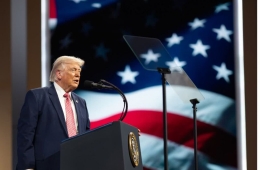
Although Powell emphasized the need for additional fiscal policy, the political situation in the U.S. is moving differently. On the same day, President Donald Trump clearly rejected the $3 trillion additional budget bill proposed by the Democratic House of Representatives the day before for economic stimulus due to the COVID-19 impact, saying it would "die as soon as it reaches the White House." While the Democrats insist on the need for swift support through additional legislation for state governments and others, the White House, U.S. government, and Republicans argue that the effects of existing measures should be observed.
© The Asia Business Daily(www.asiae.co.kr). All rights reserved.