[Weekly Review] Entering the First Ever 0% Interest Rate... Busy Preparing COVID-19 Measures

[Asia Economy Reporter Kim Bo-kyung] Due to the impact of the novel coronavirus infection (COVID-19), South Korea has entered the era of a 0% range base interest rate for the first time in history. On the 16th, the Bank of Korea lowered the base interest rate from 1.25% to 0.75% per annum in response to the economic shock caused by the COVID-19 outbreak. Additionally, the Bank of Korea focused on securing a foreign exchange market safety net by signing a currency swap agreement worth $60 billion with the U.S. Federal Reserve (Fed). The government introduced a total of more than 50 trillion won in livelihood and financial stabilization programs targeting small and medium-sized enterprises (SMEs), small business owners, and self-employed individuals to minimize the damage caused by COVID-19.
◆ Bank of Korea lowers base interest rate to 0.75% = On the 16th, the Bank of Korea held a Monetary Policy Committee meeting and cut the base interest rate by 0.50 percentage points from the previous 1.25% per annum to 0.75% per annum. This was a measure to respond to the economic shock caused by the COVID-19 outbreak. This decision followed the U.S. Federal Reserve's sudden cut of its base interest rate to near zero. Entering the 0% range base interest rate for the first time in history, the Bank of Korea is treading "an uncharted path." The rate cut also signifies that the Bank of Korea viewed the economic impact of COVID-19 as severe. Governor Lee Ju-yeol explained, "As the speed and intensity of the COVID-19 spread were greater and faster than initially expected, spreading to many regions, we anticipated a prolonged impact. To help vulnerable sectors such as small self-employed businesses and SMEs overcome difficulties, we judged that their borrowing costs must be significantly lowered, so we decided to respond actively."
◆ $60 billion Korea-U.S. currency swap agreement = On the 19th, the Bank of Korea announced that it had agreed to a bilateral currency swap contract worth $60 billion with the U.S. Federal Reserve. This amount is twice the size of the agreement made during the 2008 global financial crisis. The contract period is at least six months (until September 19, 2020). Following the news of the Korea-U.S. currency swap agreement, the Korean stock market and the soaring exchange rate, which had been plunging for consecutive days, showed signs of stabilization. Governor Lee said, "We expect the Korea-U.S. currency swap agreement to contribute to easing instability in the domestic foreign exchange market." Kim Yong-beom, First Vice Minister of Strategy and Finance, also said, "The Korea-U.S. currency swap agreement is twice the size of that during the 2008 global financial crisis and will serve as a strong safety net to stabilize the domestic foreign exchange market, which was affected by global financial instability."

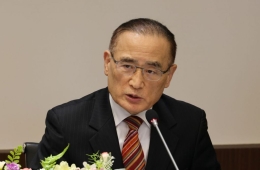
Hong Nam-ki, Deputy Prime Minister and Minister of Economy and Finance Photo by Yonhap News
View original image◆ Government implements 50 trillion won support measures for SMEs and small business owners = To respond to the COVID-19 outbreak, the government is implementing a large-scale livelihood and financial stabilization program totaling more than 50 trillion won targeting SMEs, small business owners, and self-employed individuals. On the 19th, Hong Nam-ki, Deputy Prime Minister and Minister of Strategy and Finance, announced the results of the first emergency economic meeting. Considering the funding needs of small business owners, the government will newly supply 12 trillion won in emergency management funds and apply an ultra-low interest rate of about 1.5% to significantly reduce interest burdens. To support loans for struggling SMEs and small business owners, the government will provide special guarantees worth 5.5 trillion won using supplementary budget resources. Additionally, a full guarantee will be provided for urgent small fund needs of micro small business owners who have suffered direct or indirect damage from COVID-19, totaling 3 trillion won.
Hot Picks Today
 "Now Our Salaries Are 10 Million Won a Month" Record High... Semiconductor Boom Drives Performance Bonuses at Major Electronic Component Firms
- Is It Really Like an Illness? "I Can't Wait to Go Again"—Over 1 Million Visited in Q1, Now 'Busanbyeong' Takes Hold [K-Holic]
- "Realizing How Fast Money Disappears: Should You Try Only the Essentials for 5,000 Won? [The Basics of Benefits]"
- "Heading for 2 Million Won": The Company the Securities Industry Says Not to Doubt [Weekend Money]
- Experts Already Watching Closely..."Target Price Set at 970,000 Won" Only Upward Momentum Remains [Weekend Money]
◆ Impact of COVID-19... Producer prices fall by 0.3% = In February, producer prices fell by 0.3% month-on-month due to decreased demand caused by the spread of COVID-19 and a sharp drop in international oil prices. Notably, prices of agricultural, forestry, and fishery products as well as coal and petroleum products showed a marked decline. According to the 'Producer Price Index for February 2020' announced by the Bank of Korea on the 20th, the overall producer price index last month was 103.74, down 0.3% from the previous month. Compared to the same month last year, it rose by 0.7%. Due to the sharp drop in international oil prices, prices of coal and petroleum products such as diesel (-11.4%) and naphtha (-10.9%) fell by 7.2%. Chemical products also declined by 0.4%. Overall manufactured goods prices fell by 0.5%. As consumption plummeted, demand for agricultural, forestry, and fishery products decreased, naturally leading to a drop in related prices. Prices of eggs (-13.2%), beef (-2.1%), lettuce (-60.6%), and radish (-51.0%) all plunged simultaneously. A Bank of Korea official explained, "With school openings postponed, demand for school meals decreased, leading to price drops in eggs and radishes." Prices of agricultural, livestock, and fishery products combined fell by 3.1% month-on-month. The impact of COVID-19 was also visible in sectors such as restaurants and lodging (-0.1%) and transportation (-0.2%).
© The Asia Business Daily(www.asiae.co.kr). All rights reserved.