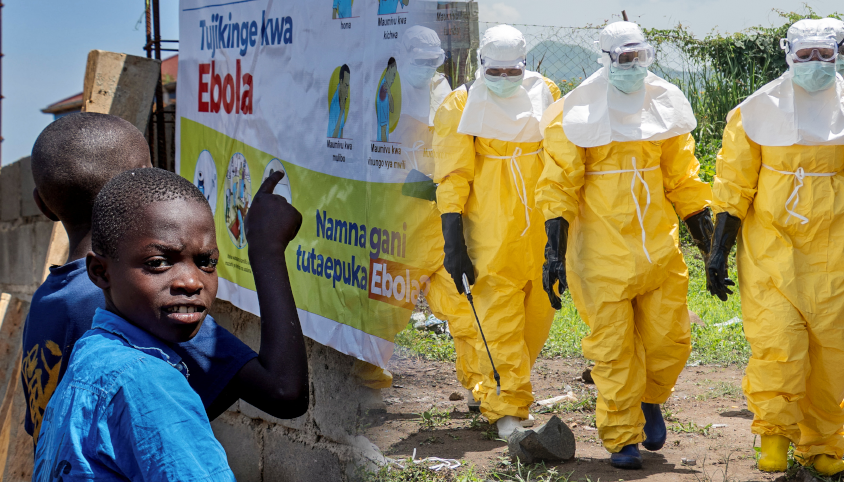
The World Health Organization (WHO) has declared a Public Health Emergency of International Concern (PHEIC) in response to the spread of the 'Bundibugyo variant of Ebola' in the Democratic Republic of Congo and Uganda.
PHEIC is the highest level of international health alert that the WHO can issue. However, this does not immediately mean a pandemic declaration like COVID-19. Rather, it serves as a warning that each country should strengthen surveillance, quarantine, and diagnostic systems, and engage in international cooperation.
!['WHO Declares International Public Health Emergency' Why the Untreatable 'Variant Ebola' Is More Deadly Than COVID-19 [Reading Science]](http://www.asiae.co.kr/news/img_view.htm?img=2026052110172272059_1779326243.png)
According to the WHO, both laboratory-confirmed and suspected cases, as well as deaths under suspicion, have been reported in Ituri Province, Congo. In addition, an infected individual who traveled from Congo has been identified in Kampala, the capital of Uganda, making this outbreak an international concern that has already crossed borders.
The main reason for heightened concern over this outbreak is the type of virus involved. The current spread is not caused by the Zaire strain of Ebola, which most existing vaccines target, but by the relatively rare and less-studied 'Bundibugyo ebolavirus (BDBV)'. There is not yet sufficient evidence on the effectiveness of vaccines and treatments against this variant.
!['WHO Declares International Public Health Emergency' Why the Untreatable 'Variant Ebola' Is More Deadly Than COVID-19 [Reading Science]](http://www.asiae.co.kr/news/img_view.htm?img=2026052110182772066_1779326307.png)
Of course, Ebola is not a virus that spreads rapidly through the air like COVID-19. Most infections occur through direct contact with the blood, bodily fluids, or contaminated materials of an infected person. Experts explain that with early response, isolation, and contact tracing, Ebola is a disease that can be effectively controlled.
Nevertheless, the reason the WHO has issued its highest alert is due to the possibility of 'invisible transmission.' It reportedly took about four weeks from the appearance of the first suspected case to laboratory confirmation, raising concerns that the virus could have spread along local transit and cross-border transportation networks during that period.
In particular, infections among medical staff are considered a serious warning sign. Reports of healthcare worker deaths suggest that infection control inside hospitals may not be functioning properly. This raises concerns that the healthcare system, which is at the forefront of the response, could itself become a pathway for further spread.
!['WHO Declares International Public Health Emergency' Why the Untreatable 'Variant Ebola' Is More Deadly Than COVID-19 [Reading Science]](http://www.asiae.co.kr/news/img_view.htm?img=2026052110191372073_1779326353.png)
The situation in eastern Congo, the epicenter of the outbreak, is also problematic. The region faces overlapping challenges of armed conflict, political instability, and inadequate medical infrastructure. The lack of road networks and diagnostic systems makes it difficult to identify infected individuals and track their contacts. On top of this, the local healthcare system is under increased strain as it also responds simultaneously to Mpox.
Experts emphasize that what is needed now is not fear, but early diagnosis, transparent risk communication, and international cooperation. It is crucial to clearly communicate what has been confirmed and what remains uncertain.
The WHO has stated that this situation does not yet meet the criteria for a pandemic emergency. However, this case once again demonstrates that a vaccine and treatment system focused only on well-known viruses is insufficient to respond to new variants and rare infectious diseases.
Ultimately, this emergency declaration is more of an early warning to prevent further spread than a proclamation of a global pandemic. What matters more than fear is rapid detection, accurate tracing, transparent communication, and cooperation from the international community.
-

Reporter Kim Jonghwa justin@asiae.co.kr
-
Edit Bae Byoungmin wuhaha@asiae.co.kr
© The Asia Business Daily(www.asiae.co.kr). All rights reserved.