
On the afternoon of the 13th, customers continued to visit Myeongdong Gyoja New Building, a representative Kalguksu restaurant in Myeongdong, Jung-gu, Seoul, for lunch. Photo by Hyunjin Jung
원본보기 아이콘On the afternoon of the 13th, even long after lunchtime, customers continued to flock to the Myeongdong Kyoja New Building, a renowned kalguksu (noodle soup) restaurant in Myeongdong, Jung-gu, Seoul. The diverse clientele ranged from elderly gentlemen, groups of women in their 60s visiting Myeongdong with old friends, to young foreign tourists capturing their travel moments by photographing kalguksu and dumplings. A couple in their 30s from Singapore, waiting in line to dine, said, “We came because we read online that this is a must-visit restaurant,” expressing their excitement. The scene at this 60-year-old kalguksu restaurant, bustling with both local and international visitors, made it hard to believe that it reported losses during the COVID-19 pandemic.

According to the electronic disclosure system on the 14th, Myeongdong Kyoja posted sales of 35.2 billion won and operating profit of 12.7 billion won last year. Sales increased by 9.7% and operating profit by 3% year-on-year. Founded in 1966 as a small kalguksu restaurant, Myeongdong Kyoja now directly operates four locations: three in Myeongdong and one in Itaewon, Yongsan-gu, Seoul. If the annual sales are arithmetically converted into the price of their signature kalguksu dish (12,000 won), it is estimated that the four locations sold 2.94 million bowls in a year-over 8,000 bowls per day.

Myeongdong Kyoja suffered significant losses during the COVID-19 period. However, it bounced back quickly, doubling its sales within five years. Its sales, which stood at 11.7 billion won in 2020, surpassed 20 billion won just two years later in 2022, and soared past 30 billion won in 2024-another two years after that.
The secret to this growth appears to be the surge in foreign visitors. According to the Korea Tourism Organization, the number of inbound foreign tourists to Korea reached an all-time high of 18.94 million last year. Notably, the number of foreign visitors to Myeongdong skyrocketed from 40,960 in 2021 to 940,000 in 2022, 9.77 million in 2023, and reached 14,275,126 last year.
Alongside rising sales, operating profit also jumped, increasing from 3.5 billion won in 2021 to 12.7 billion won last year-a 3.6-fold increase. Myeongdong Kyoja's operating margin (operating profit to sales) was 36.1% last year, nearly five times higher than the average operating margin (7.7%) for general Korean restaurants. For the past four years, Myeongdong Kyoja's operating margin has exceeded 30%, even soaring to 38.3% in 2024.

The high operating margin appears to be primarily due to price increases, which took into account the rising costs of raw materials and labor. Myeongdong Kyoja has raised the price of its kalguksu three times in the past five years (2022, 2023, and 2025), citing higher costs for raw materials and labor. During this period, the kalguksu price rose from 9,000 won to 12,000 won. The average price of kalguksu in Seoul is about 10,000 won.

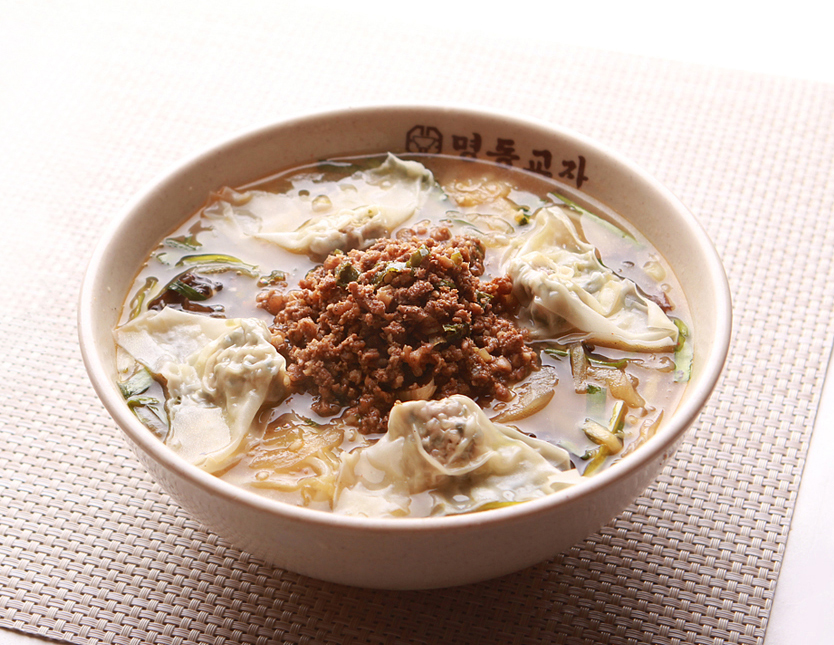
Signature dishes of Myeongdong Kyoja: knife-cut noodle soup and dumplings. Photo by Seonju Lee.
원본보기 아이콘Operating costs (selling and administrative expenses) have also increased, which is interpreted as a result of store expansion. Myeongdong Kyoja's selling and administrative expenses rose from 4.3 billion won in 2020 to 7 billion won last year. Of these, the largest share was personnel-related expenses (salaries, severance pay, and welfare benefits), which jumped from 2.7 billion won in 2020 to 4 billion won last year-an increase of nearly 50%. The number of employees decreased from 140 in 2020 to 112 in 2021, but then increased to 160 last year. In contrast, advertising expenses, which were 110,000 won in 2021, dropped to zero last year. This means that customers flock in even without advertising. Other necessary operating costs, such as telecommunications, utilities, insurance, and vehicle maintenance, have also increased.

In particular, Myeongdong Kyoja has a relatively low real estate rental burden compared to typical restaurants. The company owns land worth 91.7 billion won in Myeongdong, Seoul and Yongin, Gyeonggi Province. To break down the land prices, the Myeongdong main store occupies 189 square meters (about 58 pyeong) and is valued at 13.092 billion won, while the nearby branch covers 236 square meters (about 72 pyeong) and is valued at about 42.269 billion won. In 2023, the company purchased additional land and opened a new building in December last year. This was the first new Myeongdong location added in 49 years since opening a branch near the main store in 1976. The new building is 301.1 square meters (about 91 pyeong), with the land valued at 31.864 billion won. This is why the company can operate stores in Myeongdong, an area famous for high rents, with relatively low selling and administrative costs.
For the Itaewon location, the company pays about 334 million won in rent. The landowner, Seyoung Distribution, is a company that supplies food ingredients to Myeongdong Kyoja and is led by Chae Yeonhee, who is both the second daughter-in-law of Myeongdong Kyoja's founder and the wife of its current CEO. Seyoung Distribution's business is based on nine plots of land totaling 6,218 square meters (about 1,880 pyeong) in Yongin, Gyeonggi Province, valued at about 4.5 billion won, which are in addition to the three buildings owned by Myeongdong Kyoja in Myeongdong.
Myeongdong Kyoja is wholly owned (100% stake) by the founder's second son, James Hwijoon Park. The business began in 1966 when founder Park Yeonha started operating a small kalguksu restaurant run by a relative. In 1969, the name was changed to Myeongdong Kalguksu at Jangsu Jang. Ten years later, the company bought the current main building and opened a second store. After trademark issues, the business was renamed Myeongdong Kyoja in 1978. In 2019, it was incorporated as a corporation and continues to operate as such.
-
Reporter Jeong Hyunjin jhj48@asiae.co.kr
-
Edit Lee Seonju sjlee109@asiae.co.kr
© The Asia Business Daily(www.asiae.co.kr). All rights reserved.

!["They Said It Was 'Delicious' Milk... Is the 'List of Fake Milk Products in Korea' for Real? [Matjal X-File]"](https://cwcontent.asiae.co.kr/asiaresize/323/2023072413274517286_1690172865.jpg)

!['Record-High Net Profit' TSMC to Invest KRW 82 Trillion in Facilities This Year [Taiwan Chip Communication]](https://cwcontent.asiae.co.kr/asiaresize/304/2026011515434793142_1768459427.jpg)