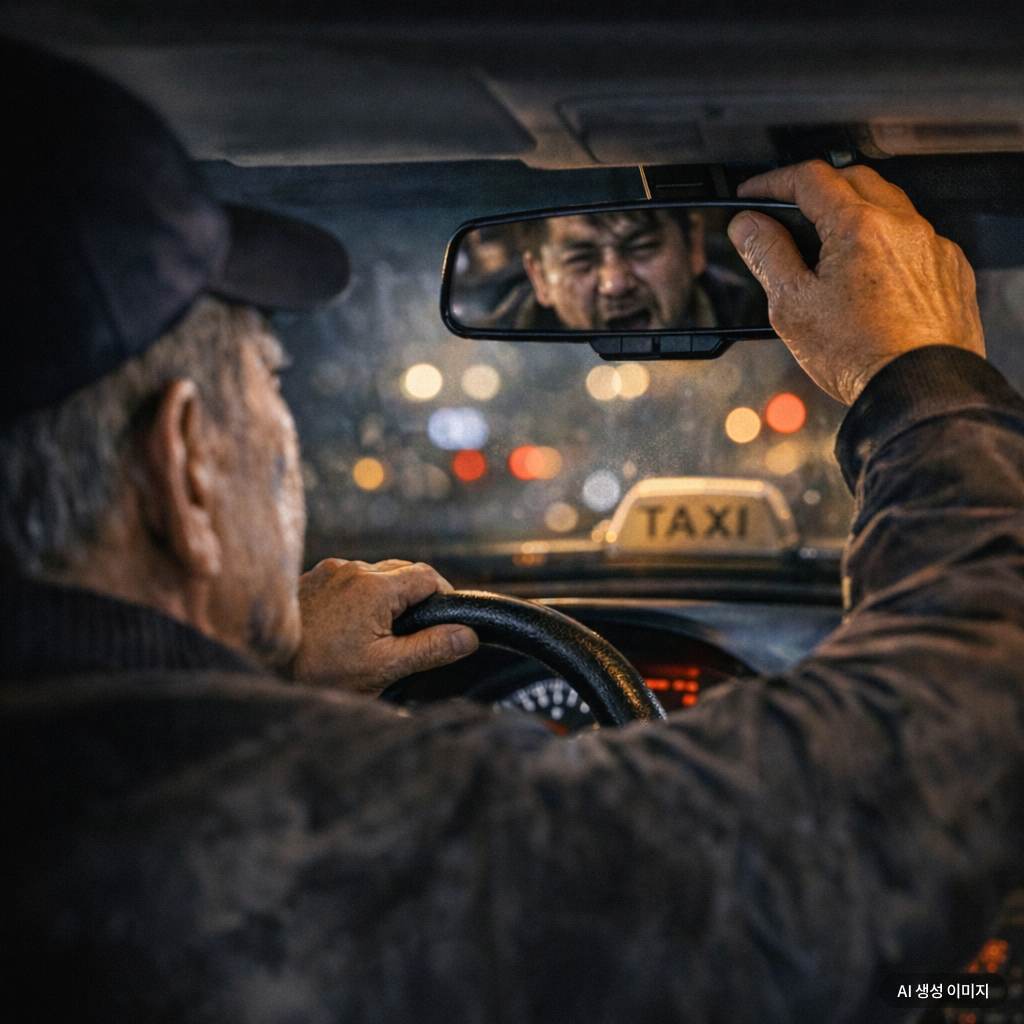
#. Five years after the COVID-19 pandemic, Mr. Kim (68), who has been driving a taxi, has recently developed a habit of checking his rearview mirror multiple times. This is due to the trauma he suffered after being assaulted several times without reason by a heavily intoxicated passenger late at night.
He still clearly remembers a passenger suddenly threatening, "I'll report you and have your license revoked." Kim confessed, "When I pick up large passengers at night and have to drive to suburban areas, my heart pounds with fear," adding, "It's hard work driving in a cramped car without knowing who's sitting behind me."
Nine Drivers Assaulted Every Day
Although the law has been revised to impose harsher penalties for assaulting public transportation drivers, incidents that threaten the safety of taxi drivers-such as drunken passengers causing disturbances-continue without end.
According to the National Police Agency on April 9, cases of driver assault under the Act on the Aggravated Punishment of Specific Crimes totaled 3,284 last year. The number has decreased from 3,947 cases in 2023 and 3,498 cases in 2024, but it still greatly exceeds an annual average of 3,000 cases. Based on last year's figures, nine drivers are assaulted every day.

The severity of the damage is also increasing. On March 5, in Asan, South Chungcheong Province, a taxi driver in his 70s was assaulted by a passenger in his 50s, suffering serious injuries including facial bone fractures and brain trauma that required 12 weeks to heal. Considering the grave nature of the incident, police charged the assailant with attempted murder. In Ansan, Gyeonggi Province, on March 21, a man in his 40s struck the driver's face multiple times with a mobile phone, causing injuries that required eight weeks to recover.
Slow Progress in Installing 'Protective Barriers'
Progress in installing 'protective barriers' to physically safeguard taxi drivers remains sluggish. Protective barriers are transparent partitions installed in vehicles such as taxis and buses to protect drivers. City buses have had mandatory installation since 2006, reaching a 100% installation rate, but there are no such requirements for taxis. As of 2024, out of approximately 70,000 taxis in Seoul, only about 700 have protective barriers installed-just 1%.
At one point, some local governments such as the Seoul Metropolitan Government provided subsidies for installing protective barriers, but these programs have been discontinued. Because taxi drivers now have to cover the costs themselves, participation rates are low. Seoul supported the installation of barriers in 30 vehicles in 2014, 236 in 2019, and 493 in 2021, but the program was halted thereafter due to a lack of budget and low demand. An official from the Seoul Metropolitan Government explained, "While the majority of taxi drivers agreed on the necessity of installing protective barriers, some were reluctant due to the costs or concerns about feeling cramped."

There are also criticisms that lenient punishments are not reducing the damage. Under current law, those who assault or threaten a driver while the vehicle is in operation can face up to five years in prison or a fine of up to 20 million won. Although such acts can lead to major traffic accidents and threaten the lives of many, in practice, many offenders receive suspended sentences or fines.
Our analysis of 10 recent court rulings on driver assault cases revealed that only about 20% resulted in actual imprisonment. Most offenders received suspended sentences or light fines, either because it was their first offense, they showed remorse, or they reached a settlement with the victim.
In October last year, a passenger in Bucheon, Gyeonggi Province, who struck a driver's face six times while the vehicle was in motion, was sentenced to six months in prison, suspended for two years. Another offender in Paju, Gyeonggi Province, who grabbed the driver's arm and punched him, was also released with 80 hours of community service and a suspended sentence, despite having a prior record of violence.
Lee Hyun-ro, Director of Organization at the National Taxi Workers' Union, said, "Because taxis are confined spaces where drivers must face passengers one-on-one, they are extremely vulnerable to crime," and emphasized, "A social atmosphere of strictly punishing even minor assaults must be established, and budgetary support is needed to reduce the financial burden of installing protective barriers."
-

Reporter Park Jaehyun now@asiae.co.kr
-
Edit Kim Hyunhee faith100@asiae.co.kr
© The Asia Business Daily(www.asiae.co.kr). All rights reserved.



!["They Said It Was 'Delicious' Milk... Is the 'List of Fake Milk Products in Korea' for Real? [Matjal X-File]"](https://cwcontent.asiae.co.kr/asiaresize/323/2023072413274517286_1690172865.jpg)

!['Record-High Net Profit' TSMC to Invest KRW 82 Trillion in Facilities This Year [Taiwan Chip Communication]](https://cwcontent.asiae.co.kr/asiaresize/304/2026011515434793142_1768459427.jpg)