One Year Since Law Enforcement
Existing Delivery Drivers Remain Unchanged
'Loophole' in Retroactive Application
Existing Delivery Drivers Remain Unchanged
'Loophole' in Retroactive Application
by Park Hosu
by Choi Yujeong
Published 18 Mar.2026 15:14(KST)
Han, a 49-year-old parent raising two elementary school children in Jungnang-gu, Seoul, says she feels anxious every time she orders delivery food these days. Rumors have been circulating that a person listed on the "Sex Offender Notification e" service is working as a delivery rider in her neighborhood. Han confessed, "I worry that the delivery driver, who freely enters and exits by pressing the main entrance password, might be a violent criminal," adding, "I'm scared that something could happen when only my children are home."
It has been a year since the enactment of laws prohibiting individuals with records of serious crimes—such as sexual offenses and drug crimes—from working in the delivery industry. However, because the law is not retroactively applied and platforms have not established related procedures, significant blind spots remain. There are growing calls for not only institutional improvements but also for platforms to implement responsible verification processes.

According to the Ministry of Justice and the delivery industry on March 18, the revised "Act on the Development of the Logistics Services Industry" (Saengmul Act) went into effect in January of last year. Under the amendment, individuals with a history of serious crimes such as murder, rape, robbery, abduction, or drug offenses are prohibited from working as delivery drivers or in small parcel delivery services for a period of 2 to 20 years. Delivery businesses are now required to check the criminal records of applicants during hiring.
However, the enforcement ordinance of this law applies these restrictions only to "new hires," meaning that drivers who were already under contract can continue working in delivery services. This has created a loophole due to the lack of retroactive application. Those who signed a contract before the law took effect are excluded from mandatory criminal background checks. Due to the nature of platforms, there is also no contract renewal procedure, so anyone previously registered as a rider—even those with serious criminal records—can continue working as a delivery driver without restriction.
In interviews conducted by The Asia Business Daily, all ten delivery drivers with over five years of experience stated that they had never been asked by the platform to reconfirm their criminal records since the law came into effect. "Once you’re registered, there is no re-verification procedure, whether it’s after 10 years or 20 years," one said. As a result, even among drivers, concerns are growing. In major online communities for delivery drivers, there are numerous posts lamenting, "Because of a few criminals, even diligent riders are being suspected."
Platforms, however, are taking a hands-off approach, citing "practical difficulties." A representative of one delivery platform stated, "With nearly 400,000 delivery drivers nationwide, it is unrealistic to conduct a full background check on all current workers without legal enforcement," adding, "Platforms have no authority to routinely check criminal records due to privacy protection laws."
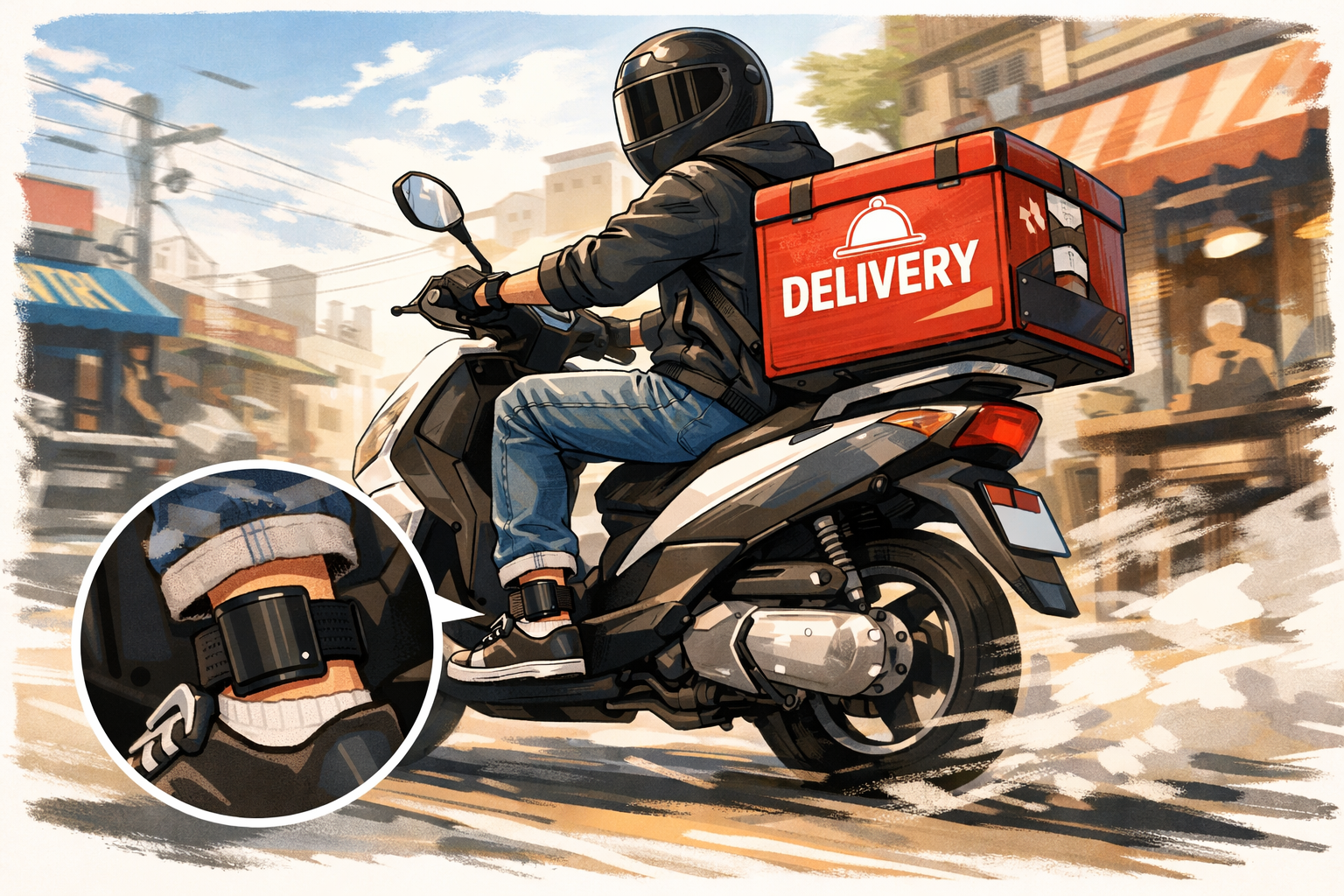
The issue is that even individuals required to wear location-tracking electronic ankle bracelets—classified as high-risk—are still able to work in delivery services. As of 2019, out of 3,296 individuals under supervision, 633 (19.2%) were classified as day laborers, and at the time, lawmakers pointed out that a significant number of them were likely working as delivery drivers.
Since then, the Ministry of Justice has reclassified delivery drivers from "day labor" to the "other" category for management efficiency. As of January this year, among 3,231 individuals required to wear electronic ankle bracelets, 428 (13.2%) were recorded as working in other industries. However, the exact number of delivery drivers among them has not been disclosed. A Ministry of Justice official said, "We are strengthening management by checking compliance with relevant requirements," but also admitted, "It is true that some still exist."

In September 2024, a witness account of a delivery rider wearing an electronic ankle bracelet was posted on an online community. The photo shows a delivery rider wearing an electronic ankle bracelet, posted on the online community "BobaeDream." Screenshot from the online community.
원본보기 아이콘The Ministry of Justice claims that it effectively restricts employment in the delivery industry through compliance requirements such as curfews at night and bans on entering certain areas. However, as long as individuals avoid these specific restrictions, they can still work as delivery drivers. A Ministry of Justice official explained, "The court must recognize a significant reason in order to modify these requirements, and if a request is denied on the grounds of freedom to choose an occupation, there are no grounds to prevent it."
Experts point out that this reality represents a "serious contradiction." Lee Unghyuk, professor of police studies at Konkuk University, stated, "It is a serious contradiction that, while the state monitors these individuals with electronic ankle bracelets, it legally allows them to approach the front doors of citizens’ homes," adding, "Rather than using the structural characteristics of platforms as an excuse to avoid social responsibility, platforms should address these loopholes by re-verifying criminal records through contract renewals."

Park Hosu lake@asiae.co.kr
Choi Yujeong yjchoi@asiae.co.kr
© The Asia Business Daily(www.asiae.co.kr). All rights reserved.