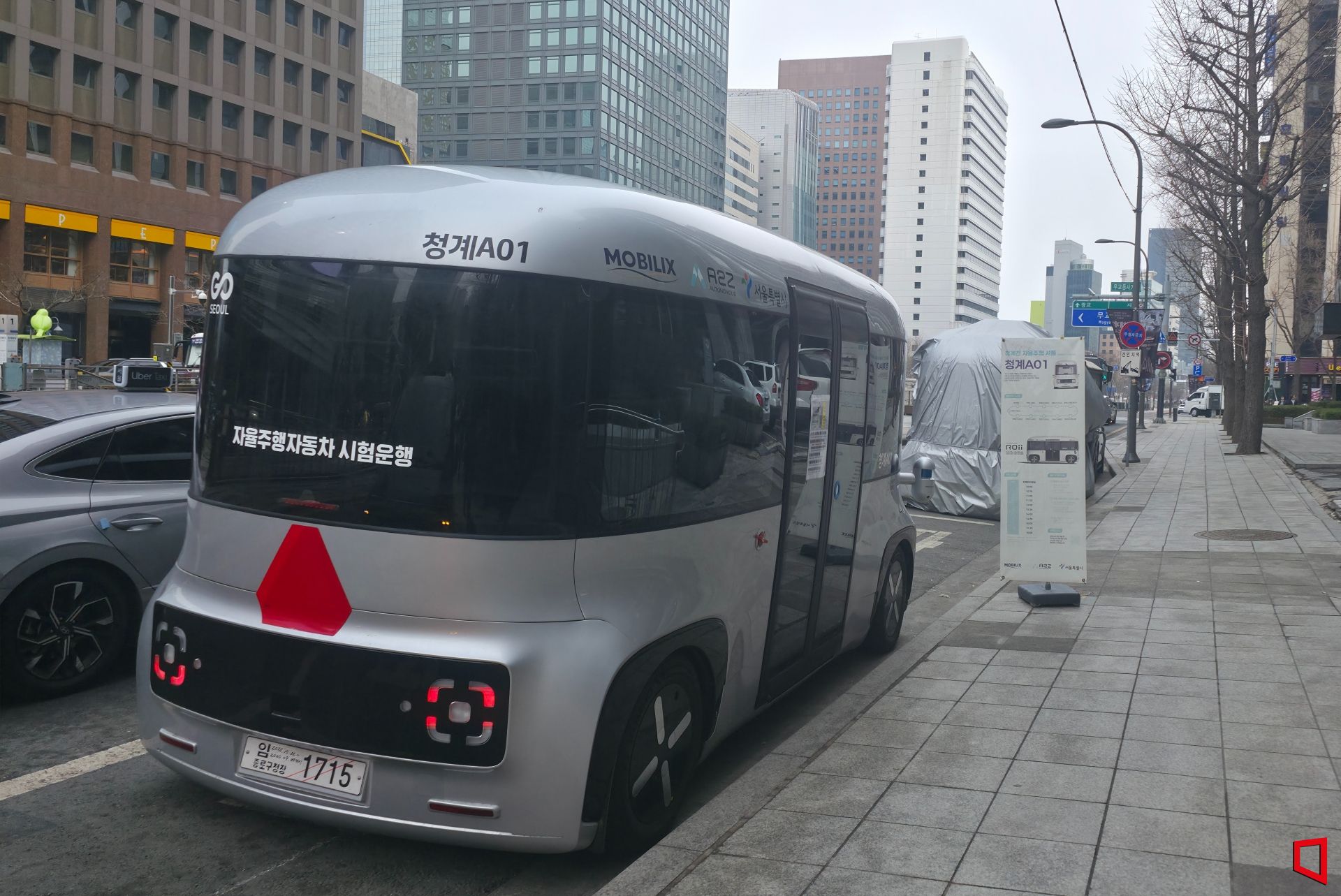

On March 5, at exactly 3:00 p.m., the A01 autonomous shuttle boarded near Cheonggyecheon in Seoul began its journey, but soon switched over to manual driving. This was because it entered a child protection zone. The test driver on board explained to passengers that a human driver is legally required to operate the vehicle in this section and used a separate controller to do so, as the vehicle is not equipped with a steering wheel.
Even when departing from the initial stop, it was the test driver who manually steered the vehicle into the lane. There were several other instances throughout the ride where the driver needed to intervene, even after passing through the child protection zone.
The Cheonggye A01 route covers a round-trip distance of 4.8 kilometers, with two shuttles circulating and stopping at a total of 11 stations in both directions. According to the driver, the shuttle typically does not stop at the Bangsan Market station. After stopping at this station, the vehicle would need to make a left turn into the lane, but the complex road environment in front of Cheonggyecheon still poses challenges for full autonomous operation.
After passing Bangsan Market station and successfully making a left turn, the vehicle soon faced another left turn. At that moment, an "edge case" (unexpected situation) occurred, as a tour bus was blocking the left-turn lane by tailgating. While passengers anticipated how the autonomous system would respond, the test driver immediately took hold of the controller without hesitation.
Even after that, due to the complicated road conditions, several more manual interventions were required, including a stretch of three minutes of continuous manual driving. Ultimately, it was the driver's responsibility to stop the vehicle at the designated drop-off point.

Inside the A01 autonomous shuttle boarded near Cheonggyecheon in Seoul on the 5th. Photo by Youngchan Choi
원본보기 아이콘The Cheonggye A01 route experienced that day is characterized by narrow streets where jaywalking pedestrians frequently appear. Operated by Autonomous A2G, this vehicle detected pedestrians from a distance, slowed down, and came to a gentle stop. When a pedestrian appeared in front of the vehicle ahead, it was recognized in advance, resulting in a smooth stop without sudden braking or acceleration.
Given that Cheonggye A01 only runs on predetermined routes and stops, it cannot yet be considered fully autonomous. Situations requiring human intervention were frequent due to the 30 km/h speed limit, manual driving requirements in child protection zones, and the need to adjust to the flow of other vehicles. There was no room on the road to wait for the autonomous vehicle to resolve unexpected situations on its own.

The late-night autonomous vehicle (operated by SWM) boarded in Seoul's Gangnam district on another day presented a similar situation. Operating from 11:00 p.m. until 5:00 a.m., this vehicle navigates passenger-designated pick-up and drop-off points on some of Gangnam's dark and busy roads.
Even at the speed limit of 50 km/h, the ride was stable, and left turns and lane changes were smooth. When the car in front stopped with its hazard lights on, the vehicle slowed down and smoothly changed lanes.
However, in this case as well, frequent interventions by the test driver meant that the autonomous driving software never operated the vehicle from start to finish without human involvement. Although domestic autonomous driving technology is not yet fully complete, excessive regulations and unclear legal responsibility are clearly holding back technological progress.
An industry official explained, "Under current law, test drivers are classified as emotional laborers due to 24-hour in-vehicle video recording, which causes significant psychological stress, and autonomous driving operators are reluctant to demand aggressive autonomous driving from them. When an accident occurs, the ambiguity of legal responsibility means that drivers are compelled to take control at the slightest sign of danger."
-
Reporter Choi Youngchan elach1@asiae.co.kr
-
Edit Kim Boram kbram6457@asiae.co.kr
© The Asia Business Daily(www.asiae.co.kr). All rights reserved.


![[Reportage]"It Only Leads to Arguments"... Chungnam's True Sentiments Hide Deeper After Martial Law](https://cwcontent.asiae.co.kr/asiaresize/304/2026051223490460082_1778597344.jpg)