Editor's NoteWill simply eliminating night overtime and reducing labor intensity as President Lee Jaemyung has ordered solve everything? The core issue behind the recurring fatal entrapment accidents at SPC Group factories is that workers operating unmanaged machines could not stop the machines when they sensed danger. Asia Economy reconstructed the three fatal accidents and the machines involved, and examined the moments when the accidents could have been prevented.
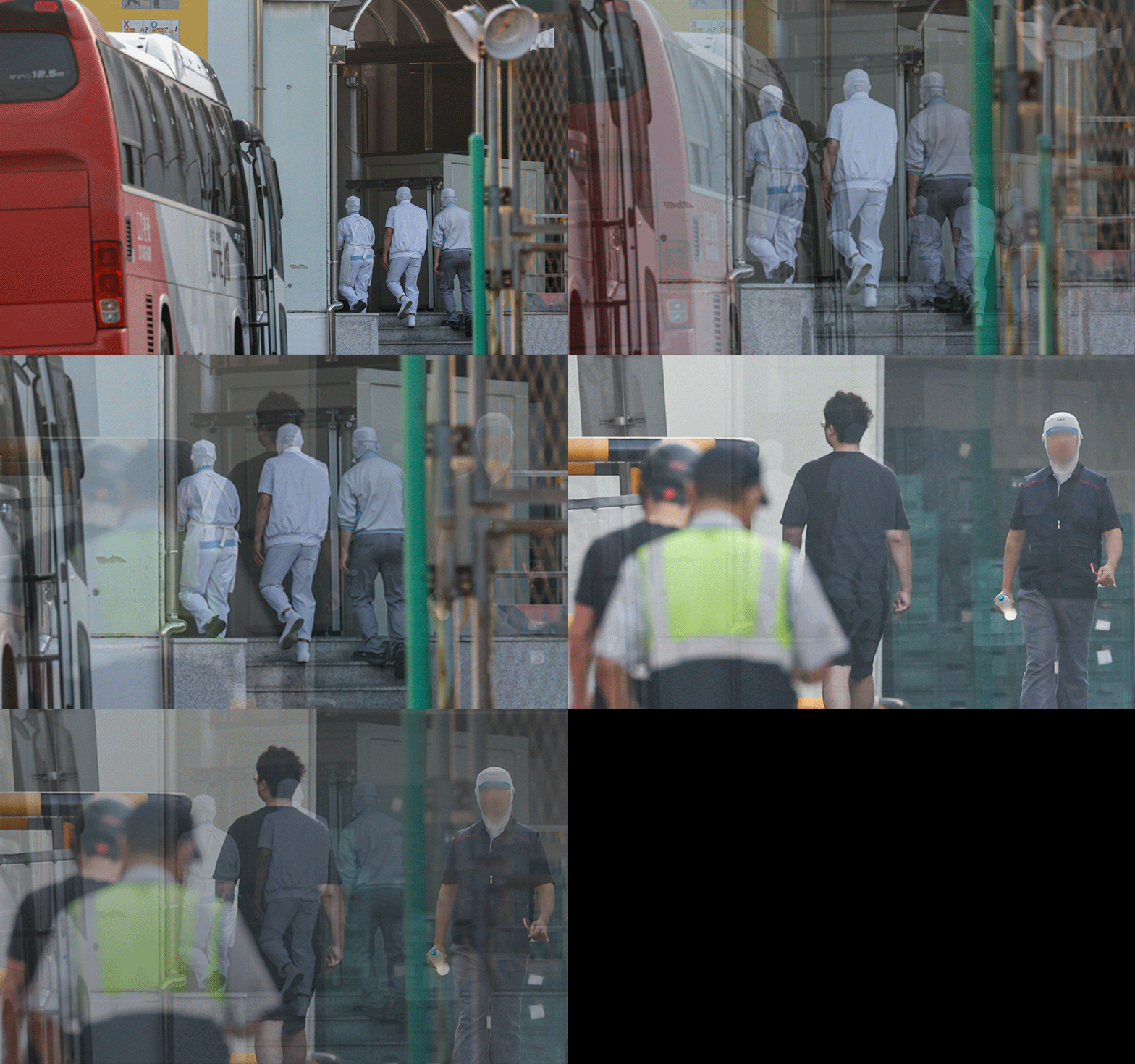
On the 27th of last month, when SPC Group announced its reform plan to shorten the night shift from the previous 11 hours to 8 hours, red commuter buses carrying employees arriving for the 7 a.m. shift lined up in front of the SPC Samlip Siwha factory in Siheung, Gyeonggi Province. Shortly after, employees who had worked a full 12-hour shift from 7 p.m. the previous day began to leave. News of SPC's new work system reform was just starting to be reported in the media. When a reporter asked, "How is the internal atmosphere now that the work system is about to be reformed?" everyone either shook their heads or stared into space. "This is pointless. Are you going to upload this to YouTube or something?" One employee even followed the reporter to ask this question directly.
President Lee Jae-myung visited the SPC Samlip factory in Siwha, where a worker died due to being caught in machinery, and pointed out problems with the night shift system and labor intensity, urging improvements.
SPC, which had not reformed the work system even after the worker's death, announced measures to limit night shifts for production workers to within 8 hours and to increase night shift allowances.
However, the atmosphere inside the SPC bakery is unusual. Workers say that rather than the risks disappearing, working has become even harder.
Is it really okay for the factory to continue like this after the accident?
Is It Just the Hours That Are Reduced... Even With Changed Shifts, the Machines Never Stop
According to the reform plan that began its trial operation on the 1st of this month, SPC Group is changing from a two-shift system (2 teams, 2 shifts) to a three-shift system (3 teams, 3 shifts) at SPC Samlip and Shani factories, and introducing a connecting shift at SPL and BR Korea to maintain production volume as night work hours are reduced. Discussions on how to compensate for the reduced wages are determined by labor-management agreements at each affiliate.
Labor-management agreement on the work system reform of SPL, an SPC Group affiliate, obtained by Asia Economy.
First, SPL decided to raise the night shift allowance rate to up to 79%. Given that the legal night shift allowance rate is 50%, this is a significant increase. Temporary allowances of 40,000 won will also be paid to workers in labor and technical positions. Some have described these changes as a 'groundbreaking decision compared to the industry standard'. However, the attached conditions change the story. According to the labor-management agreement for SPL's shift reform obtained by Asia Economy, the 79% night shift allowance rate will be paid only until the end of the 2026 wage agreement. The agreement states, "Wage payments resulting from the shift reform will be applied temporarily until the end of the wage agreement." There is also a condition that the night shift allowance rate will revert from 0.79 times to 0.5 times.
Although it is possible to negotiate to maintain or increase the 79% night shift allowance rate after that, the internal sentiment is that "the likelihood is low." Lim Jongrin, head of the Paris Baguette branch of the Korean Federation of Chemical & Textile Workers' Unions, said, "During the 2017 wage negotiations, management also promised to match headquarters' wages within three years, but it fizzled out. There is no guarantee it won't happen again this time." The management countered, "The clause 'until the end of the wage agreement' in the labor-management agreement means that the current terms may change because the wage structure for the following year will be discussed with the union in the next wage negotiations," and added, "It does not mean that the extra allowances will be unilaterally eliminated or reduced."
Some affiliates only entered new agreements after SPC's work system reform plan was announced. BR Korea announced on the 19th of last month that it would raise the base salary by 2% in line with the shift reform, but later withdrew this and, as of the 1st of this month, announced a new agreement introducing a new production allowance and an additional 0.15 times night shift allowance. Unlike SPL, there was no clause limiting the additional allowance to the duration of the wage agreement.
With the change from a two-shift system to a three-shift system at SPC Samlip, the workweek changed from 52 hours over 5 days to 48 hours over 6 days, with one more workday per week.Among factory workers, there was anxiety from the beginning that "if the hours are reduced, won't the number of workdays just increase?" as the company prepared for the night shift reduction system.
Because the new shift system focused solely on reducing night work hours, side effects such as increased production pressure have emerged. C, a current employee at an SPC factory introducing the connecting shift, said, "Since not all connecting shift personnel have been recruited yet, the machines are stopped for three hours. As work hours have been reduced, the work has become busier to meet production targets. No one can leave the line, so currently, even meals and restroom breaks are taken one at a time in rotation. It's a chaotic situation." He added, "Thousands of loaves of bread come off a single line every 10 minutes, so if you reduce work hours by three hours, you would have to drastically reduce production volume." He continued, "If production is not reduced, chaos is inevitable."
SPC explained, "These measures were implemented to preemptively prevent decreased concentration and accident risks during vulnerable hours," and "the connecting shift hours were determined in consultation with the union to ensure the most effective work connection, as well as to benefit employees in terms of night shift allowances and commuting conditions." The company added, "Production volume and product types are being adjusted to appropriate levels based on demand forecasts and process efficiency. We cannot disclose specific production reduction targets."
The Overlooked Duality of Night Work by the President
The previous two-shift (2 teams, 2 shifts) system at SPC bakeries worked as follows: the day shift worked from 7 a.m. to 4 p.m., and the night shift took over from 7 p.m. to 4 a.m. Overtime of up to three hours was allowed, and most workers worked all three extra hours every day. In practice, this meant a "12-hour rotating shift" from 7 p.m. to 7 a.m. the next day.
The operation of the "Spiral Cooling Conveyor" at the SPC Samlip factory in Siheung, Gyeonggi Province, where an accident occurred at 3 a.m. on May 19 this year, was recreated in 3D. Mr. Yang entered the lower part of the operating machine to spray lubricant. There was no emergency stop button at the lower part of the machine. Studio UtaThe accident that occurred on August 8, 2023, at 12:33 PM at the Shani factory in Seongnam, Gyeonggi Province, while working on the "dough lift" was recreated in 3D. Although tasks such as adjusting the dough quantity were in progress, workers were able to approach the machine. Since no warning sound was emitted, the accident could not be avoided. Studio UtaThe accident that occurred on October 14, 2022, at the sauce mixer in the SPL factory in Pyeongtaek, Gyeonggi Province, was recreated in 3D. The emergency stop button was located on the right control panel but was out of reach without taking a step forward. Studio Uta
SPC has various allowance systems, such as extra pay and overtime allowances, to compensate for this. Wages are calculated as the sum of base salary and various allowances. For SPC factory workers, who relied heavily on special allowances for night or holiday work, night work was an unavoidable choice for their livelihood. This is why workers were concerned about wage reductions due to shorter night shifts.
Asia Economy calculated the wage changes due to the reduction of night work based on C's monthly salary. C's base salary is 2.8 million won. Dividing this by C's working hours results in a base hourly wage of about 13,000 won. SPC pays 1.5 times the base hourly wage for overtime beyond regular working hours. Night work pays 18,000 won per hour, higher than during the day. Depending on years of service, just three extra hours a day can result in at least an additional 1 million won per month from overtime and night work. For new employees whose base salary is similar to the minimum wage, they are forced to work overtime, whether day or night.
C explained, "Because the base salary for factory workers is not high, you can't make ends meet unless you volunteer for night or overtime work," and "everyone would rush to volunteer for weekend overtime just to earn a little more."
Are Opinions Properly Heard... Deep-Rooted Distrust
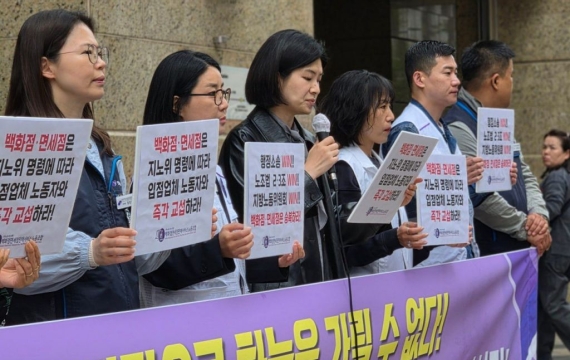
Unremoved banners and appeals in front of the SPC Group headquarters in Yangjae-dong, Seocho-gu, Seoul. Photo by Jeon Jinyoung
Why have workers come to distrust the company so much? The origin of this distrust goes back to 2022. After a worker was sucked into a sauce mixer and killed at the SPL bakery in Pyeongtaek in 2022, Chairman Hur Youngin of SPC promised to invest 100 billion won to strengthen safety. However, even after the announcement of the 100 billion won investment, two more fatal entrapment accidents occurred in 2023 and this year. The 100 billion won pledged for safety did not seem to have any effect.
"Where exactly was the 100 billion won spent?" Even when lawmakers questioned SPC, the company failed to provide a proper answer. Former Justice Party lawmaker Lee Eunju, who handled SPC fatal accidents as a member of the Environment and Labor Committee in the 21st National Assembly, recalled, "I asked SPC to explain how the 100 billion won was spent, but never received the data. They submitted a report on accident prevention to the committee, but it was so insincere that I even reprimanded company officials in an official setting."
Seven safety rules assigned to the SPC Shani Factory just before the fatal accident involving a ball lift entrapment in August 2023. Kwon Youngguk, leader of the Justice Party, who was in charge of reviewing them at the time, pointed out that "the safety education content is uniformly the same and remains limited to abstract slogan chanting." Kwon Youngguk, leader of the Justice Party.
It was only after the third accident in May this year that SPC submitted a report to the National Assembly titled "Safety Management Innovation Plan." In this report, SPC stated that 96.9 billion won of the 100 billion won was invested in industrial safety. Of this, 17.26 billion won was spent on strengthening equipment safety, such as replacing old machinery, and 25.43 billion won was spent on providing protective equipment and preventing entrapment accidents.
However, many factory workers say they do not feel any real changes. While there have been changes such as putting up "Watch Your Hands" and "Beware of Entrapment" stickers on machines and hanging banners listing safety rules inside the factories, there have been few cases of completely replacing outdated equipment.
Some point out that the measures have been merely patchwork. After the third fatal entrapment accident (see related article: SPC Accident Log... The Records of Three People), SPC announced it would invest 5 billion won to replace the spiral conveyor at the Samlip factory. The company overlooked the fact that not only SPC Samlip, where the accident occurred, but also other subsidiaries such as BR Korea, which produces Dunkin Donuts, were using the same machine (see related article: The Deadly Commonality of Dangerous Machines). After lawmakers revealed that there were a total of 47 spiral cooling conveyors like the one involved in the accident across all SPC factories, SPC quickly began inspections.
Seo Yongyun, professor of Industrial Systems Engineering at Dongguk University who researches industrial accident prevention, said, "Fatal industrial accidents do not happen on the same machine every time. It's like playing whack-a-mole: when an accident happens and measures are taken for that machine, another accident occurs on a different machine," adding, "That's why there is a call to create a comprehensive safety management system, and I question whether the 100 billion won was used efficiently."
An SPC official stated, "We have invested 96.9 billion won in strengthening safety systems as of May this year, but it is regrettable that another accident occurred. We recognize the limitations of the existing approach and are re-examining the entire production system from the ground up. We plan to quickly push forward with work system reforms and the construction of a new smart safety factory to further strengthen safety."
Asia Economy has used pseudonyms for sources who did not wish to disclose their real names for their protection.
More details on SPC's machine entrapment accidents can be found in the Asia Economy Visual News.