How does the current CSAT compare to the Academic Aptitude Test?
"The CSAT has only ever been conducted according to its original purpose once, in its first year"
The motto of the College Scholastic Ability Test (CSAT) when it was launched in 1993 was "The end of rote memorization contests" and "Breaking away from memorization-based questions." The previous Academic Aptitude Test, which required students to take up to 17 subjects, was criticized as the main culprit of entrance exam practices that instilled fragmented knowledge. Concerns persisted that education was being consumed by memorization competitions, and there was criticism that it was unreasonable for the fate of tens or even hundreds of thousands of test-takers to be determined by a difference of just one or two questions.
Do-Soon Park, emeritus professor at Korea University (age 83), who played a pivotal role in launching the CSAT, said, "The CSAT was started with the aim of measuring broad thinking skills and only the ability to take university classes." Society had high expectations as well. At the time, major newspaper front pages featured headlines about the CSAT such as "Integrated questions beyond textbooks, real-world education" and "Reforming the abnormal education climate."
During the Roh Tae-woo administration, Professor Park introduced the current CSAT after conducting seven experimental evaluations between 1990 and 1992. Since then, the CSAT has been implemented 32 times, with 13 detailed changes made along the way. However, he said that it was operated in line with its original purpose "only once, in the first year." In effect, it is as if it never truly existed.

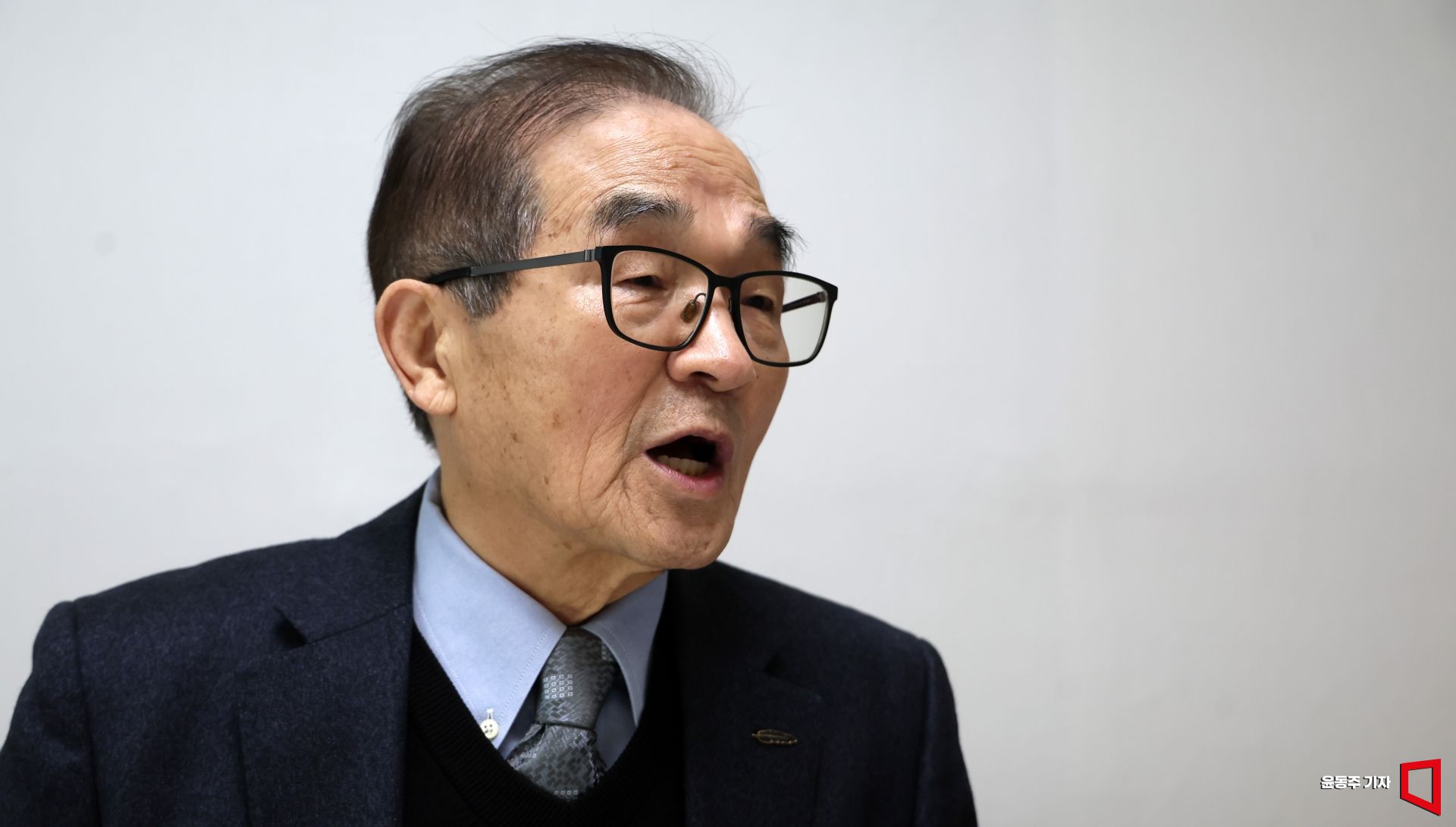
Professor Do-Soon Park, emeritus professor at Korea University known as the creator of the CSAT, is giving an interview to Asia Economy. Photo by Dongjoo Yoon
원본보기 아이콘'The architect of the CSAT,' who has now become a critic of his own creation, Professor Park, was interviewed earlier this month at his office in Bundang, Seongnam, Gyeonggi Province. He emphasized, "The CSAT must return to its original purpose," and added, "It should be used solely as a qualification test to determine whether a student can keep up with university classes, and it should be changed from a relative grading system that ranks students to an absolute grading system." He stressed that, through reforming the CSAT, "universities should be allowed to select the students they want, with minimal government intervention." He argued that "entrance selection should be left to university autonomy, which is the global standard."
'Can they attend university lectures?' The test was meant to assess this, but subject-based self-interest led to additions, and the CSAT became distorted as it changed with each administration

▲There has been no change from short-answer questions to usage methods. Rather, the number of subjects has increased, and the method of calculating rankings has become more complex. The CSAT was introduced when former President Roh Tae-woo proposed an 'aptitude test' to replace the Academic Aptitude Test as an election pledge. At that time, Minister of Education Jeong Won-sik, Seoul National University Professor Lee Young-duk, and Roh met and agreed to conduct it as an 'aptitude test.' They determined that the essential skill for university education was the 'ability to listen well to lectures,' so they selected the language subject. Universities focused on education with the goal of 'elite cultivation,' and since logical thinking was necessary for this, mathematics was included as a means to assess reasoning ability.
Additionally, reflecting the demand that reading comprehension was necessary to read university textbooks written in foreign languages, a foreign language subject was introduced. Thus, the initial plan for the CSAT was to have three subjects: language, mathematics, and foreign language. This was a significant reduction compared to the Academic Aptitude Test. However, as the CSAT, which was originally intended to be 'reference' for college admissions, turned into an 'absolute standard,' the same drawbacks as the Academic Aptitude Test emerged. Except for the first year, the CSAT has never been conducted according to its original purpose.
Why did the number of subjects increase again?
▲When it was announced that language, mathematics, and foreign language would be tested, scientific organizations opposed it. They emphasized 'science as a national priority' and argued that basic scientific abilities should be measured. Although the president explained that 'this is not a test for selecting talent,' they were not persuaded. Consequently, 'science inquiry' was added to the mathematics section. Then, the social sector protested, arguing, 'Inquiry studies start from social subjects, so why were they excluded?' The current CSAT subjects were thus established as language, mathematics and inquiry (science inquiry and social inquiry), and foreign language. There were further objections from various fields such as home economics. The CSAT took shape only after emphasizing that it is not an all-purpose evaluation. We persuaded people that the CSAT is a test of that nature, just as some people fail despite achieving a perfect score on the SAT in the United States. Subjects have been added due to subject-based selfishness, the belief that exclusion from the CSAT subjects leads to loss of competitiveness, and political intervention for votes. This is why the CSAT has changed with each administration.
-Is the current CSAT not a fair exam?
▲The standard of fairness is based on validity. It is only possible when everyone accepts that standard. Suppose selection is based on height, measured down to 0.001 mm to rank candidates. Is this fair? People would immediately question, "Why are we ranking by height?" The same applies to the CSAT. The CSAT was created on the premise that its results would not be used as the sole determinant of college admissions. For example, if it were a test where anyone who scored over 60 out of 100 would be granted college admission, then those who passed would not need to retake the test. But when the test is used to determine admission, students end up taking it repeatedly. This is a fundamental mistake.
-Isn't 'differentiation' also a necessary element in exams?
▲The CSAT was originally designed to include integrated questions that anyone who had properly completed the high school curriculum could answer. In the seven experimental evaluations before the CSAT was implemented, test-takers said the questions were "too easy." Too many people got the correct answers. Statistically, the appropriate difficulty is when students' scores form a normal distribution. However, public attention always focuses on the distribution among top students. Among the bottom 30%, there are those scoring zero or in the teens, but this group is ignored. The very concept of differentiation is misunderstood. Differentiation should mean assessing whether a student is capable of studying at university. This can be evaluated through absolute grading. It does not matter if all 100 students get the answers right or wrong. However, differentiation is being used as a concept for ranking, and as the CSAT has been adjusted to fit this standard, it has inevitably become distorted.
-There are growing criticisms about side effects of the CSAT, such as increased private education.
▲It is pointless to blame only the CSAT without discussing the entire college admissions system. Did the number of repeat test-takers increase because of the CSAT? Not necessarily. Even during the Chun Doo-hwan administration, before the CSAT existed, there was the "three-time penalty system" (starting with the 1979 college entrance preliminary exam, students who took the test three times or more had three points deducted from their score). To discuss long-term improvements to the CSAT, we must consider the future direction of college admissions and the role the CSAT will have within that system.


-Are you saying the college admissions system itself needs to change?
▲Before that, we must reconsider our perspective on universities. From a teleological viewpoint, universities are institutions for nurturing talent. The idea of cultivating so-called elites only applied when the college entrance rate was below 30%. Now, 90% of high school graduates go to university. In such a society, universities should be institutions for universal education, a place to acquire general knowledge. From a functional perspective, universities are places to secure good jobs. In our society, we tend to view universities from both of these perspectives. However, from another viewpoint, universities are spaces for the pursuit of learning itself. The reason for education is simple: it is enjoyable. In this case, entrance exams cannot be the purpose. Yet, we rank education, making it so that only a select few can enter. The overheated private education market ultimately stems from this ranking system.
We also need to consider the relationship between secondary and higher education. Secondary and higher education have different purposes and curricula, but we place universities at the top and middle and high schools below. As a result, when the CSAT changes, the secondary school curriculum changes as well. For example, this was the case with Korean history. During the Park Geun-hye administration, Korean history was deemed important and was immediately included as a CSAT subject before it was even addressed in the curriculum. This is what happens when we focus only on entrance exams and change the admissions system accordingly.
The CSAT should not be the sole standard for college admissions; it should be used only as a qualification criterion. Each university should select the students it wants, and the government's role in admissions should be reduced.
How should the CSAT change?
▲The current CSAT, which is in the form of subject-specific academic tests, needs to change. This is because it evaluates content almost identical to the student record (student transcript). The nature of the CSAT should shift from subject-specific, field-specific academic tests to a general aptitude test related to university admission, evaluating universal abilities (or basic core competencies for creative education). This approach can also resolve the current unreasonable issue of EBS-linked questions. Additionally, the relative grading system should be replaced with absolute grading, allowing results to be used only as data showing five levels or pass/fail, while gradually increasing the number of subjective questions. The CSAT results would then be used solely as qualification criteria.
Are you suggesting giving universities autonomy in selection?
▲There is no institution with more autonomy than universities. The more the government intervenes in university admissions, the more problems arise. Why keep interfering? Universities should be allowed to select the talents they want, and if problems occur as a result, the universities themselves should bear the responsibility. In the United States, no one objects to universities not selecting perfect SAT scorers because universities have autonomy. What matters more than the 'qualification exam' is how to use the CSAT as a 'qualification test.' If universities want to select students through other methods besides the CSAT, they should request the Korea Institute for Curriculum and Evaluation to devise methods, and the government can support this institute to secure university autonomy. University autonomy is linked to finances, so government support is necessary. However, this does not mean indiscriminate support. If universities request budgets related to talent selection, such as 'budget for university admission improvement,' these should be reviewed and supported. Such planned budget expenditure is much more economical on a national scale. Look at the current private education expenses. Isn't that a national waste?
What are the advantages if universities autonomously select students?
▲First, the annual controversy over 'difficulty level' would disappear. The current CSAT is a nationwide exam for students, so complaints about differentiation and difficulty frequently arise. If university autonomy is strengthened, each school can create questions tailored to the type of talent they want, so there is no need to solve the highest-level problems from first to last place. Secondly, the government's role in university admissions can be reduced. Because universities would have the authority to select talents and also bear the responsibility, social costs can be reduced by minimizing the repetitive process of changing education policies whenever admission side effects occur.
Of course, side effects from university autonomy can also arise. However, problems occur in any system. If some cases of abuse emerge, they should be punished and prevented. At least, the entire education policy should not be changed every year as it is now. Whether through written exams or strengthened interviews, universities should be given autonomy to select the talents they want, not just those ranked by standardized criteria.
-In any case, it seems that change to the current CSAT is inevitable.
▲Transitioning to absolute grading is an attempt to turn the CSAT's meaningless score differentiation into a measure of ability. It is also necessary to maximize the use of student records. Under the current CSAT, all efforts are focused on adjusting difficulty for relative differentiation each year. If absolute grading is adopted, debates about difficulty become meaningless. Using CSAT results for relative grading, as is currently done, emphasizes ranking students and means that admissions decisions are made through this single ranking. However, what cannot be overlooked is that CSAT scores do not necessarily distinguish students who should attend university. The CSAT results only partially contribute to identifying basic academic abilities as one part of determining college admission eligibility.
-There is also significant criticism of the multiple-choice, five-option format.
▲The biggest flaw of the CSAT is its multiple-choice format. To foster creativity, the exam should be converted to include subjective questions. Adding subjective questions can address the CSAT's major weakness. While there may be difficulties in grading, most countries have implemented such systems. The CSAT should be developed as a question bank to minimize errors in question creation. If the CSAT shifts to measuring common core abilities, it will be less sensitive to curriculum changes. If the influence of the CSAT on admissions is minimized and competition is reduced, using a question bank will become more feasible.
-Can this also reduce the negative effects of the admissions process?
▲Although it is not a fundamental solution, if the CSAT is improved in this way, excessive spending on private education could be reduced, and secondary education could be freer from the influence of entrance exams than it is now. I believe that the irrational educational climate caused by excessive competition and ranking could be improved, at least in part.

About Do-Soon Park, Emeritus Professor at Korea University
Emeritus Professor Do-Soon Park (age 83) received his bachelor's and master's degrees in educational psychology from Korea University and earned his doctorate in educational methodology from the University of Pittsburgh in the United States. In the late 1980s, he participated in the Education Policy Advisory Council under the Roh Tae-woo administration, working to devise a new admissions policy to address the many issues with the 'Academic Aptitude Test' of the time. He played a leading role in introducing the current College Scholastic Ability Test (CSAT), earning him the nickname 'the architect of the CSAT.'
The original vision for the CSAT that Professor Park sought to introduce was in the form of an 'aptitude test' measuring language ability and reasoning skills. He initially envisioned the CSAT being used only as student evaluation data in college admissions, with each university autonomously selecting students through essays and interviews.
Professor Park served as the first president of the Korea Institute for Curriculum and Evaluation (KICE), the CSAT's test-making institution, from 1998 to 2000. He provided policy advice on education throughout the Roh Tae-woo, Kim Young-sam, Kim Dae-jung, and Roh Moo-hyun administrations. He has also served as the 36th president of the Korean Educational Research Association and the 8th president of the Korean Society for Educational Evaluation, making him a living witness to the history of Korean education.
The original vision for the CSAT that Professor Park sought to introduce was in the form of an 'aptitude test' measuring language ability and reasoning skills. He initially envisioned the CSAT being used only as student evaluation data in college admissions, with each university autonomously selecting students through essays and interviews.
Professor Park served as the first president of the Korea Institute for Curriculum and Evaluation (KICE), the CSAT's test-making institution, from 1998 to 2000. He provided policy advice on education throughout the Roh Tae-woo, Kim Young-sam, Kim Dae-jung, and Roh Moo-hyun administrations. He has also served as the 36th president of the Korean Educational Research Association and the 8th president of the Korean Society for Educational Evaluation, making him a living witness to the history of Korean education.

IndexKorean Education, Losing Its Way
- Nine Admissions Rollercoasters in Twelve Years: The Unlucky Golden Pig Year High School Seniors
- "CSAT Architect" Criticizes the Exam: "Distorted by Subject Self-Interest and Political Intervention"
- "A Classroom Without Set Answers, Presentations Are No Longer Scary"
- "Raise Regional Flagship Universities to Create 10 Seoul National Universities"
-
Reporter Oh Jooyean moon170@asiae.co.kr
-
Edit Bae Byoungmin wuhaha@asiae.co.kr
© The Asia Business Daily(www.asiae.co.kr). All rights reserved.
!['WHO Declares International Public Health Emergency' Why the Untreatable 'Variant Ebola' Is More Deadly Than COVID-19 [Reading Science]](https://cwcontent.asiae.co.kr/asiaresize/323/2026052110164072055_1779326201.png)
!["Please Help Us": How Much Do Those Bowing 90 Degrees These Days Actually Earn? [Data Pick]](https://cwcontent.asiae.co.kr/asiaresize/323/2026052010120870131_1779239528.png)