"There Is No Right Answer in Literature... Boosting Confidence in Presentations"
Teachers Designing Classes Also Feel Proud of Student Growth
Teachers Designing Classes Also Feel Proud of Student Growth

by Lee Hyeonjoo
by Kang Dongwon
Published 02 Jun.2025 15:13(KST)
Updated 02 Jun.2025 15:17(KST)
'Baccalaureate' Classes Breaking Away from Rote Learning ...Inside the IB Classes at Gyeongbuk National University High School
"Because the answers were always predetermined, I used to be really afraid of presenting in class. I was worried about being wrong..." "But after taking the Baccalaureate Language and Literature class, I realized there is no set answer in literature. Now, I can present with confidence."
Woo Hakyung, an 18-year-old second-year student at Gyeongbuk National University High School in Jung-gu, Daegu, shared this sentiment with Asia Economy after finishing her 'Language and Literature' presentation class on April 23. Language and Literature is a subject rarely found in general Korean high schools. It is one of the International Baccalaureate (IB) subjects, and classes have been offered since 2018 when the Daegu Metropolitan Office of Education first introduced the IB program in Korea.
The IB, an internationally accredited school education program headquartered in Switzerland, is adopted by 5,964 schools in 165 countries worldwide. The program is conducted separately for elementary, middle, and high schools. High school students take the Diploma Programme (DP) courses. There are six subjects in total: Language and Literature, Language Acquisition, Individuals and Societies, Sciences, Mathematics, and The Arts.
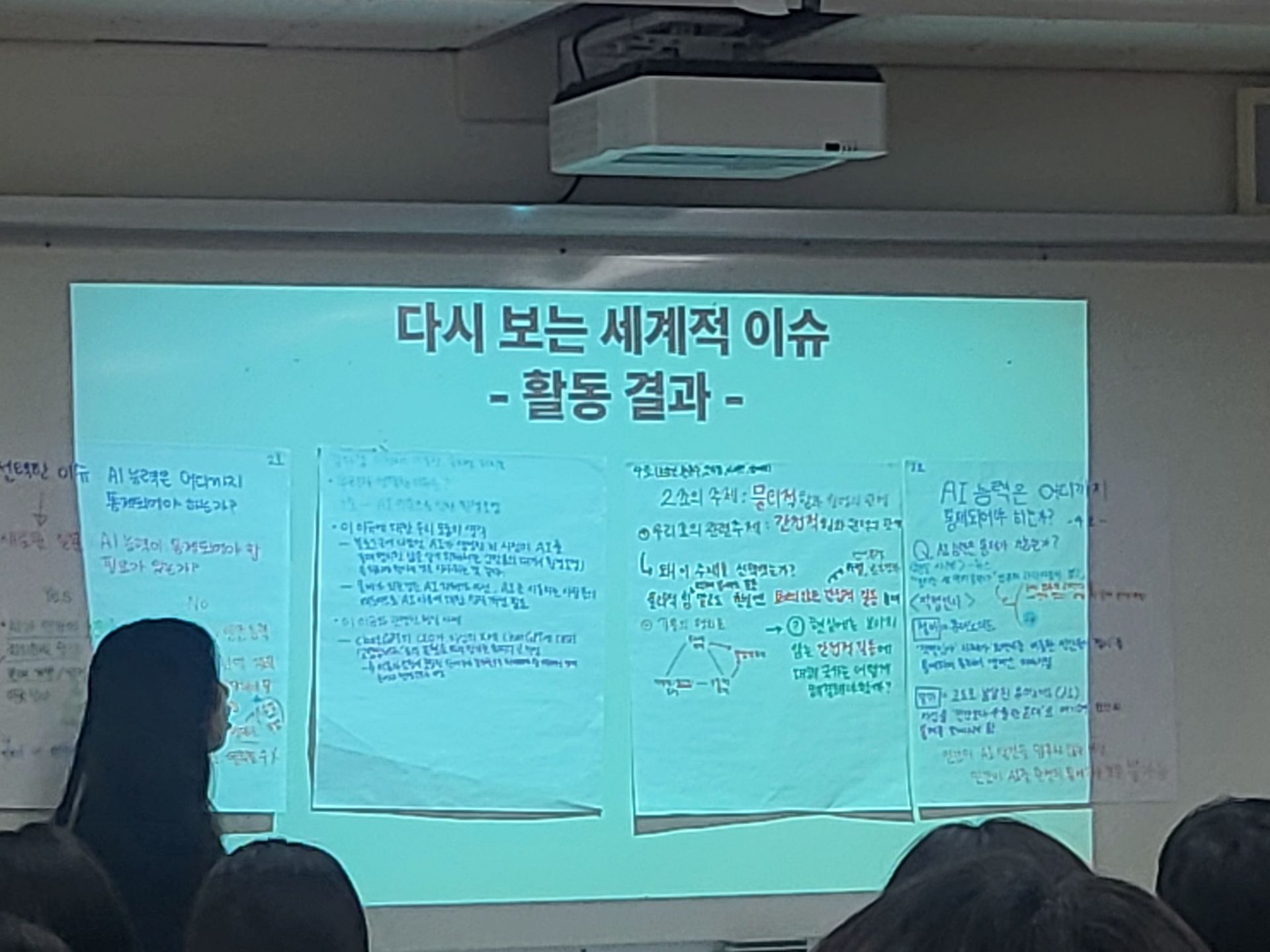
The reporter observed a 'Language and Literature' class. Before the class began, most students looked cheerful. Many students had brought their own tablet PCs or laptops to prepare for class. That day, students gave group presentations on the topic of "How Global Issues Are Presented in Texts."
The novel "Farewell" by novelist Kim Youngha was used as the subject of the presentations. Students selected and introduced excerpts from the novel, connecting them to global issues. Groups of five or six students presented their assignments using PowerPoint. Each member took turns presenting for two to three minutes without exception.
Woo was in Group 2 for the presentation. Her group identified "power" as a global issue in Kim Youngha's novel and introduced the Japanese animated film "Attack on Titan" as a related non-literary text. Another group of students identified "environmental pollution caused by artificial intelligence (AI)" as an issue in the novel and presented a blog image highlighting the large amount of electricity used whenever generative AI is utilized.
After the group presentations, students freely participated in a Q&A session. They then wrote down what went well (Glow) and what could be improved (Grow) and posted them at the front of the classroom. Woo said, "I enjoyed being able to analyze a movie I often watch (Attack on Titan) in connection with a global issue (power). Since we can use things we like in class, everyone feels confident about presenting, and the presentation time is fun."
Teacher Won Hyosun, who prepared the class, said, "Students participating in IB classes are generally passionate about school life and classes. They enjoy discussions, debates, and studying, and gradually become accustomed to collaborative learning." Won also explained, "The IB program is designed so that students can freely express their thoughts in every class and produce results by accepting others' ideas, which leads to high participation and concentration."
Teacher Won noted that IB program classes are very different from traditional memorization-based classes. She assessed that IB enables in-depth, concept-based inquiry learning, making it more effective in realizing the essence of education. She said, "IB classes have set elements that must be taught, but teachers design the specific lessons themselves. I have to think about how to lead each class every time." She added that students benefit by learning to independently find what to study and deepen their understanding through discussion, while teachers cannot neglect their own research for classes.
Won said, "Each class feels like it is part of a larger project. Designing and conducting classes within this big framework allows teachers to take the initiative, which is a major advantage." She added, "I also feel that I am growing as a teacher."
According to teachers who conduct IB classes, students in these classes generally do not attend private academies. Woo, who spoke with the reporter, also said that except for English speaking and writing lessons, she does not attend any other academies directly related to her school subjects. Woo said, "I am learning English on my own because I want to improve, but for IB subjects, actively participating in class is directly linked to good grades, so there is no need to rely on private education."
The IB program does not use the typical multiple-choice written tests or performance assessments. Instead, final grades are determined by combining internal assessments (20-30%), mainly essays and oral presentations, with external assessments (70-80%). To ensure grading reliability, a chief examiner is appointed and a standardization process is followed. The final grades are calculated on a scale of 1 to 7. With these grades, students can apply to domestic universities through the comprehensive student record system or pursue admission to overseas universities.
An Seyoung, head of the Future Education Department at Gyeongbuk National University High School, said, "To conduct IB classes, teachers have to give direct feedback to students and prepare separate lessons, so the workload increases significantly. However, teachers feel they are doing truly meaningful work, enjoy teaching, and feel proud when they see students growing rapidly."
Interest in the IB program is rising nationwide. Some students even move to Daegu specifically to attend high schools offering these classes. The Seoul Metropolitan Office of Education and the Gyeonggi Provincial Office of Education are also expanding the designation of 'IB interest schools' and providing training for teachers.

Lee Hyeonjoo ecolhj@asiae.co.kr
Kang Dongwon kangdw76@asiae.co.kr
© The Asia Business Daily(www.asiae.co.kr). All rights reserved.



!["Please Help Us": How Much Do Those Bowing 90 Degrees These Days Actually Earn? [Data Pick]](https://cwcontent.asiae.co.kr/asiaresize/323/2026052010120870131_1779239528.png)