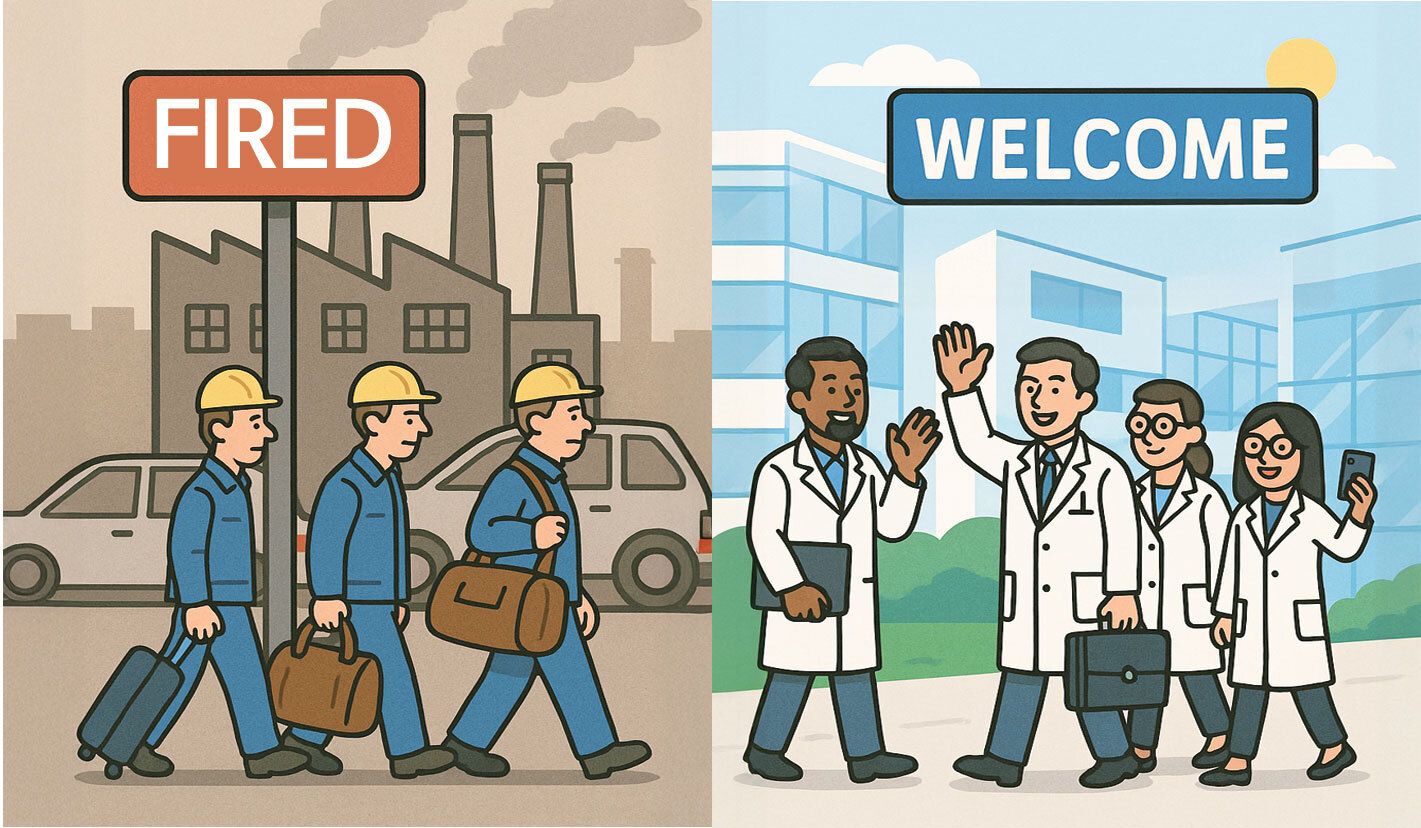


According to a public opinion survey conducted by the scientific journal 'Nature' last March involving 1,600 scientists, three out of four respondents are considering leaving the United States due to the policies of the Trump administration.
Global Company Employees Packing Up One After Another
Tens of Thousands Laid Off in Auto Industry Due to Tariffs
U.S. Big Tech Firms Including Microsoft and Meta Also Hit by Job Cuts
Intel and Starbucks Undergo Restructuring Amid Poor Performance
U.S. Big Tech Firms Including Microsoft and Meta Also Hit by Job Cuts
Intel and Starbucks Undergo Restructuring Amid Poor Performance
Global corporations have chosen workforce reductions as a survival strategy in response to the uncertainty caused by President Donald Trump's tariff policies and the rapid industrial restructuring driven by artificial intelligence (AI) and electric vehicles. This move to "streamline organizations" is interpreted as a proactive effort to reduce unnecessary costs and respond swiftly to rapidly changing market conditions.
Amid widespread layoffs across all industries, restructuring in the automotive sector is particularly prominent. According to NHK and the Asahi Shimbun on May 12 (local time), Japan's Nissan Motor, which is experiencing management difficulties, has decided to reduce its workforce by 20,000 employees, accounting for 15% of its total 130,000 staff. Previously, in November of last year, Nissan announced plans to cut 9,000 jobs, but has now decided to lay off an additional 11,000 employees. Furthermore, Nissan plans to reduce its number of factories worldwide from 17 to 10 by 2027.
In March, Audi, a subsidiary of Germany's Volkswagen Group, also announced plans to cut 7,500 jobs by 2029. Last year, Volkswagen's management and labor union agreed to reduce the workforce by 35,000 by 2030.
Industry analysts say that automakers are turning to layoffs as they face a combination of crises, including the transition to electric vehicles, declining demand, and intensified competition. Chinese automakers are increasing their market penetration by leveraging price competitiveness and technological prowess, pushing out traditional powerhouses in the auto industry such as Germany and Japan.
In particular, the 25% tariff imposed by the Trump administration on imported cars since last month has delivered a significant shock. Stellantis, the parent company of Chrysler, Peugeot, Fiat, and Jeep, temporarily laid off 900 workers at its U.S. parts plants last month after suspending operations at its factories in Canada and Mexico in response to the Trump administration's tariff measures. Volvo Cars also announced on May 7 that it would cut about 125 of its 2,500 employees at its South Carolina plant, citing changes in trade policy, tariffs, and market conditions.
The wave of layoffs has also reached U.S. big tech firms. On May 13, Microsoft announced plans to lay off about 7,000 employees, which is 3% of its total workforce. This is the largest layoff since 2023. Microsoft explained that one of the purposes of the layoffs is "to reduce unnecessary management layers."
Meta Platforms, the parent company of Facebook, laid off about 3,600 employees, or approximately 5% of its total workforce, in February. Last month, Meta also reportedly reduced some staff in its virtual reality (VR) development division, Reality Labs. In January, Meta CEO Mark Zuckerberg stated, "We have decided to raise performance management standards and to let go of underperforming employees more quickly."
Google has also been reducing its workforce, especially in non-core departments, after announcing in early 2023 that it would cut 12,000 jobs, about 6% of its global workforce. In February, Google carried out layoffs in its cloud division, and last month, it reportedly cut several hundred employees in its platforms and devices division.
Intel, once known as the "semiconductor king" for its dominance in server and PC CPU markets, is also undergoing restructuring as it loses ground to competitors. Lip-Bu Tan, who succeeded former CEO Pat Gelsinger in December 2024, told employees on April 24 that "layoffs will begin in the second quarter." According to Bloomberg News, Intel plans to cut around 20,000 employees, which is 20% of its total workforce.
Starbucks, the iconic U.S. coffee chain, has also resorted to layoffs due to poor performance and the impact of tariffs. In February, Starbucks CEO Laxman Narasimhan announced plans to cut 1,100 corporate support staff. The Financial Times (FT) noted that "as President Trump's trade war prompts more cautious consumer behavior, Starbucks is facing increasingly difficult circumstances."
Additionally, British oil giant BP is reportedly planning to lay off about 4,700 employees, which is more than 5% of its total workforce. In February, U.S. PC and printer manufacturer Hewlett-Packard (HP) announced plans to reduce its workforce by up to 2,000 employees this year.
Countries Around the WorldCompete to Attract U.S. Scientists
Trump Slashes Support for Science and Technology
"A Once-in-a-Century Opportunity to Secure Talent"
Nations Offer Incentives to Recruit U.S. Scientists
"A Once-in-a-Century Opportunity to Secure Talent"
Nations Offer Incentives to Recruit U.S. Scientists
With the Trump administration drastically reducing support for science and technology by cutting research budgets and dismantling research institutes, scientific talent is leaving the United States. As a result, countries around the world are competing to attract these American talents.

Protest against the Trump administration's cuts to research, health, and education budgets held on the 8th of last month. Photo by AFP Yonhap News
원본보기 아이콘On May 14 (local time), The New York Times (NYT) reported this trend in an article titled "The World Courts U.S. Researchers Shunned by Trump."
The NYT noted that the United States, which has long been the top destination for leading researchers, scientists, and scholars, has for decades been unmatched by other countries in attracting talent. Now, however, other nations see an opportunity to reverse this trend.
The United States has historically invested heavily in research and development, supporting it with as much as $1 trillion (about 1,404 trillion won) last year alone. High research budgets, competitive salaries, and excellent research facilities have attracted many talented researchers and scientists to the U.S. However, the atmosphere changed after President Trump took office. Billions of dollars in funding for research institutes and universities were slashed, and the scope of research topics was restricted. In particular, strict immigration policies have left foreign researchers and international students in an uncertain situation.

On the 8th, the Australian Strategic Policy Institute called this "a once-in-a-century opportunity to secure talent" and urged the government to recruit skilled individuals.
According to a public opinion survey conducted by the scientific journal 'Nature' last March involving 1,600 scientists, three out of four respondents are considering leaving the United States due to the policies of the Trump administration.
In response, major countries are introducing various incentives to attract talent leaving the United States.
On May 8, the Australian Strategic Policy Institute called this "a once-in-a-century opportunity to secure talent" and urged the government to recruit skilled individuals.
On May 5, the European Union (EU) announced a comprehensive science research support program called "Choose Europe." The EU plans to invest an additional 500 million euros (about 785.6 billion won) over the next two years to make Europe more attractive for researchers.
EU member states are also individually seeking to attract U.S. researchers. French President Emmanuel Macron announced that France would spend $113 million on a program to recruit American researchers. Aix-Marseille University said it would provide up to $16.8 million to support 15 foreign researchers, and according to Science magazine, more than 50 applicants have already applied. Paris-Saclay University is also creating five new positions specifically for U.S. researchers.
The Spanish government announced that it would allocate an additional 45 million euros to attract scientists undervalued by the Trump administration. In addition, the United Kingdom plans to spend 50 million pounds (about 93.2 billion won) to support foreign scientists.
The NYT also reported that Canada, Denmark, Sweden, Norway, Portugal, Austria, Ireland, Belgium, Australia, China, and South Korea have discussed government-level support programs targeting U.S. researchers.
-

Reporter Lee Seunghyeong trust@asiae.co.kr
-

Reporter Oh Suyon syoh@asiae.co.kr
-
Edit Heo Seoyeon lala22@asiae.co.kr
© The Asia Business Daily(www.asiae.co.kr). All rights reserved.