"What should I do when I go to middle school next year?"
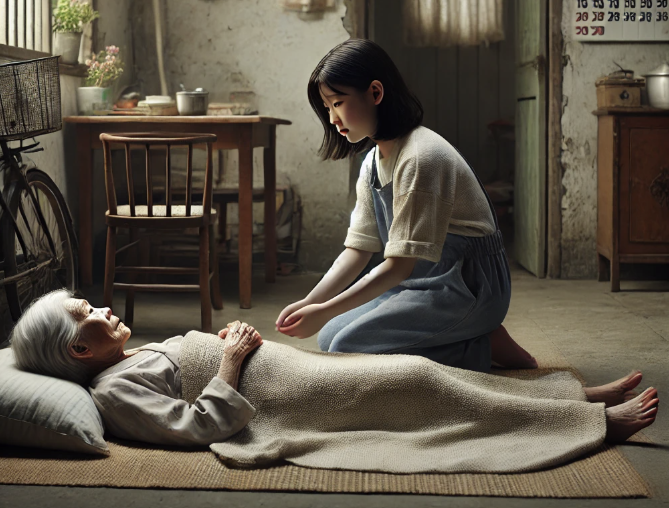
The biggest worry for 12-year-old Jungwoo is taking care of his 4-year-younger brother Shinwoo and his father, who is hearing-impaired. After school at 2:40 p.m., it is Jungwoo's important task to look after the two. Since he will come home later once he becomes a middle school student, Jungwoo seemed worried about his father and brother being left alone until then. Preparing dinner for them after his mother gets home past 8 p.m. is also Jungwoo's responsibility. As if he is used to it, Jungwoo skillfully turned on the gas stove and boiled water. The most frequent menu items are ramen and eggs, often eaten with side dishes his mother prepared in advance. The black plastic bag on the kitchen floor was filled with various types of ramen.
Although he takes care of his family's meals like homework, Jungwoo himself skips breakfast. He feels sorry to make his mother, who works 12 hours a day, six days a week, prepare breakfast as well. His mother, T??ng (51), a marriage migrant from Vietnam, works at a restaurant famous for its soft tofu, grilling tofu, cooking hot pot, and washing dishes all day without a break. She used to work every single day without a day off, but after injuring her leg in a traffic accident a few years ago, her boss allowed her to take Wednesdays off. The roughly 2 million won she earns and the 670,000 won in living subsidies her husband Jeonghwan (65) receives are the family's entire monthly income. Jungwoo said he feels sorry for his mother. "Mom is always busy every morning. So I just don't eat breakfast."


Upon entering Jungwoo's home, the small size is immediately apparent. The master bedroom used by the couple is so full of the children's clothes and household items that there is no space to step except for the bedding. Still, it is much better than before, when wallpaper was peeling and the heating didn't work properly. This improvement is thanks to a remodeling completed two months ago with the help of an organization. "Now, with just three briquettes, it's too hot to sleep. So these days, we only use two," Jeonghwan said proudly, spreading his fingers. Warmth filled the living room floor where the family sat together for the interview. The neat white walls with foam blocks were the result of the couple's three sleepless nights of work.
Even so, the phrase Jungwoo said most often was "It's okay." According to care experts and child welfare workers, "It's okay" or "It's not hard" are the most common phrases used by young "young carers" like Jungwoo. Families where children of an age that should be protected take on caregiving responsibilities often face multiple vulnerabilities such as poor housing and low income, but the children themselves are not objectively aware of their situation.
"Young care youth who have already recognized their reality are filled with anger. As they grow up, they realize the burden they've shouldered is not normal. But among care youth, the younger ones tend to downplay their situation. Objectively, they are not only in very difficult circumstances, but also score very high on depression scales. Since they don't know what situation they're in or how to cope, it's hard for them to access welfare resources." (Ham Sunyu, Associate Research Fellow, Korea Institute for Health and Social Affairs)


"Too Young for Support"... Children Driven into Blind Spots Without Surveys
Each local government has its own ordinance for supporting care youth. The Ministry of Health and Welfare's dedicated agency, the Youth Future Center, defines care youth as those aged 13 to 34 who are responsible for family care, while local governments may apply broader criteria. However, because the ordinances are inconsistent, there is no unified age definition for care youth. Based on the age criteria in the Youth Act (ages 9?24) and the Young Adult Act (ages 19?34), Seoul, Incheon, and Jeonnam define care youth as ages 9?34. In regions such as Busan and Ulsan, the range is even broader, up to age 39.
In Gangwon Province, where Jungwoo lives, only those aged 14 to 39 who care for family or are responsible for the household are recognized as care youth eligible for support. Seoul and Gwangju include those aged 9 and above, but children younger than that are still excluded from support lists. In single-parent or grandparent-headed families, care children may have to shoulder both earning a living and caregiving, but may be excluded from support solely due to age. Of the 900 people identified in the 2023 Seoul City survey of family care youth, 36% (326 people) were from single-parent or grandparent-headed families.

Japan, which has a situation similar to Korea, recently recognized that many children start family caregiving at a very young age, even under 9, and has begun surveys to prepare support policies. According to a 2021 survey by the Japan Carer Federation of sixth-grade elementary school students caring for family, nearly half said they started caregiving before age 9 (17.3% under 6, 30.9% ages 7?9). About 40% said they began caregiving between ages 10 and 12.
In Korea, young children among care youth are not included in the scope of support ordinances, so there is not even a survey. The government estimated in its recently released "Social Trends in Korea 2024" that 153,044, or 1.3% of the population aged 13?34, are caring for family. If children under 13 were included, the number of care youth would be even higher, but the government does not conduct separate surveys and cannot even estimate the number of children missing out on support.
Jung Heeseon, a social worker at the Gangwon branch of ChildFund Korea, said, "We conduct our own surveys on care youth, but since this is sensitive personal information, we cannot arbitrarily provide the data to the public." She explained, "Ultimately, a nationwide survey of missing children must be conducted, but without data to understand the situation, proper support is impossible."
Heo Minsook, a researcher at the National Assembly Research Service, emphasized that the target of caregiver support policies should be expanded to include preschool children. This is because young people who take on caregiving roles in grandparent-headed families are often elementary school age or even younger. She explained, "When children are separated from their parents at a young age and raised by their grandparents, they often end up caring for them from as young as four or five. These children have no experience of growing up in a typical family, so they cannot recognize the problem or ask for help." Excluding young care youth who could be socially vulnerable from support policies is itself an incomplete policy resulting from inadequate surveys.
Heo added, "The goal of care child support policies should be to help these children grow up and become independent in an environment similar to their peers. If children are forced to provide excessive care to the point of dropping out of school or developing negative emotions, the state should share that burden."
*The names of caregivers and their families in this article have been changed to protect their identities.
IndexYouth Close to Serious Illness
- "I Don't Want to Go to Middle School": 12-Year-Old Jungwoo's Sigh
- Struggled but Became a 'Caregiver Killer': The Story of a 22-Year-Old Young Man
- "Caregiving Youth: 5-8% in Other Countries, but Only 1.3% in Korea?"