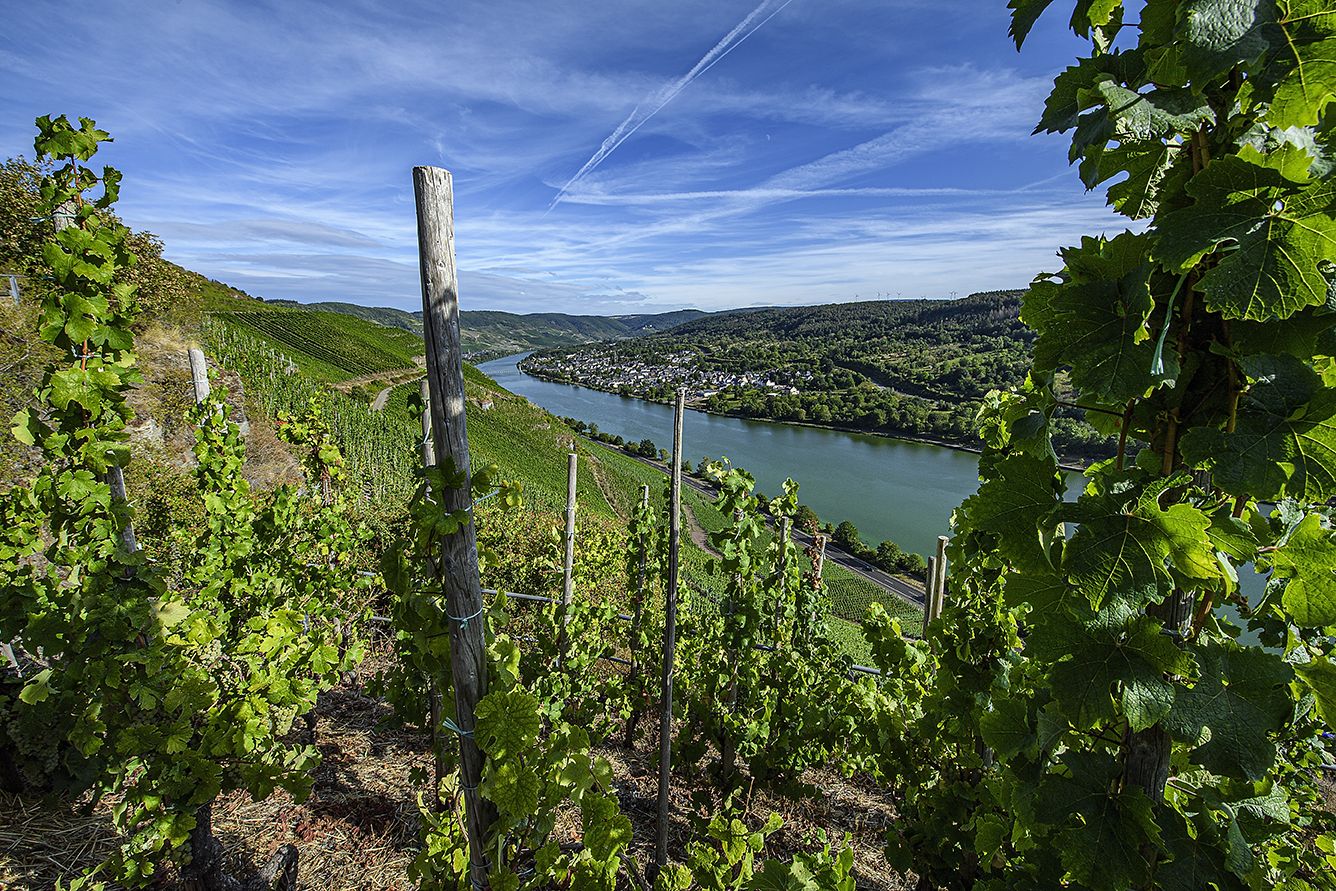
"Drawing out the differences of each vineyard during the winemaking process so that you can taste those differences?that is truly the beautiful part."


Markus Molitor spends every single day focused solely on wine. He checks and rechecks whether the winemaking process is progressing smoothly and if the aging is proceeding properly. He has no interest in anything other than tending vineyards and making wine, which is why those around him call him the 'Cellar Ghost.'
What led Markus Molitor to become the Cellar Ghost, living a life wholly devoted to wine, is the terroir of Mosel and the infinite diversity and potential contained in the Riesling grown there. Riesling, with its thousand faces, is a grape variety capable of displaying endlessly diverse charms. Knowing this, he believes it would be a dereliction of duty to simply produce the same style of wine out of inertia without attempting anything new.
The differences created by the orientation and slope of each vineyard, the subtle changes in weather each year, and the resulting variations in ripeness and character of the grapes?Markus Molitor sees these not as variables that undermine the consistency of wine, but as opportunities to create a diverse array of uniquely attractive wines.
Markus Molitor produces over 120 different wines each year, a stark contrast to most wineries in Bordeaux, France, which typically produce only a main wine and a second wine. He is a winemaker who enjoys the diverse outcomes that arise from various variables. The winery he started under his own name, 'Weingut Markus Molitor,' is located in Mosel, Germany, one of the country's premier wine regions.

Diverse Interpretations of Terroir... Leading the Golden Age of German Riesling
The Molitor family is a venerable household that has been cultivating vineyards in the Mosel region for eight generations. However, during Markus Molitor's parents' time, circumstances became difficult, and the vineyard area was greatly reduced. In 1984, at the age of twenty, Markus entered the wine industry with just 1.5 hectares of vineyard inherited from his father. Since then, through meticulous analysis of terroir, he has consistently produced wines that are recognized by wine experts worldwide and captivate consumers' palates. Now, 40 years after its founding, the vineyard has grown to 120 hectares, making it one of the top wineries in Mosel, Germany's premier wine region.
The vineyards in Mosel, where Markus Molitor is based, are mostly situated on steep slopes along the Mosel River. Due to the steep, terraced structure, all work must be done by hand, and the time and cost required to manage the same area are five to ten times greater than for flat vineyards. Markus Molitor's vineyards typically have slopes of over 30 degrees, with many exceeding 70 degrees. Vineyards like Urziger Wurzgarten have slopes as steep as 85 degrees.

Although this requires double the time, cost, and effort, Mosel has become Germany's top wine region precisely because the geographical conditions here offer clear advantages for grape cultivation. The steep slopes allow the vines to receive abundant and even sunlight, while the Mosel River and the slate soil store heat during the day and release it at night, providing a warming effect that enables grapes to ripen slowly and steadily. Grapes that ripen slowly in Mosel develop a brilliant aromatic profile and mineral notes, giving rise to delicate and elegant wines.
The core variety for Markus Molitor is Riesling, which accounts for over 90% of his vineyards. Representing both Germany and Mosel, Riesling boasts delicate and vibrant aromas of white flowers, peach, apple, and lime. To preserve its unique flavors, malolactic fermentation and oak barrels are rarely used. Its high acidity allows for long-term aging, during which it develops complex and rare aged aromas. Riesling is also highly sensitive to soil characteristics: heavy clay soils bring out citrus notes, red sandstone emphasizes apricot flavors, and slate soils highlight mineral nuances. For these reasons, Riesling is regarded as a variety that transparently expresses the terroir.
Markus Molitor judged that Riesling, which reveals the characteristics of vineyard and climate as they are, is the optimal variety for producing true terroir-driven wines. Planted in poor, well-drained vineyards with large diurnal temperature swings, Riesling receives ample late autumn sunlight and develops complex flavors. As a result, the period from flowering to harvest is typically about 150 days?considerably longer than the roughly 100 days in Bourgogne, France. This means that the grapes endure tough conditions for a long time to achieve the highest quality.
Master of Selective Harvest... Capsule Color Coding for Consumer Convenience
Riesling, an outstanding variety, has the potential to produce a wide range of wine styles from dry to sweet thanks to its excellent quality. Markus Molitor leverages this potential to produce a diverse array of wines that reflect the characteristics of the vineyard and vintage. Before winemaking, the grape harvest is delayed as long as possible to allow the grapes to fully ripen. Experienced workers then hand-pick the grapes in several passes, followed by additional sorting in the cellar. Every step is overseen by Markus Molitor himself, ensuring that only the best grapes are selected according to their individual ripeness for the highest quality wine.
Germany, located at the northern limit for grape cultivation, places great importance on grape ripeness. The riper the grapes, the higher the sugar content and the more outstanding the aroma and flavor. Thus, in Germany, grapes with different levels of ripeness are used depending on the wine style, and wines are classified according to the sugar content of the grape juice at harvest. In the German wine classification system, the highest category, 'Pradikatwein,' is divided into six subcategories based on grape ripeness.

The basic category, 'Kabinett,' uses young, tart, and fresh green grapes harvested within a week after the harvest period begins. These wines are light, fresh, and high in acidity, with low sweetness and pronounced fruit aromas such as lemon, lime, and apple. The next category, 'Spatlese,' meaning 'late harvest,' is made from grapes picked about a week later than usual, resulting in wines with greater concentration, flavor, alcohol, and body compared to Kabinett. One step higher, 'Auslese,' is made from only the ripest grape clusters, giving the wine higher sweetness and richer aromas.
'Beerenauslese (BA)' is a higher category than Auslese, made from only the very ripest grapes hand-picked individually, resulting in a rare, sweet wine with limited production. 'Eiswein,' which has the same sugar content as BA, is made from grapes that have frozen on the vine during the winter cold. The highest category, 'Trockenbeerenauslese (TBA),' is a sweet wine made from botrytized grapes dried like raisins on the vine, and is considered one of the most expensive white wines in the world.
The German wine classification system is famously complex, even within the industry. To prevent consumer confusion, Markus Molitor has been using different capsule colors according to sweetness since 2007: white for dry, green for off-dry, and gold for sweet wines. Both white and green capsules are used for wines from Kabinett to Auslese, while the gold capsule covers all categories from Kabinett to TBA.
White capsules reveal higher alcohol and riper fruit flavors as the category increases. To ensure a clean finish, grapes affected by botrytis are not used. Green capsules offer a harmonious balance of sweetness and acidity, making them ideal for pairing with food. They are especially well-suited to spicy and savory Asian cuisine or grilled and smoked meats like barbecue.
Gold capsules are enjoyable immediately but reveal even more complex and seductive flavors after aging for over 10 years. In particular, gold capsule wines of Auslese or higher have the potential to age for over 30 years. Generally, white capsule wines, which are almost dry, are vinified in neutral 3,000-liter oak barrels, while the sweeter green and gold capsule wines are made in stainless steel tanks.
Since Markus Molitor produces over 100 different wines each year, not all are imported into Korea. Currently, about a dozen are available domestically, among which the 'Zeltinger Sonnenuhr Riesling Auslese' stands out. Made from grapes grown in the Zeltinger Sonnenuhr vineyard, one of Mosel's top-rated vineyards, this dry wine features a transparent, clean color and a crisp, fresh palate. The texture of the soil is clearly perceptible, and the elegant peach aroma is particularly attractive.
For a slightly more approachable wine, the 'Kinheim Hubertuslay Riesling Auslese' is recommended. Made from grapes grown in the Urziger Wurzgarten vineyard, this dry wine combines intense fruit and petrol aromas. On the palate, it offers a hint of oxidative flavor, well-structured acidity, and perfect texture, creating multiple layers. In addition to capsule color, Markus Molitor also uses one to three star symbols on the label to indicate the quality of the vintage?the more stars, the more selective the grape sorting. This is just one of many ways he shows consideration for consumers.
Markus Molitor's wines first received a perfect 100-point score in 2013 from 'Wine Advocate,' the influential publication run by renowned wine critic Robert Parker, for the 2011 vintage 'Wehlener Sonnenuhr Riesling Auslese.' In 2015, three wines from the 2013 vintage simultaneously received 100 points, astonishing the wine world. To date, Markus Molitor has achieved a total of 22 perfect 100-point scores, making it the German winery with the most 100-point wines.
IndexAgeng Wine Cellar
- The Mosel Region in Germany: Nature's Variations on the Green Grape Theme
-

Reporter gooeunmo@asiae.co.kr
-
Edit Kim Hyunhee faith100@asiae.co.kr
© The Asia Business Daily(www.asiae.co.kr). All rights reserved.


!["They Said It Was 'Delicious' Milk... Is the 'List of Fake Milk Products in Korea' for Real? [Matjal X-File]"](https://cwcontent.asiae.co.kr/asiaresize/323/2023072413274517286_1690172865.jpg)

!['Record-High Net Profit' TSMC to Invest KRW 82 Trillion in Facilities This Year [Taiwan Chip Communication]](https://cwcontent.asiae.co.kr/asiaresize/304/2026011515434793142_1768459427.jpg)