In Depth
Asking About the Path to Independence in Wind Power Generation
-
26.04.29 10:35
- Japan's Reliance on Foreign Turbines... Even the "Wind" Has Stopped ③
-
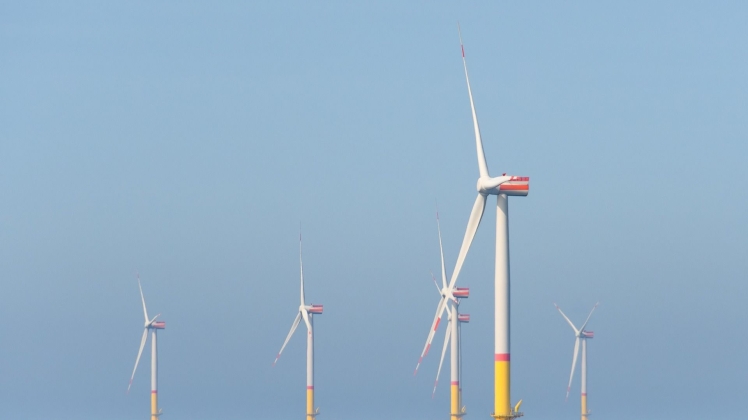
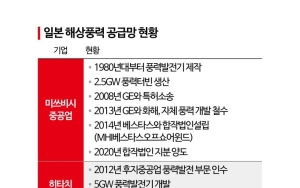
In August of last year, Mitsubishi of Japan abruptly withdrew from three offshore wind power projects with a combined capacity of 1.7 gigawatts (GW), which they had won at auction. This marked the collapse of the first offshore wind project from Japan’s inaugural auction for renewable energy expansion, first held in 2021. Local media referred to this as the "Mitsubishi Shock." Japan had planned to increase its offshore wind capacity to 10 GW by 2030, but as of March 2026, installed capacity stands at only 0.5 GW. South Korea has also set a target of 14.3 GW by 2030 but currently remains at about 0.3 GW, showing that Japan’s setback is not a distant issue. Mitsubishi’s stated reason for abandoning the project was rising construction costs. However, the underlying issue was different: the company relied on imports for most of the key equipment, such as turbines. Mitsubishi pursued aggressive low bids to secure the contracts. However, after the Russia-Ukraine war, inflation and a weaker y
-
26.04.28 09:11
- Monitoring 24,000 Wind Data Points... AI Prevents Wind Turbine Failures in Advance ②
-
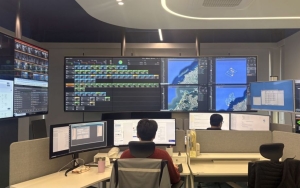
Doosan Enerbility opened the Wind Power Center (WPC) in Ora-dong, Jeju City, in September last year. The Wind Power Center is an integrated control center that provides 24-hour real-time monitoring and control of all wind turbines across the country with which Doosan Enerbility has signed operation and maintenance (O&M) contracts. Global wind turbine companies such as Vestas, Siemens Gamesa, and GE Renewable Energy all have similar integrated control centers. In Korea, Doosan Enerbility is the first to establish such a facility. The Wind Power Center is highly significant, as not only manufacturing capabilities but also O&M capabilities determine the competitiveness of turbine companies. The Wind Power Center remotely monitors 80 turbines at 11 wind farms under contract, out of the 98 wind turbines installed nationwide. It analyzes operational histories and data from wind turbines in real time, enabling early detection of issues and minimizing malfunctions. The goal is to increase the
-
26.04.28 09:10
- 'K-Wind' with 70% Domestic Components Aims for Greater Competitiveness Than Europe ①
-
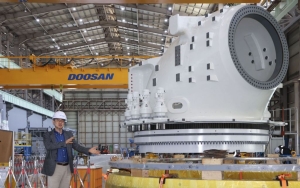
On April 15, upon entering Doosan Enerbility's Changwon plant in Gyeongsangnam-do, several massive wind turbine main frames placed on safety platforms came into view. Once generators and various electronic devices are attached to these main frames and the hub is assembled, the wind turbine system is complete. Doosan Enerbility converted this facility, which originally served as a boiler steam pipe factory for thermal power plants, into a wind turbine plant in 2023 to align with the era of renewable energy. Cranes capable of lifting up to 150 tons were installed on the ceiling. Nam Kyungmin, head of Doosan Enerbility's wind turbine factory, stated, "We now have the capacity to produce about 30 wind turbines per year," adding, "If we expand the facility, we will be able to produce up to 40 units annually." This means the factory that used to produce thermal power equipment has now been transformed into a wind turbine production site. It was a scene that clearly illustrated the gradual sh