Trump Says "Trade Over War"... Holds Summit with Xi Jinping Amid Iran Conflict
Discussions on Soybean, Beef, and Boeing Contracts
China Puts the Taiwan Issue Front and Center
Plans for a Board of Trade and Board of Investment on the Table
U.S. President Donald Trump has made a bold move for a 'trade deal' with China amid stalled end-of-war negotiations. During his summit with Chinese President Xi Jinping, President Trump stated that he would focus on trade negotiations rather than the Iran war. However, China appears likely to place the Taiwan issue at the forefront, leading to divergent priorities between the two countries.

On May 12 (local time), before leaving the White House to attend the summit in Beijing, China, President Trump told reporters, "We have a lot to discuss," adding, "Above all, trade will be a (main) topic of discussion."
When asked what message he wished to convey to President Xi regarding the Iran war, he said, "We will have a lengthy conversation about it," but added, "Frankly, Iran will not be one of the main topics. We are managing the Iran situation well."
President Trump and President Xi will meet for the first time in about six months since their last summit in Busan, South Korea, in October of last year. It will also be the first time in about nine years that the two leaders meet in Beijing since the Trump administration’s first term from November 8 to 10, 2017.
The Key Agendas: U.S. Soybeans, Boeing, Beef Exports, and Trade
The U.S. and China are expected to discuss extending the trade truce, China’s purchase of U.S. agricultural products and aircraft, and follow-up measures on fentanyl smuggling at this summit. There are particularly high expectations for export contracts involving U.S. soybeans, beef, and Boeing aircraft. These three items account for about 12% of total U.S. exports to China.
The list of U.S. business leaders visiting China reveals the country’s main interests. In addition to Tesla, Apple, Meta, Blackstone, and Micron Technology, Cargill (a feed company) and the CEO of Boeing will be present. Additionally, the establishment of a Board of Trade and a Board of Investment is cited as a key agenda item.

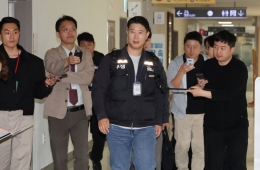
Scott Bessent, U.S. Treasury Secretary (left), holding a press conference. Photo by Yonhap News Agency
View original imageThere is a notable point that illustrates how important trade and economic relations between the two countries are to President Trump: the summit was led by U.S. Treasury Secretary Scott Bessent.
Nicholas Burns, former U.S. Ambassador to China, pointed out, "For the first time since Henry Kissinger, the Secretary of State and the National Security Advisor are not leading relations with China."
The Iran war is also one of the main topics. This is because China is the largest purchaser of Iranian oil and a strategic partner of Iran. Some observers believe the U.S. may use the summit as an opportunity to gauge China’s willingness to help resolve the Iran war.
China is also facing energy supply difficulties due to the closure of the Strait of Hormuz as a result of the war. Before the Iran war, China sourced 11% of its crude oil imports from Iran. In addition, it imports 20% from Russia, 14% from Saudi Arabia, and 29% from other Middle Eastern countries.
However, Bloomberg reported that, despite having postponed his visit to China once due to the Iran war, President Trump has failed to achieve a ceasefire, which has weakened the U.S.'s negotiating position.
China’s Top Priority Is ‘Taiwan’... U.S. Stance Remains Unchanged

U.S. President Donald Trump and Chinese President Xi Jinping (right) shaking hands. Photo by Yonhap News
View original imageAccording to Bloomberg, Taiwan is expected to be China’s highest priority at the summit. China has strongly protested large-scale U.S. arms sales to Taiwan. Nevertheless, in December of last year, the U.S. approved its largest-ever arms sale to Taiwan, totaling 11 billion dollars.
Zhu Feng, Dean of the School of International Studies at Nanjing University, explained, "China will pressure President Trump not only on arms sales but also for a shift in his Taiwan policy," adding, "This issue is China’s most sensitive and core interest."
In addition, China is reported to have demanded that the U.S. adopt the term "oppose" rather than simply "not support" Taiwanese independence. However, the U.S. is unlikely to change its position on Taiwan. The New York Times, citing White House officials, reported that there will be no significant changes to U.S. policy on Taiwan.
Hot Picks Today
!["Those Who Hesitated at 3,000 Still Haven't Bought" 7 Trillion-Won Asset Manager Says "Opportunities Remain" [Investment Strategies of the Wealthy] ⑦](https://cwcontent.asiae.co.kr/asiaresize/93/2026050715101553735_1778134216.jpg) "Those Who Hesitated at 3,000 Still Haven't Bought" 7 Trillion-Won Asset Manager Says "Opportunities Remain" [Investment Strategies of the Wealthy] ⑦
"Those Who Hesitated at 3,000 Still Haven't Bought" 7 Trillion-Won Asset Manager Says "Opportunities Remain" [Investment Strategies of the Wealthy] ⑦
- "Why Are My Child's Grades Like This?" Surge in Overprotected, Isolated, and Reclusive University Students [University Students in Crisis] ⑧
- "Not Just Olive Young"... Word-of-Mouth Drives Foreigners to Pharmacies, Spending Surges 156%
- "Don't Come to Work from Tomorrow": Two Million Face Unemployment Crisis...Iran Shaken by War Shock
- "SK hynix Could Reach 2.8 Million Won; Why Securities Firms Are Confident That the Main Chapter of AI Has Not Even Begun Yet [Click eStock]"
Meanwhile, President Trump’s official plane for the summit was joined by Secretary of State Marco Rubio, Secretary of Defense Pete Hegseth, United States Trade Representative (USTR) Jamison Greer, and White House Deputy Chief of Staff James Blair.
© The Asia Business Daily(www.asiae.co.kr). All rights reserved.