"Protecting Vulnerable Groups Against Summer Natural Disasters"... KRW 2.2 Trillion Invested in Disaster Prevention Projects
Comprehensive Summer Natural Disaster Countermeasures Begin on May 15
15,000 Temporary Shelters Secured in Advance for Post-Disaster Recovery
Introduction of "Heat Wave Critical Alert" and On-Site Dispatch of Situation Managers
The government is strengthening protections for vulnerable groups in preparation for natural disasters such as typhoons, heavy rainfall, and heat waves this summer. This year, KRW 2.2 trillion will be invested in disaster prevention projects, a 22% increase from last year.
On May 12, the government announced the launch of the "2026 Government-wide Comprehensive Summer Natural Disaster Countermeasures" to address flooding and heat waves, and said it will operate the national disaster response period starting May 15.

Last August, due to heavy rain in Jeonnam, traditional market merchants are carrying out flood recovery work. Photo by Yonhap News
View original imageThe government will establish a response system for flooding and heat waves that takes into account extreme weather events beyond predicted ranges, with a focus on reducing casualties and minimizing public inconvenience through an all-out response.
During the summer natural disaster response period, the government will maintain a 24-hour situation management system. In the event of severe weather, the Central Disaster and Safety Countermeasures Headquarters will be activated preemptively, operating an emergency response system in cooperation with relevant agencies.
In particular, to secure the golden time for resident evacuation, evacuation orders will be executed under the leadership of local township, town, and neighborhood chiefs.
For areas at risk of casualties—including landslides, river disasters, and underground space flooding—the government will manage 9,412 locations this year, an increase of 448 from last year. To prevent urban flooding, 4.08 million stormwater inlets nationwide will be regularly inspected, and stormwater pipelines with reduced function due to sediment buildup will be maintained.
To prepare for extreme rainfall, the standard rainfall for disaster prevention performance targets has been raised from a 30-year frequency to a 50-year frequency. The investment in disaster prevention projects has also increased from KRW 1.8 trillion last year to KRW 2.2 trillion this year.
The number of landslide-prone areas near residential zones will be expanded to about 34,000, and risk factors such as wildfire-affected areas and steep slopes will also be intensively inspected.
When a "Severe" flood warning is issued, residents will be notified via emergency disaster text messages, and a pilot public alert service will be launched to notify the public of areas at risk of flooding. For underpasses, vehicle entry will be immediately restricted if water depth exceeds 5 cm.

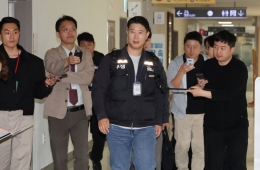
Yun Hojung, Minister of the Ministry of the Interior and Safety, is responding to lawmakers' questions at the 2nd plenary meeting of the 434th National Assembly (extraordinary session) Budget and Accounts Special Committee held at the National Assembly on April 8, 2026. Photo by Hyunmin Kim
View original imageFor the safety management of vulnerable groups, the number of priority evacuation candidates will be increased to over 24,000—more than double last year’s figure—and the "Resident Evacuation Support Teams" that assist them will be expanded to every municipality nationwide.
In the event of communication failures, all available means—such as civil defense sirens and local village broadcasts—will be mobilized to quickly alert residents to danger. In addition, 15,000 temporary shelters and 51,000 emergency relief and cooking kits have been secured in advance to help support recovery after disasters.
Furthermore, the government distributed KRW 30 billion in heat wave countermeasure funds to local governments last month in advance and has begun proactive preparations for heat waves. Starting this year, a new "Heat Wave Critical Alert" will be issued when the perceived temperature reaches 38 degrees Celsius or higher. When this alert is issued, the Ministry of the Interior and Safety will convene a situation assessment meeting, establish the Central Disaster and Safety Countermeasures Headquarters, and dispatch situation managers to support local governments' heat wave response efforts on site.
Recipients of basic living security benefits and others will receive energy voucher support, on-site energy welfare services, and assistance for air conditioner installation or replacement.
For vulnerable workplaces, authorities will check whether rest breaks are provided during heat waves, offer support—including KRW 28 billion for mobile air conditioner installations—and ensure that work is suspended according to heat wave alert levels at worksites.
Hot Picks Today
!["Those Who Hesitated at 3,000 Still Haven't Bought" 7 Trillion-Won Asset Manager Says "Opportunities Remain" [Investment Strategies of the Wealthy] ⑦](https://cwcontent.asiae.co.kr/asiaresize/93/2026050715101553735_1778134216.jpg) "Those Who Hesitated at 3,000 Still Haven't Bought" 7 Trillion-Won Asset Manager Says "Opportunities Remain" [Investment Strategies of the Wealthy] ⑦
"Those Who Hesitated at 3,000 Still Haven't Bought" 7 Trillion-Won Asset Manager Says "Opportunities Remain" [Investment Strategies of the Wealthy] ⑦
- "Why Are My Child's Grades Like This?" Surge in Overprotected, Isolated, and Reclusive University Students [University Students in Crisis] ⑧
- "Not Just Olive Young"... Word-of-Mouth Drives Foreigners to Pharmacies, Spending Surges 156%
- "Don't Come to Work from Tomorrow": Two Million Face Unemployment Crisis...Iran Shaken by War Shock
- "SK hynix Could Reach 2.8 Million Won; Why Securities Firms Are Confident That the Main Chapter of AI Has Not Even Begun Yet [Click eStock]"
Yun Hojung, Minister of the Interior and Safety, stated, "We will prioritize protecting the lives and property of the people and do everything possible to reduce casualties from flooding and heat waves. We will also closely monitor the field to provide robust protection for vulnerable groups, who are more severely affected by climate crisis-driven disasters."
© The Asia Business Daily(www.asiae.co.kr). All rights reserved.