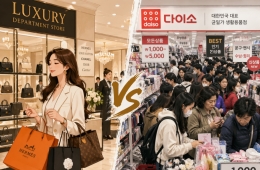
Department Stores Shine with Gourmet Offerings, Discount Marts Rival 1,000-Won Shops... Survival Rules for Unlocking Consumer Wallets [K-Shaped Consumption Era] ③
Women's Fashion Brands on 29CM Triple in Two Years
Reduced Fixed Costs and Enhanced Data Utilization
#The number of domestic major women's fashion brands entering the 29CM fashion platform last year more than tripled compared to 2023. It also increased by 43% compared to the previous year. This is an indicator showing that traditional fashion companies are rapidly moving away from an offline-centered distribution structure. In particular, there is a notable trend of expanding touchpoints, especially on platforms that attract women in their 20s and 30s. In the past, the core strategy was to design brand positioning, store layouts, and seasonal strategies to enter major department stores. Recently, however, more brands are planning products, pricing policies, and content strategies with platform entry as a premise.
As K-shaped consumption spreads, companies operating mid-priced brands are shifting their business focus to online fashion platforms. This is a survival strategy aimed at targeting consumers' preferences by reducing the high commissions and operating costs of offline distribution networks such as department stores, and by using platform data to increase the precision of product planning.
According to the fashion industry on April 21, the transaction volume of women's fashion brands from major fashion conglomerates on 29CM increased by more than 67% year-on-year in the first quarter of this year. Kolon FnC's "Lucky Chouette" has been operating its online-exclusive second line "Chouettiz" solely on the platform, and its transaction volume surged by more than 548% during the same period. Shinsegae International's brands "VOV", "Studio Tomboy", and "G-cut" also saw their transaction volumes increase by more than 110%. "On&On", launched in 1992, recorded a transaction volume of more than 600 million won in March alone, driven by new spring products. The accessory brand "Joy Gryson" also grew by more than 25% during the same period.
![Department Stores Shine with Gourmet Offerings, Discount Marts Rival 1,000-Won Shops... Survival Rules for Unlocking Consumer Wallets [K-Shaped Consumption Era] ③](http://www.asiae.co.kr/news/img_view.htm?img=2026041413535625340_1776142436.jpg)
An industry insider explained, "Platforms are more than just sales channels—they can optimize product planning and inventory management based on consumer data," adding, "The speed and efficiency achieved are difficult to realize in an offline-centered structure."
Major distribution channels are also pursuing their own survival strategies as polarization deepens between luxury and ultra value-for-money consumption. The department store industry is focusing on renewing and investing in core stores with strong commercial viability. In addition to competition to attract luxury brands, there is also a push to transform these stores into experiential spaces that combine exhibitions, gastronomy, and cultural content.
In fact, Shinsegae Department Store is developing its Gangnam branch as a "flagship for ultra-premium strategy." The store continues to expand its food and luxury sections, repositioning itself as a "premium lifestyle mall" rather than a simple shopping space. In particular, the Gangnam store's food section has been revamped to enhance gourmet offerings and encourage longer customer stays. Lotte Department Store is concentrating investment in its Jamsil and Myeongdong (Main) branches. Especially at Jamsil, the store has undergone a luxury brand renewal and greatly expanded its food and beverage (F&B) areas, transforming it into an experiential space. Hyundai Department Store is cultivating its Pangyo branch as a key strategic location. Targeting IT, family, and premium consumers simultaneously, Pangyo has increased its focus on food, living, and cultural content, and by expanding gourmet and experiential spaces, it has established itself as a "regional premium mall."
![Department Stores Shine with Gourmet Offerings, Discount Marts Rival 1,000-Won Shops... Survival Rules for Unlocking Consumer Wallets [K-Shaped Consumption Era] ③](http://www.asiae.co.kr/news/img_view.htm?img=2025090413094119652_1756958981.jpg)
On the other hand, hypermarkets and mid-range distribution channels are responding head-on with a focus on price competitiveness. Emart continues to expand its private brand (PB) product lineup, strengthening its ultra-low-price strategy. Following the launch of its new PB "5K PRICE" with Emart Everyday last August, the retailer also introduced "Wow Shop," an in-store ultra-low-price product select shop, at the end of the year.
"5K PRICE" is an ultra-low-priced PB line in which most products are priced under 5,000 won. "Wow Shop" is an in-store select shop featuring ultra-low-priced household goods that Emart directly plans and sources, characterized by minimizing intermediary distribution stages through direct overseas sourcing. In fact, about 60% of Wow Shop's sales come from products priced under 2,000 won, and products under 3,000 won make up 90% of the assortment.
Hot Picks Today
 "Over 20 Times More Than Overseas": 104.5 Milli...
- "Only the Top 1% Winning Big in Stocks Smile... '300 Million Won Splurges' or '1...
- “Nothing Left to Protect” as Japan Drops Its “Peace State” Banner... Lifts B...
- "Even Luxury Cars Drive Off Without Paying"... UK Sees Surge in Fuel Theft at Ga...
- "Please Launch It in Korea!" After All the Hype... This Coffee Finally Arrives i...
An industry insider said, "Nowadays, if there is no significant difference in quality, the trend of choosing cheaper products is very clear," adding, "If you cannot secure price competitiveness, it has become difficult to survive in the market at all."
© The Asia Business Daily(www.asiae.co.kr). All rights reserved.