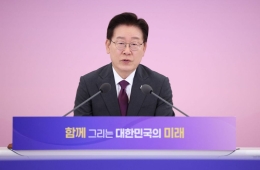
[Local Election Interview] Kim Boo-kyum: "I Am the Right Person to Secure the Budget Daegu Needs"
Putting Forward the 'Worker Approach' Over Career Politicians
Kim Boo-Kyum: "The Mood in Daegu Has Changed... Citizens' Urgency Is Showing"
"Securing 5 Trillion Won Annually Through Daegu-Gyeongbuk Administrative Integration"
"Since I made my phone number public, I have received about 10,000 text messages. I particularly remember a senior citizen who said, 'I've supported only one political party my entire life, but this time, what matters for Daegu is the person.'
On the 20th, Kim Boo-Kyum, Democratic Party candidate for Daegu Mayor, responded with these words in an interview with The Asia Business Daily, when asked what he has heard most often from Daegu citizens. Through conversations and eye contact with citizens he met on the street, as well as text messages, he said he has come to deeply feel the hardships and concerns for the future experienced by Daegu residents, from young people to the elderly.
Candidate Kim is emphasizing the 'worker' approach in this election. Addressing those who argue that the local elections should serve as a check on the Lee Jae-myung administration, he stated, "The Daegu mayoral post is not about checking the central government, but about being responsible for the lives of Daegu citizens and the future of Daegu."
Kim asserted that he is more qualified than his rival, Choo Kyung-ho, the People Power Party candidate, to revive Daegu's economy. He said, "As an economic official, knowing the budget process well and having the political ability to actually secure government budgets and legislative support for Daegu are two completely different matters." He continued, "If you look at the growth rate of national funding for Daegu, it was much higher during my term as Prime Minister than during the period when Candidate Choo served as Deputy Prime Minister for Economic Affairs." Kim also noted, "Although overall economic growth rates during the Yoon Suk-yeol administration have not been good, there was a year when Daegu's real growth rate was as low as -0.8%."
This is Kim's fifth bid in a Daegu election. After serving three terms as a lawmaker for the Gunpo district in Gyeonggi Province, he ran in the 2012 National Assembly election (Daegu Suseong-gap), the 2014 Daegu mayoral election, the 2016 and 2020 National Assembly elections (Daegu Suseong-gap), and is now running again. Except for the 2016 race, he has been defeated every time.
However, Kim stated, "There is definitely a different trend now," and added, "People Power Party members are collectively quitting the party and publicly declaring their support, and endorsements from various sectors are following." Kim commented, "People have trusted one political party for decades, but Daegu's economy has only regressed and the outflow of young people continues," and said, "This is the result of citizens' urgent awareness of the problem."
He said, "Citizens are asking, 'Who can revive Daegu's economy?' and 'Who can secure budget support through cooperation with the government and the majority ruling party in the National Assembly?'" He added, "This election is a watershed moment that will determine whether Daegu takes a new leap forward or remains stagnant."

The following is a Q&A session.
- There are growing concerns that the outflow of young people from Daegu has reached a structural crisis. If you have a key policy that can deliver tangible results within a year of taking office, what is it?
▲ The issue of youth jobs will begin with strengthening the basics of existing jobs as well as creating high-quality jobs through an industrial transformation. After I made my phone number public, I received many messages from people saying they are not even getting minimum wage. I will work with the Daegu Regional Employment and Labor Office to examine the actual conditions by industry and employment type and correct violations of the minimum wage and overdue wage payments. At the same time, I will consider tax and cost support, as well as incentives, for small business owners and self-employed people who are struggling. Starting from my first year in office, I will push core tasks to the execution stage such as securing a budget for the new TK airport and laying the groundwork for construction, establishing a joint Daegu-Gyeongbuk administrative integration task force, and launching the AX Leading City Project.
- What is your approach to the new TK airport? There is fatigue among citizens who feel that development slogans are repeated without real progress. Can you provide a concrete timeline?
▲ The new airport can no longer remain just a slogan about 'Daegu's future.' The fatigue people feel stems from the fact that, although the plan has been around for a long time, no real progress is visible. If I become mayor, I will first address the bottlenecks in the pre-construction stages, such as land acquisition and design. I have completed discussions with the central party on securing a total of 1 trillion won in priming funds, with 500 billion won each from the Public Capital Management Fund and government fiscal support. I will use these funds to reduce uncertainty and move the project forward. At the same time, I will push for legislation to convert the new airport into a national government-supported project as a party platform. Within my term, I will ensure that citizens can see tangible progress in construction.
- You have advocated for administrative integration of Daegu and Gyeongbuk. What are the need and expected effects of this integration?
▲ The administrative integration of Daegu and Gyeongbuk is not merely about merging administrative districts, but the starting point of creating a single living, economic, and growth zone. If the foundation for integration is delayed, all future strategies—such as the new airport, high-tech industrial belts, metropolitan transportation networks, and talent cultivation—will inevitably be delayed as well. Through integration, we can secure an annual autonomous fiscal base of 5 trillion won as promised by the Lee Jae-myung administration, and design TK New Airport, semiconductors, robotics, AX (AI transformation), future mobility, and energy industries as a unified industrial belt. If I become mayor, I will immediately form a joint integration promotion committee with Gyeongbuk Province, conduct public discussions and a resident referendum, and proceed with the enactment of a special law for integration, laying the groundwork to elect an integrated head of government by 2028.
- If you had to pick one thing in Daegu's current city administration that needs urgent change, what would it be?
▲ It would be the way the city is managed. Major agendas in Daegu have often remained at the level of political slogans or have been pushed forward independently. However, to get things done, it is essential to persuade the central government and the National Assembly and build a cross-partisan cooperative structure. City administration must be able to simultaneously verify funding, procedures, and progress, and deliver solid results. For example, in the case of the TK new airport project, six years have passed since the site was designated, but the project remains at a standstill. The relocation alone will cost 1.15 trillion won, which is equivalent to Daegu's annual budget. It is a scale that the city cannot possibly handle with its own finances.
- Candidate Choo claims that he contributed to securing Daegu's budget during his tenure as Deputy Prime Minister for Economic Affairs.
▲ Objective figures do not support this claim. During my time as Prime Minister, the year-on-year growth rate of national funding for Daegu increased by more than 10%. In contrast, while Candidate Choo was Deputy Prime Minister and floor leader, the growth rate was less than 1%, or thereabouts. During his tenure, there were two consecutive years of failed tax revenue forecasts, resulting in the largest tax revenue deficit in history. That burden was shifted to local governments by cutting local allocation grants. Naturally, Daegu was also affected.
- There was a recent debate about Daegu-related pledges. What do you see as the main problem with Candidate Choo's pledges?
▲ Candidate Choo said he would attract large corporations. What local government head wouldn't want that? The real issue is 'how to make it possible.' To attract large corporations, we need deregulation, tax benefits, sufficient power and water supply, talent development, and an industrial ecosystem. Companies do not move just because a politician announces it. I plan to develop the site of the relocated airport as a base for attracting large corporations. Since it is the site of the existing airport, we can use its power, water, and transportation infrastructure. I aim to enhance competitiveness by providing a tailored support package for companies, including workforce supply, regulatory improvements, and tax support. Only then can we create a space that is truly attractive to businesses.
Hot Picks Today
 At President Lee's Call to "Give Enough to Shock," Whistleblower Rewards Become a Real Lottery
- "If Both Spouses Work There, How Much Would They Make?" "They Earn More Than Me, and I'm a Doctor"... Envy Erupts Over Samsung Electronics' Bonus
- Lived as Family for Over 30 Years... Daughter-in-Law Cast Aside After Husband's Death
- "Who Is Visiting Japan These Days?" The Once-Crowded Tourist Spots Empty Out... What's Happening?
- Park Minshik Shaves Head: "I Will End Han Donghoon's Predatory and Parasitic Politics"... Ongoing Calls for Conservative Consolidation in Busan Buk-gu Gap within PPP
- Some citizens say that central party issues, such as the 'Special Prosecutor Act for Fabricated Prosecution,' are influencing local elections. What is your position on this?
▲ Regarding the Special Prosecutor Act for Fabricated Prosecution, I have already publicly called on the central party to make a prudent decision. The Democratic Party floor leader also stated that the timing, procedures, and contents will be discussed and sufficiently deliberated with citizens and party members after the local elections. Right now, Daegu cannot afford to waste time with political disputes over central government issues. What citizens are asking is who can revive Daegu's economy, who can design a new century for Daegu, and who can actually break ground on the integrated new airport.
© The Asia Business Daily(www.asiae.co.kr). All rights reserved.