"This Strike Must Fail": Criticism Emerges Within Samsung as DS-MX Conflict Surfaces
Blind Post Allegedly by MX Employee Spreads
Discontent Over Strike Centered on DS Division
"Semiconductor Investments Were Sustained by Mobile Profits," Claims Employee
Amid the strike by the Samsung Electronics labor union, internal conflicts are escalating among employees. In particular, complaints have emerged that the strike and union activities are primarily centered around the Device Solutions (DS) division, which is responsible for semiconductors. This has brought to the surface a sense of deprivation among employees in the Mobile eXperience (MX) division.

The exterior of the Samsung Electronics building in Seocho-gu, Seoul. Photo by Dongjoo Yoon
View original imageRecently, an anonymous post titled “The Reason the Samsung Electronics Strike Is So Awful” was uploaded to the Blind workplace community, sparking controversy among Samsung Electronics employees. The author, identified as employee A and presumed to work in the MX division, claimed, “Except for a few special bonuses, most of the money we earned over more than 10 years selling phones has been used for R&D and investment in the production lines of the memory business division.” A went on to express discontent, stating, “It was the mobile division’s endurance in the global market that made semiconductor investment possible, but now the company is trying to share the rewards mainly with the memory division.”
Hot Picks Today
!["Rather Than Endure a 1.5 Million KRW Stipend, I'd Rather Earn 500 Million in the U.S." Top Talent from SNU and KAIST Are Leaving [Scientists Are Disappearing] ①](https://cwcontent.asiae.co.kr/asiaresize/93/2026051914165468840_1779167814.png) "Rather Than Endure a 1.5 Million KRW Stipend, I'd Rather Earn 500 Million in the U.S." Top Talent from SNU and KAIST Are Leaving [Scientists Are Disappearing] ①
"Rather Than Endure a 1.5 Million KRW Stipend, I'd Rather Earn 500 Million in the U.S." Top Talent from SNU and KAIST Are Leaving [Scientists Are Disappearing] ①
- Given Grants, Then Says "No Launch" ... Innovative Korean Technology Ultimately Forced Overseas
- [Breaking] Chairman Park Sookeun: "Possibility of Agreement Instead of Samsung Electronics Labor-Management Mediation Proposal"
- "If That's the Case, Why Not Just Buy Stocks?" ETFs in Name Only, Now 'Semiconductor-Heavy' and a Playground for Short-Term Traders
- "No Cure Available, Spread Accelerates... Already 105 Dead, American Infected"
A also criticized the way the union is run. “They call it the Samsung Electronics union as a whole, but in reality, it only represents the semiconductor side,” A wrote. “Because most phone production lines are overseas, the number of domestic employees is naturally lower.” A also voiced dissatisfaction with the company’s HR and compensation system, saying, “It’s true that the company hasn’t treated its employees properly all this time,” but added, “Even so, I believe this strike must fail.”

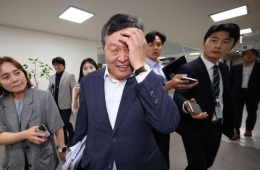
Employees are busily moving around the Samsung Electronics headquarters in Seocho-gu, Seoul, on the 18th, ahead of the 2nd post-mediation meeting between Samsung Electronics labor and management at the Central Labor Relations Commission. 2026.05.18 Photo by Dongju Yoon
View original imageThe post received comments both in support of and against A’s views. One Samsung Electronics employee agreed, saying, “There were times when the home appliance and mobile divisions helped sustain the memory business,” and, “It’s hard to deny that the revenue earned while competing with global rivals like Nokia and Sony Mobile was used for semiconductor investments.” On the other hand, there were also many opposing opinions. Some employees argued, “We also need to reflect on the attitude shown by the MX division within the group when it was performing well,” and, “Even if the mobile division posted strong results in the past, it’s difficult to compare that to the current operating profit of the semiconductor business.” Some pointed out that the union is operating based on the interests of specific business units. One employee stated, “If the company’s main union only looks after certain divisions, it will be hard to get sufficient support even from within the company,” adding, “In the end, such internal conflicts could weaken the momentum of the strike.”

Samsung Electronics Pyeongtaek Campus is bustling with people commuting to work and the constant flow of shuttle buses. Photo by Dongjoo Yoon
View original imageMeanwhile, on the 18th, the second post-mediation meeting between labor and management at Samsung Electronics was held at the Central Labor Relations Commission, but the two sides failed to narrow their differences over the amount and institutionalization of performance-based bonuses. Labor and management agreed to reconvene on the 19th to continue discussions. The union is demanding that 15% of the operating profit of Samsung Electronics’ DS division be set aside as the performance bonus pool and that the cap on the excess profit incentive (OPI)—currently limited to 50% of annual salary—be abolished and formally stipulated. Based on the expected operating profit of 45 trillion won, the average payment per semiconductor division employee would amount to 600 million won.
© The Asia Business Daily(www.asiae.co.kr). All rights reserved.
![Cheaper Than Candy, Yet Impossible to Find... Fears of a 'Pediatric Medical Crisis' as Pharmaceutical Companies Halt Production [Why&Next]](https://cwcontent.asiae.co.kr/asiaresize/307/2026051910065268365_1779152813.jpg)