Brilliant Korean Technology Flows Overseas... Subsidies Granted, but "No Product Launch Allowed"
KC Safety Standards Require Integrated Ground Circuit
Regulatory Sandbox Rejected Even After 10,000 Rotation Test
Ombudsman Recommendation Also Met With Refusal
"This is a technology that was promoted by the government, but when it came to commercialization, the government itself became the barrier. I don't think I can find a solution in Korea, so I'm considering going abroad."

A socket developed by Choi Jeongho, CEO of Mui, which applies the first rotational socket technology in Korea. Mui
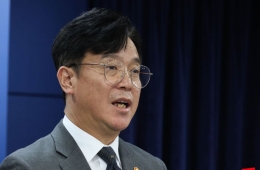
View original imageChoi Jeongho, CEO of Mui, who developed the first multi-tap in Korea featuring rotational socket technology in 2020, expressed his frustration to reporters on the 19th. The product allows users to rotate the socket in their desired direction before plugging in, and its technological merit was recognized with government grants totaling around 300 million won through the Korea Institute of Startup & Entrepreneurship Development's preliminary startup package and the Korea Youth Startup Academy of the Korea SMEs and Startups Agency.
Although the government acknowledged the potential of this product, it has not seen the light of day for over five years. According to the current Electrical Safety Management Act, in order to manufacture and sell sockets in Korea, safety certification must be obtained from the Korea Testing Certification (KC). However, the current certification standards are designed based on the premise of "fixed sockets."
To bypass these regulations, CEO Choi applied for a regulatory sandbox demonstration exception, but the Korean Agency for Technology and Standards refused, citing "fire hazard due to aging and corrosion during long-term use." Even after submitting test results showing that the socket operated normally after being rotated more than 10,000 times in an attempt to overcome the regulation, the outcome did not change.
He said, "Since it is impossible to launch the product under the current safety standards, I applied for the regulatory sandbox, but it was ultimately rejected for not fitting into the existing standards. The risk of fire from long-term use is the same for ordinary multi-taps, yet this new structure is not permitted simply because it is different," he continued. "I have already spent 200 million won solely on development costs and nearly four years trying to obtain safety certification, but I am frustrated because I cannot even sell the product."

The SME Ombudsman also recently received this matter and recommended regulatory improvements to the Ministry of Trade, Industry and Energy, but what came back was yet another opinion that it would be "difficult to accept." They reaffirmed their existing position that, since the safety standards for electrical products are operated based on the international standard (IEC) in accordance with international agreements, allowing a structure that deviates from the current standards could lead to safety issues such as fire accidents.
There are criticisms that, compared to major overseas countries, domestic regulations are excessively rigid. In the United States and elsewhere, the structure and form of the grounding circuit are not restricted to an "integrated type" as in Korea; as long as an equivalent level of safety is ensured, a variety of designs are permitted. Rotational socket products are freely sold through overseas distribution channels such as Amazon and Walmart.
CEO Choi said, "The government suggests that I modify the product to meet international standards and then reapply for the demonstration exception, but I do not have much expectation. I am currently preparing to register overseas patents and obtain European certification, because there is a limit to how long I can endure by focusing only on the domestic market."
Industry insiders point out that such cases are not merely the problem of an individual company. According to a survey by the SME Ombudsman last year, nearly half (45.2%) of small and medium-sized enterprises responded that they were experiencing difficulties due to regulations. Among them, 62.4% said they had "reduced or altered their business to comply with the regulatory level," while only 37.6% responded that they were "actively responding to resolve regulatory issues."
Hot Picks Today
 "Stocks Are Not Taxed, but Annual Crypto Gains Over 2.5 Million Won to Be Taxed Next Year... Investors Push Back"
- "Don't Throw Away Coffee Grounds" Transformed into 'High-Grade Fuel' in Just 90 Seconds [Reading Science]
- Signed Without Viewing for 1.6 Billion Won... Jamsil and Seongbuk Jeonse Prices Jump 200 Million Won in a Month [Real Estate AtoZ]
- "Groups of 5 or More Now Restricted"... Unrelenting Running Craze Leaves Citizens and Police Exhausted
- "Even With a 90 Million Won Salary and Bonuses, It Doesn’t Feel Like Much"... A Latecomer Rookie Who Beat 70 to 1 Odds [Scientists Are Disappearing] ③
The SME Ombudsman stated, "During the process of the demonstration exception being denied, companies often do not receive sufficient clear reasons or objective grounds. We will continue to push for institutional improvements to prevent a situation where companies with new technologies are repeatedly blocked from market entry by outdated regulations."
© The Asia Business Daily(www.asiae.co.kr). All rights reserved.