Official Multi-Unit Housing Prices to Be Announced on April 30... 9.13% Increase, 0.03%p Lower Than Provisional Figure
Seoul Sees an 18.60% Increase—Twice the National Average
Objections to Official Price Assessments Surge 3.5 Times Year-on-Year
Nearly 80% Request Price Reductions... Objection Applications Accepted Until May 29
This year, the officially assessed prices for multi-unit residential properties (including apartments, row houses, and multiplex housing) have been set at a 9.13% increase, which is 0.03 percentage points lower than the figure announced last month.
The Ministry of Land, Infrastructure and Transport announced on April 29 that it had finalized the official prices, following a 20-day period for collecting feedback from property owners, stakeholders, and local governments on the provisional prices, which lasted from March 18 to April 6. The final figures will be officially released on April 30.
A total of 14,561 opinions were submitted during the review period, marking a 3.5-fold increase compared to the previous year (4,132 submissions). After declining since 2021 (49,601 submissions), the number of submissions rebounded significantly this year. However, the rate of acceptance was only 13.1%, about half of last year's rate (26.1%), making it the lowest in the past five years. By region, Seoul saw the highest number of submissions (10,166), followed by Gyeonggi Province (3,277) and Busan (257). By housing type, apartments accounted for the most submissions (11,887), followed by multiplex housing (2,281) and row houses (393).
Requests to lower prices due to declining housing values constituted the majority, with 11,606 submissions (79.7%). After a review, the government adjusted the official prices for 1,903 cases (13.1%). As a result, the nationwide official price change rate was slightly reduced from the initially announced 9.16% to 9.13%.

Among the 17 provinces and metropolitan cities nationwide, Seoul was adjusted downward by 0.07 percentage points, Jeju by 0.05 percentage points, and Daegu and Gwangju by 0.02 percentage points each, while Gyeonggi Province and Busan were reduced by 0.01 percentage points each. Daejeon was the only region where the rate was adjusted upward, by 0.01 percentage points.
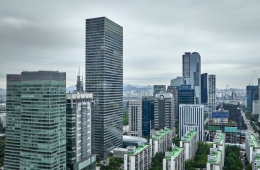
Accordingly, this year Seoul's officially assessed prices for multi-unit housing rose by 18.60% compared to the previous year. Gyeonggi Province increased by 6.37%, Sejong by 6.28%, and Ulsan by 5.22%. In contrast, Jeju (-1.81%), Gwangju (-1.27%), Daejeon (-1.11%), and Daegu (-0.78%) saw declines.
The number of homes subject to the comprehensive real estate holding tax this year—those with officially assessed prices exceeding KRW 1.2 billion—was 487,362 (3.07%), up by 169,364 homes (53.3%) from last year’s 317,998 homes (2.04%). The number of homes subject to the tax decreased by 266 compared to the provisional figure released last month (487,628 homes).
The 2026 official assessed prices for multi-unit residential properties can be checked starting April 30 on the Real Estate Price Disclosure Service website or at civil service counters in local city, county, and district offices.
If there are objections to the official prices, an objection application can be submitted by May 29. In addition to online submission through the website, applications can also be made in person at the Ministry of Land, Infrastructure and Transport, local city, county, and district offices, or regional offices of the Korea Real Estate Board, as well as by mail or fax.
Hot Picks Today
![Home Appliance Woes Mount, Yet 45 Trillion Won in Bonuses? Samsung's Risky Asymmetry [Why&Next]](https://cwcontent.asiae.co.kr/asiaresize/93/2022111609212518207_1668558086.jpg) Home Appliance Woes Mount, Yet 45 Trillion Won ...
Home Appliance Woes Mount, Yet 45 Trillion Won ...
- "Major Crash Is Coming... Buy Even If You Have to Skip a Meal" 'Rich Dad' Shares...
- [Exploring Finland's Innovation Ecosystem] ① Surpassing Nokia's Golden Era... A...
- 500% Energy Efficiency... Samsung Electronics’ 'Energy Magic' to End the Fear o...
- "It Was Fantastic" Jensen Huang's Daughter Seals 'Robot Alliance' with LG throug...
The Korea Real Estate Board plans to conduct a re-investigation of all submitted objections and will notify applicants of the results by June 26.
© The Asia Business Daily(www.asiae.co.kr). All rights reserved.