Meritz and Mirae Asset Buildings Also Set for Redevelopment... Deregulation and Capital Inflow to Transform Yeouido Skyline [Real Estate AtoZ]
Five First-Generation Financial Office Buildings to Be Redeveloped by 2028-2031
Asset Managers and Financial Institutions Flock as Floor Area Ratio Raised to 1,000%
Office Supply Shortage Drives Vacancy Rates Below 2%... Policy Continuity Remains Uncertain
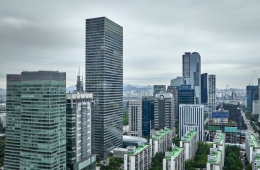
As a wave of redevelopment sweeps through aging office buildings in Seoul’s Yeouido financial district, the Yeouido skyline is expected to change significantly. Five sites—including the KB Kookmin Bank Yeouido Main Building, Korea Fire Insurance Association Building, Kiwoom Finance Square, Meritz Fire & Marine Insurance Yeouido Building, and Mirae Asset Securities Building—have seen their reconstruction projects become tangible. These buildings, constructed in the 1970s and 1980s, are regarded as first-generation office buildings that were built as Yeouido established itself as a financial district.
The surge in redevelopment of Yeouido’s financial office buildings can be attributed to the Seoul Metropolitan Government’s “Yeouido Financial Center District Unit Plan.” In May 2023, Seoul announced this plan to foster Yeouido as an international digital finance hub, and officially finalized it in November 2024. The city designated approximately 1.12 million square meters on the east side of Yeouido Park, an area densely populated with financial institutions, as the “Yeouido Financial Center District Unit Plan Zone.”
Within this zone, the Financial Specific Development Promotion District was designated as an “Area Subject to Zoning Adjustment,” enabling a shift from general commercial (floor area ratio of 800%) to central commercial use (1,000%). Under this designation, if requirements such as public contributions are met, the central commercial floor area ratio can be applied. If eco-friendly designs and creative, innovative architecture are incorporated, the ratio can be relaxed further to over 1,200%. The height limit for buildings has also been raised to 350 meters, paving the way for new skyscrapers taller than Park One (333 meters), currently the tallest in Yeouido.
![Meritz and Mirae Asset Buildings Also Set for Redevelopment... Deregulation and Capital Inflow to Transform Yeouido Skyline [Real Estate AtoZ]](http://www.asiae.co.kr/news/img_view.htm?img=2026042908005444442_1777417254.jpg)
The most visible examples of high-density redevelopment are the Korea Fire Insurance Association Building (completed in 1977) and Kiwoom Finance Square (completed in 1979), both constructed in the 1970s. Last June, both projects passed Seoul’s Urban and Architectural Joint Committee’s infrastructure adequacy review, confirming redevelopment plans with a floor area ratio of over 1,000%.
The Korea Fire Insurance Association Building, which will begin demolition this year, is set to be redeveloped under the management of Mirae Asset Global Investments, with completion scheduled for 2030. The new building will have eight underground and 31 above-ground floors, and a total floor area of 82,645 square meters. The under-construction Kiwoom Finance Square will be transformed into an office building with seven underground and 28 above-ground floors, targeting completion in 2028. The design was created by renowned American architect Richard Meier, while construction is being carried out by SK ecoplant.
Office buildings constructed in the 1980s have also joined the redevelopment trend. The Meritz Fire & Marine Insurance Building, built in 1983, is being redeveloped under the leadership of Brighton Asset Management, a Shin Young Group affiliate, with Dongwon Industrial Development responsible for construction. This site is scheduled for completion in 2028 through high-density development exceeding a 1,000% floor area ratio.
The Mirae Asset Securities Building, completed in 1984, was acquired by Woori Financial Group in 2024 for 372.7 billion won. Woori Financial Group is reportedly planning to redevelop the building into a new Yeouido hub, including a new headquarters for Woori Investment & Securities, with seven underground and 28 above-ground floors, and a total area of 82,306 square meters. The target completion date is 2031. The KB Kookmin Bank Main Building, also built in 1984, will be reconstructed as a new building with eight underground and 34 above-ground floors, covering a total area of 104,800 square meters (approximately 31,700 pyeong).
Industry insiders in commercial real estate expect the Yeouido office market to maintain a distinctly strong position compared to other business districts for the foreseeable future. Since the completion of the TP Tower (formerly the Private School Pension Hall) in 2024, there has been virtually no supply of large new office buildings, and with existing office spaces being demolished during the redevelopment process, the vacancy risk is also decreasing.
Lee Kyung-ja, Head of Alternative Investments at Samsung Securities, commented, “Among Seoul’s office districts, the Yeouido area has the smallest absolute area and limited potential for new development. Traditional financial institutions continue to prefer the area, and the strong business case for redevelopment is driving integrated development efforts.” According to LSQUARE, a comprehensive commercial real estate service company, the vacancy rate in Yeouido stood at just 1.9% in the fourth quarter of last year, even as vacancies increased across Seoul. This is less than half of the vacancy rates in the central business district (4.5%) and the Gangnam area (4.8%) during the same period.
Hot Picks Today
![Benefiting from Non-Chinese Demand and SpaceX News, This Stock Surged 257%... How Long Will the Rally Last? [This Week's Hot Stock]](https://cwcontent.asiae.co.kr/asiaresize/93/2025081909273687512_1755563255.jpg) Benefiting from Non-Chinese Demand and SpaceX N...
Benefiting from Non-Chinese Demand and SpaceX N...
- Gangneung Hotels Jump from 80,000 Won to Over 600,000 Won... Korea, China, Japan...
- "2.4 Million Won iPad Listed for Just 830,000 Won on Coupang"... Another Pricing...
- Over 70 U.S. House Members Urge Trump to Ban Chinese Automakers from Manufacturi...
- 'Maternity Leave for Second Child' Interrupted... 1997-born White House Spokespe...
However, policy continuity remains a variable. The CEO of a commercial real estate consulting firm remarked, “There is a difference between the policy feasibility under former Mayor Oh Se-hoon’s ‘Asia Financial Hub’ initiative and individual projects actually receiving final approvals. Since the development of Yeouido as a financial center is closely tied to Seoul’s urban planning, the pace of specific projects and the application of incentives may change depending on upcoming local elections and shifts in city administration.”
© The Asia Business Daily(www.asiae.co.kr). All rights reserved.