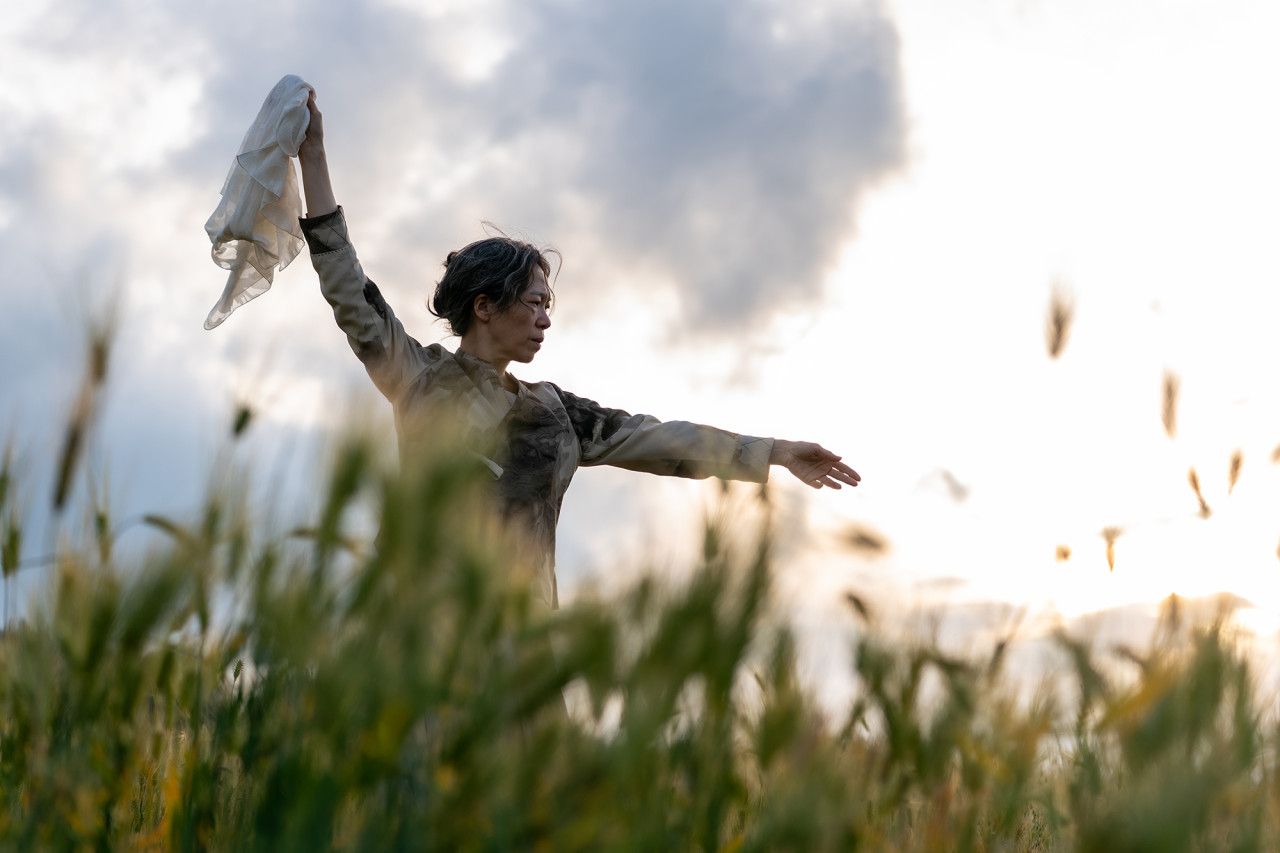


The Wounds That Span Generations
The focus is less on the historical event itself and more on the emotional residue left behind in people. This connects with the desire for self-reinvention that young people feel across generations. Director Jeong alternates between scenes of Youngok’s classroom in 1998 and Jeongsun’s process of recovering her memories to illustrate this. Youngok becomes class president, but ends up as a mere puppet. She is helplessly drawn into collective violence led by transfer student Kim Kyungtae (Park Jibin). Meanwhile, Jeongsun, through psychiatric treatment, gradually recalls fragments of her memory. The more she travels around Jeju, the clearer her memory of that day 49 years ago becomes.
Suddenly, the emotion that has long dominated Jeongsun is revealed as the lingering echo of history. The violence of an era persists in the forms of inexplicable stubbornness, nameless fears, and excessive obsessions. The frustration Youngok feels can no longer be dismissed as typical adolescent angst. This raises the possibility of interpreting it as the inheritance of a parent generation’s silence-a legacy lived out by the next generation.
Rules imposed without context often feel oppressive to the younger generation. For Youngok, changing her name initially seems like a simple procedure to get rid of an old-fashioned name. It is an act of redefining herself, breaking free from the framework assigned by her parents, and a desire to live with a self-chosen identity. However, the film does not depict the fulfillment of that desire, but rather the discovery of a deeper truth beyond it. As Youngok learns the history behind her name, she changes her mind. For her, changing her name comes to symbolize erasing the past narrative in order to write a new one.


History Passed Down Through Silence
The memory of the Jeju 4·3 Incident began to surface in the late 1980s. The film is set in 1998, a transitional period when the incident was moving from being a regional wound to an issue of national investigation and truth-finding. Until then, it had existed only in the language of literature, art, and civil society. This is why novelist Hyun Ki-young, after publishing 'Aunt Suni', underwent interrogation and investigation.
Director Jeong captures the moment when personal recovery and historical healing begin simultaneously. To show that the Jeju 4·3 Incident still shakes the present lives of survivors, he presents fragments of memory and uses school violence as a metaphor for the mechanisms of state violence. Unlike works such as 'Jiseul' (2013), which realistically depicted the terror of villagers trapped in caves, this film traces how grand narratives ultimately take shape in individual lives. Its aim is not to reconstruct, but to evoke empathy.
This shift is particularly interesting given Director Jeong’s long-standing focus on institutional violence. In his previous works, such as 'North Korean Partisan in South Korea' (1990), 'White Badge' (1992), 'Black Money' (2019), and 'The Boys' (2023), war zones and courtrooms served as sites for uncovering the truth. In 'My Name Is', fragments of history are found within the ordinary moments of daily life.


The focus has moved from public to private spaces, but the sense of purpose has deepened. Generations who have lived through war and division often raise the next generation in silence. The unspoken past operates within families in different forms: unexplained sensitivity, unspoken taboos, excessive anxiety, and so on. The children’s generation experiences only the consequences, without knowing the cause. Thus, historical tragedy does not always remain with the next generation as textbook knowledge or explicit memory.



![What Becomes Visible Only After Disappearing [Slate]](https://cwcontent.asiae.co.kr/asiaresize/304/2026042702504740750_1777225847.jpg)