Major Investment Banks Raise Oil Price Forecasts Amid Middle East War... Emerging Economies Hit Hard
International Oil Price Forecasts Raised by Global Banks
IMF Lowers Growth Outlook for Emerging Economies
Asia's High Dependence on Hormuz Raises Supply Concerns
As the war between the United States and Iran reaches its second month as of April 28 (local time), there are projections that if the situation in the Strait of Hormuz is not normalized, the price of Brent crude oil futures, which serves as the global oil benchmark, could reach 130 dollars per barrel in the second quarter of this year. This is expected to further exacerbate the difficulties faced by emerging economies already struggling with inflation driven by rising oil prices.

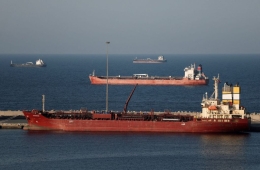
An oil tanker near the Strait of Hormuz on the 12th (local time). Photo by Reuters Yonhap News.
View original imageAccording to reports from The Wall Street Journal (WSJ) in the United States and the Financial Times (FT) in the United Kingdom on the 27th, global investment banks such as Goldman Sachs and Citigroup have raised their outlooks for international oil prices one after another. This move comes after U.S. President Donald Trump canceled the dispatch of a delegation to Islamabad, Pakistan, which had been scheduled for April 25 as part of peace talks with Iran.
Goldman Sachs forecasted that the price of Brent crude oil futures would reach 90 dollars per barrel in the fourth quarter of this year, revising its earlier projection of 80 dollars upward. Citigroup also raised its second-quarter outlook for Brent crude oil prices from 95 dollars to 110 dollars per barrel. Furthermore, Citigroup analyzed that if normalization of the Strait of Hormuz remains difficult through the end of June, Brent crude oil prices could reach 130 dollars per barrel during that quarter.
Expectations for market stabilization through peace negotiations have also diminished. Analysts at Goldman Sachs pointed out that the recovery of production in the Persian Gulf region is slower than expected and projected that exports will not be normalized by the end of June. The current scale of crude oil production loss is estimated at about 14.5 million barrels per day. Citigroup moved its projected timeline for the resumption of passage through the Strait from mid-April to the end of May. Citigroup stated, "Even if logistics resume, commercial and strategic inventories will need to be rebuilt, so oil prices could structurally remain at elevated levels not for several months, but for several years."
The economic impact of the Middle East war is especially pronounced in Middle Eastern countries and emerging economies. The International Monetary Fund (IMF), in its recent April World Economic Outlook, lowered its growth forecast for emerging and developing economies from 4.2 percent to 3.9 percent, a downward adjustment of 0.3 percentage points. Emerging Asian economies are also considered "vulnerable" due to their high dependence on the Strait of Hormuz for oil and gas imports. In particular, JP Morgan projected that Qatar's economy, which has suffered direct damage from blockade of oil export routes and airstrikes, will contract by 9 percent this year.
Rising energy prices and inflationary pressure are reducing the room for "rate cuts" by central banks in emerging markets and prompting a shift toward "rate hikes." The Philippines raised its policy rate last week, while Turkey, Poland, Hungary, the Czech Republic, India, and South Africa are also adopting a more hawkish stance. JP Morgan noted that the market now expects monetary policy to become tighter in most of the 15 major emerging economies over the next six months.
The diminished policy flexibility is also true for central banks in advanced economies. The U.S. Federal Reserve (Fed) and the Bank of Japan (BOJ) are both expected to keep their benchmark rates unchanged at their monetary policy meetings this month. Before the outbreak of the Middle East war, the Fed was expected to cut rates twice within the year. While the BOJ was anticipated to maintain a medium- to long-term policy of rate hikes, there are increasing concerns that actual increases could cause significant economic shock.
Some point out that there is a renewed risk of hardship for low-income countries that have already experienced economic crises such as Egypt, Sri Lanka, and Pakistan. The impact on low-income countries in sub-Saharan Africa is also estimated to be significant. The IMF has assessed that an additional 20 billion to 50 billion dollars in emergency support will be needed as a result of this crisis.
Hot Picks Today
 "Driven by Samsung and SK hynix: Korean Stock M...
- "Pay for the Postpartum Care Center with My Card"... Grandparents Open Their Wal...
- "Forged IDs Easily Bypass Convenience Stores, Bars, and Motels... Delinquency En...
- "Skipping Diamond Rings... Gen Z in the US Opts for Finger Tattoos"
- Back After 3 Years and 5 Months with a 'Shark Nose Surgery'... Hyundai Unveils T...
© The Asia Business Daily(www.asiae.co.kr). All rights reserved.