[Exclusive] Aluminum and Tin Operational Stockpiles Halved in Three Months
Aluminum: -7.4 Days, Tin and Zinc: -8.6 Days
Release Quota Cut by 20% as Stockpiles Decline
Public Procurement Service: "Temporary Trend, No Supply Issues"
As international raw material prices fluctuate due to the prolonged Middle East war, the government's reserves of non-ferrous metals are being depleted rapidly. In particular, concerns have been raised that the inventory level of aluminum, a critical material, has fallen significantly short of the target, potentially undermining its role in stabilizing the market.
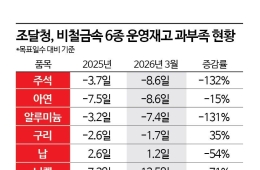
According to data on 'Non-Ferrous Metal Stockpile Status' obtained by The Asia Business Daily on the 27th from the office of Assemblyman Park Sunghoon of the People Power Party, a member of the National Assembly's Planning and Finance Committee, the operational stockpile of aluminum in March this year recorded a shortfall of -7.4 days compared to the target stockpiling days. This represents a 2.3-fold increase in the deficit compared to the end of last year (-3.2 days), and the actual inventory is only about 40% of the target level. Aluminum is a core national strategic resource used in electric vehicle batteries and automotive lightweighting.
![[Exclusive] Aluminum and Tin Operational Stockpiles Halved in Three Months](http://www.asiae.co.kr/news/img_view.htm?img=2026042707501840849_1777243817.jpg)
The operational stockpile of aluminum had improved over the past five years—standing at -10 days in 2022, -9 days in 2023, -8 days in 2024, and -3.2 days in 2025—but has sharply deteriorated due to the Middle East war. During the same period, the deficit for tin widened from -3.7 days to -8.6 days, and for zinc from -7.5 days to -8.6 days. While copper saw some improvement, it still failed to meet the target level. Only two metals—lead (from 2.6 days to 1.2 days) and nickel (from 7.3 days to 12.5 days)—maintained or increased their inventory relative to the target.
Operational stockpiles refer to the volume of raw materials held by the Public Procurement Service for the purpose of supplying (selling) or lending to small and medium-sized enterprises, thereby helping to regulate market price fluctuations. The recent sharp drop in inventory is due to unstable international supply chains causing price volatility, prompting companies to seek out the government's relatively affordable and stable stockpiled materials. As of April 12, the total inventory of the six major non-ferrous metals at the Public Procurement Service had decreased by about 6,200 tons compared to the end of last year.
Hot Picks Today
 Lingering at the Olive Young Shelf, Then Straig...
- Silently Climbing to the Top... Will Samsung Electronics Become the World's Most...
- Old Town Residents Say 'We Envy This Place'... Nearly 60% of Residents in Their ...
- "I Want to Sleep Here"... The Reason a Girl Lay Beside Her Grandparents' Grave a...
- Once a Leading 'Outdoor Legend'...Is Nepa Headed Down the Same Path as Homeplus?...
Since mid-March, the Public Procurement Service has also reduced the release quota for aluminum by 20% compared to previous levels. A representative from the agency stated, "In the case of certain raw materials, there has been an increase in purchases of government stockpiles at lower prices due to supply and demand issues caused by the Middle East war. However, considering the time lag with the sequential arrival of contracts signed at the beginning of the year, we see this as a temporary trend. There are no disruptions in securing the planned supply quantities."
© The Asia Business Daily(www.asiae.co.kr). All rights reserved.