"Strait of Hormuz Control vs. Nuclear Weapons Ban"... US and Iran Remain at an Impasse
Iran Presents Conditions Without Nuclear Issue
Trump Reaffirms Ban on Nuclear Weapons
U.S. Delegation's Trip to Pakistan Suspended

As the United States canceled the visit of its end-of-war negotiation delegation to Pakistan and the second round of talks collapsed, Iran has returned to Pakistan and presented its conditions for ending the war. U.S. President Donald Trump continues to maintain his stance on 'prohibiting nuclear weapons possession,' suggesting that it will take time for the two countries to reach a comprehensive agreement.
According to Iranian news agency Tasnim and others on April 26 (local time), Iranian Foreign Minister Abbas Araghchi returned to Islamabad, the capital of Pakistan, after visiting Oman and before heading to Russia. IRNA reported that some members of the Iranian negotiating team who had returned to Iran were also expected to join Minister Araghchi in Islamabad later that night.
After meeting with Sultan Haitham bin Tariq Al Said in Oman, Minister Araghchi immediately returned to Islamabad, Pakistan, and met with Pakistan's Chief of Army Staff Asim Munir and others.
Tasnim News Agency reported that Minister Araghchi conveyed Iran's conditions for ending the war during this meeting. The conditions presented by Araghchi include: ▲the introduction of a new legal regime for the Strait of Hormuz; ▲war reparations; ▲a ban on further attacks against Iran; and ▲the lifting of the maritime blockade on Iran.
However, an Iranian official stated, "The nuclear issue is not relevant to these discussions," adding, "The key agenda is to deliver Iran's conditions for ending the war to Pakistan."
Previously, Iran had not officially responded regarding participation in the second round of talks following the extension of the ceasefire. However, by deciding to visit Pakistan, speculation arose that the second round of talks could take place during the weekend (April 25-26). Nevertheless, Minister Araghchi announced in Pakistan that there were no plans to meet with the United States, resulting in the collapse of the second round of talks.
The New York Times (NYT) reported that Araghchi's return to Pakistan and presentation of end-of-war conditions was based on the assessment that Iran could endure for another three to six months under the current circumstances. While Iran's economy is facing a severe crisis, the NYT pointed out that disruptions in the export of key raw materials such as oil and fertilizer could have a greater impact on the global economy, and therefore Iran believes it can persuade President Trump to advance the negotiations.
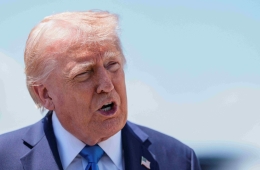
Meanwhile, the United States reiterated that preventing Iran from acquiring nuclear weapons is a 'red line.' President Trump, in a phone interview with Fox News, said, "I am not going to send people (the U.S. negotiation delegation) on an 18-hour trip," and added, "They cannot have nuclear weapons. Otherwise, there is no reason to meet." He continued, "We will proceed by phone. So if they want, they can call us."
Just a few days ago, there had been talk of Vice President J.D. Vance visiting Pakistan, emphasizing the possibility of face-to-face negotiations, but this stance has now changed.
Hot Picks Today
![Will Samsung Electronics Really Become the World's No. 1 Company Next Year [Why&Next]](https://cwcontent.asiae.co.kr/asiaresize/93/2026042707544140857_1777244081.jpg) Will Samsung Electronics Really Become the Worl...
Will Samsung Electronics Really Become the Worl...
- Even with KOSPI at 6,500..."Selling Samsung and SK hynix for Cash," Individuals ...
- "What Should I Eat? Cooking at Home Is a Hassle... 10,000~20,000 Won 'Hotel-Leve...
- "Up to 600,000 Won Per Person, Finally Available"... Be Careful: Filling Up at Y...
- No Work, No Inheritance for the Eldest... 30 Billion KRW in Shares Gifted to Sec...
Bloomberg pointed out that "some leaders in Europe and Gulf Arab countries are skeptical as to whether a peace agreement can be reached quickly even if the second round of talks resumes," adding, "They expect that it may take several months to resolve issues such as the future of Iran's nuclear program."
© The Asia Business Daily(www.asiae.co.kr). All rights reserved.