Local Companies to Gain Advantage in Public Procurement Bids: "Additional Points and Priority Granted"
Emergency Economic Headquarters Meeting Chaired by Deputy Prime Minister Koo Held on April 24
Government Unveils Support Measures for Non-Metropolitan Companies through Public Procurement
Scale of Additional Points Undecided... "Details to Be Finalized After Industry Feedback"
Going forward, companies located outside the Seoul metropolitan area—including those in regions experiencing population decline—will receive additional points in public procurement bids. If all other conditions are equal, products from non-metropolitan companies will be prioritized for purchase. The government aims to promote balanced national development by expanding contract opportunities for local companies in the public procurement market, which is valued at 225 trillion won annually.

The comprehensive public procurement expo, "Korea Nara Market Expo," held on the 13th at KINTEX in Goyang, Gyeonggi Province, was organized to support the expansion of domestic public sales channels for outstanding small and medium-sized enterprise products and their entry into overseas procurement markets. Citizens visiting the expo are waiting to enter.
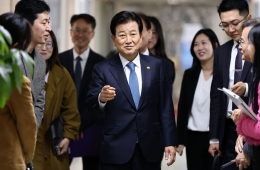
View original imageOn April 24, the government announced these measures, titled “Support Measures for Non-Metropolitan Companies through Public Procurement,” at a joint meeting of the Emergency Economic Headquarters and the National Startup Era Strategy Committee, chaired by Deputy Prime Minister and Minister of Economy and Finance Koo Yoon-cheol.
Public procurement refers to the system in which the government, local governments, or public institutions purchase or contract goods, services, or construction. As of 2024, the market is valued at 225 trillion won. Previously, the government granted additional points to local companies participating in bids based on the location of the ordering institution. However, recognizing the need to reduce disparities between the metropolitan and non-metropolitan areas, the government has decided to revise the system to focus on non-metropolitan companies. An official from the Ministry of Economy and Finance explained, “Recently, President Lee Jaemyung emphasized at a cabinet meeting that there is no future if we continue to focus only on the metropolitan area. As part of this, we have decided to reform the public procurement support system.”
First, in the eligibility evaluations for goods and services, as well as in multiple supplier contracts, a new preferential category will be added for non-metropolitan companies in the credibility scoring. The scale of the additional points has not yet been determined. The points will be awarded in order of: companies that have relocated their headquarters, companies in population-declining regions, and other non-metropolitan companies. The government is also considering giving higher points to companies located farther from the metropolitan area. A Ministry of Economy and Finance official stated, “We will finalize the level of additional points after gathering feedback from the industry.”
When awarding contracts for goods and services, if all other conditions are equal, products from non-metropolitan companies will be prioritized for purchase. In addition, for multiple supplier contracts where the contract amount is large and a second-stage competition is required instead of an immediate purchase, companies in population-declining regions will be prioritized over companies that simply offer lower prices. The threshold amount for requiring a second-stage competition for companies in population-declining regions will also be increased. For these companies, the ceiling for direct contracts will be raised from 20 million won to 50 million won, aligning them with women-owned, disabled, social enterprise, and youth startup companies.
However, there are concerns that these changes could result in reverse discrimination against metropolitan companies or lead to contracts being awarded to unqualified companies. Regarding this, a Ministry of Economy and Finance official stated, “For the country to achieve sustainable growth, it is essential to have regionally led growth. Fundamentally, if a company does not meet requirements such as price, delivery capability, or financial soundness, it cannot win a contract based solely on additional credibility points.” Addressing concerns that companies might create paper companies and falsely relocate to non-metropolitan areas, the official added, “We plan to continuously monitor through on-site inspections to ensure that companies have actually relocated their headquarters or factories.”
Hot Picks Today
 "You Can Only Have This in Korea": Which Nation...
- "How Do Six People Sleep in a 44㎡ Apartment?" Subscription Point System Controv...
- Despite Claims That “Korea Is a Price-Gouging Heaven, I'd Rather Go to Japan”....
- The Quoted 800,000 Won, the Bill Was 5 Million... Bereaved Families of 'No-Funer...
- "Never Hike Alone as a Woman" "Even Two Are at Risk"... Growing Fear of Crime on...
The government plans to implement these changes in the second half of the year by revising the Enforcement Decree of the State Contracts Act and the Public Procurement Service’s regulations and guidelines. A government official stated, “Taking into account market sensitivities, we will collect sufficient feedback and conduct thorough deliberations to establish detailed implementation plans.”
© The Asia Business Daily(www.asiae.co.kr). All rights reserved.

![The 'Epic' 1,500 Trillion Won Bill... In the End, the Poor Pay the Price [Data Pick]](https://cwcontent.asiae.co.kr/asiaresize/307/2026042310001637425_1776906017.jpg)