Trying to Sell Stocks but the Internet Goes Down... Could It Become Reality? Iran's Ominous Warning
"Infrastructure That Modern Digital Life Depends On"
Seven Cables Linking Europe, the Middle East, and Asia Installed
A local hardline media outlet associated with Iran's Islamic Revolutionary Guard Corps (IRGC) has referenced the 'submarine internet cable' infrastructure passing through the Strait of Hormuz. Some observers are raising concerns that the IRGC may be seeking to threaten not only the blockade of the strait but also global communication infrastructure.
Tasnim News Agency, an Iranian outlet linked to the IRGC, published an article on April 22 (local time) titled "The Strait of Hormuz Is the Main Artery for Internet Cables of the Persian Gulf Coastal States." The media outlet stated, "The Strait of Hormuz is not just a corridor for transporting oil and gas," and added, "This narrow passage is one of the most important internet chokepoints in the Middle East and globally."

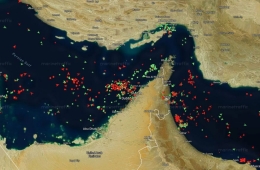
Maintaining submarine communication cables. Italian Institute of International Political Studies.
View original imageSubmarine cables are fiber-optic communication lines installed in deep oceans, playing a vital role in connecting the world's internet as a single network. Tasnim posed the question, "How do social networking services, Instagram, or a single internet call travel from one country to another?" and emphasized, "It is thanks to submarine cables. They are the infrastructure upon which modern digital life depends."
At least seven submarine communication cables cross the Strait of Hormuz, including FALCON, AAE-1, and TGN-Gulf, which connect Asia, the Middle East, and Europe. The outlet reported, "Many internet cables pass through the strait and then connect to coastal landing points and major data centers in the region."
Some are expressing concerns about an outlet linked to Iran's hardline armed groups mentioning submarine cables. Submarine communication cables are critical infrastructure that become targets when a country at war seeks to threaten the economy of another nation. In September 2023, there were suspicions that pro-Iranian Houthi rebels in Yemen had cut fiber-optic cables installed in the Red Sea. In both 2024 and 2025, submarine cables in the Baltic Sea were cut several times, with claims at the time pointing to Russian military involvement.
If a submarine cable is damaged, the affected segment must be located, and restoration requires specialized repair vessels and permissions to pass through various territorial waters. This makes for a complex process that takes both time and money. During this period, it is difficult to avoid side effects such as slower internet speeds and increased latency.
Hot Picks Today
 Chilling Timing "Did They Know Again?"... $640 ...
- [Exclusive] SK hynix Becomes First Korean Semiconductor Firm to Win IEEE Innovat...
- "I Spent Money in a Truly Meaningful Way"... How an SK hynix Employee Donated 10...
- "If You Have This at Home, Remove It Immediately"... 'This Item' Is as Harmful a...
- Foreign Vessels Once Swept Up the Seas Every Season... Now Face Fines of Up to 1...
Tasnim added, "(If the cables are damaged,) Iran will still suffer some damage, but its vulnerability is much lower," and stated, "A crisis in the Strait of Hormuz would result in Arab countries adjacent to the Persian Gulf suffering much more than Iran."
© The Asia Business Daily(www.asiae.co.kr). All rights reserved.