"To Ensure Success of Community-Based Integrated Care, the Role of Licensed Practical Nurses Must Be Clearly Defined"
Ji-yeon Kwak, President of the Licensed Practical Nurses Association: "Legal Status Needed as Core Resource for Primary Care"
Only 27% of Certificate Holders Work in the Field... Urgent Measures Needed to Prevent Skilled Workforce Attrition
It has been argued that, for the government's "community-based integrated care" policy—currently being implemented in response to Korea's transition into a super-aged society—to succeed, the legal status and roles of licensed practical nurses must be clearly defined so that as many skilled personnel as possible can work in the field.

On April 23, Ji-yeon Kwak, President of the Korea Licensed Practical Nurses Association, held a press briefing and stated, "As the paradigm of Korea's healthcare shifts to a community-centered model, the participation scope of licensed practical nurses as home-visit and home-care workforce must be clearly expanded to bridge the care gap."
According to the association, as of the end of 2024, there are approximately 246,500 licensed practical nurses employed nationwide, accounting for over 50% of the nursing workforce in major healthcare institutions such as local clinics, long-term care hospitals, public health centers, and long-term care facilities.
President Kwak explained, "Approximately 138,000 licensed practical nurses are employed at local clinic-level medical institutions, making up nearly 86% of the total nursing workforce in these settings. Under Article 6 of the Nursing Act, they are essential personnel who provide nursing and medical assistance under the guidance of doctors, and are the core resource for primary care optimized for chronic disease management."
Accordingly, she advocated for revising the "Integrated Support Act for Regional Care, including Medical and Long-Term Care" to officially designate licensed practical nurses as providers of nursing services. She also called for allowing them to serve as home-visit and home-care personnel in integrated community home nursing centers run by local governments.
President Kwak also pointed out that only 27% of all licensed practical nurse certificate holders are currently active in healthcare, identifying poor working conditions as the main reason for workforce attrition. To address this, the association demands practical measures to improve working conditions at both the local government and central government levels.
Specifically, she proposed that local governments amend ordinances to provide "welfare improvement allowances" to maintain the competency of staff at long-term care institutions. By differentially paying between 50,000 won and 180,000 won per month depending on years of service, the aim is to fill workforce gaps in medically underserved areas. Furthermore, she called for including licensed practical nurses working in daycare centers, who are responsible for infant and child health, as recipients of long-term service allowances for childcare staff in order to eliminate occupational discrimination. She also urged the establishment of a practical compensation system, such as providing an allowance of around 100,000 won per month to clinic-level staff in medically underserved areas.
She also emphasized the need to strengthen the role of licensed practical nurses within the public healthcare system. She called for legal requirements to ensure at least two licensed practical nurses are assigned to public health centers and public health sub-centers, which serve as bases for community-based integrated care. In addition, she requested that additional points be awarded for licensed practical nurse certification when hiring local government public health officials.
Hot Picks Today
 Chilling Timing "Did They Know Again?"... $640 ...
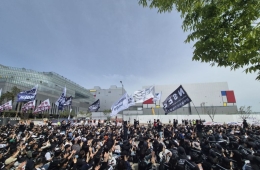
- 'Sea of Black' Sweeps Pyeongtaek... 40,000 Samsung Union Members Unite in Call t...
- "I Spent Money in a Truly Meaningful Way"... How an SK hynix Employee Donated 10...
- "If You Have This at Home, Remove It Immediately"... 'This Item' Is as Harmful a...
- Foreign Vessels Once Swept Up the Seas Every Season... Now Face Fines of Up to 1...
President Kwak stressed, "Now, nursing and care are not issues confined to particular facilities, but have become tasks for the entire 'community' where we live. With last year's approval as a statutory body, licensed practical nurses—now recognized as skilled professionals in their own right—will serve as the fundamental workforce and capillaries supporting the community's public health care system."
© The Asia Business Daily(www.asiae.co.kr). All rights reserved.