
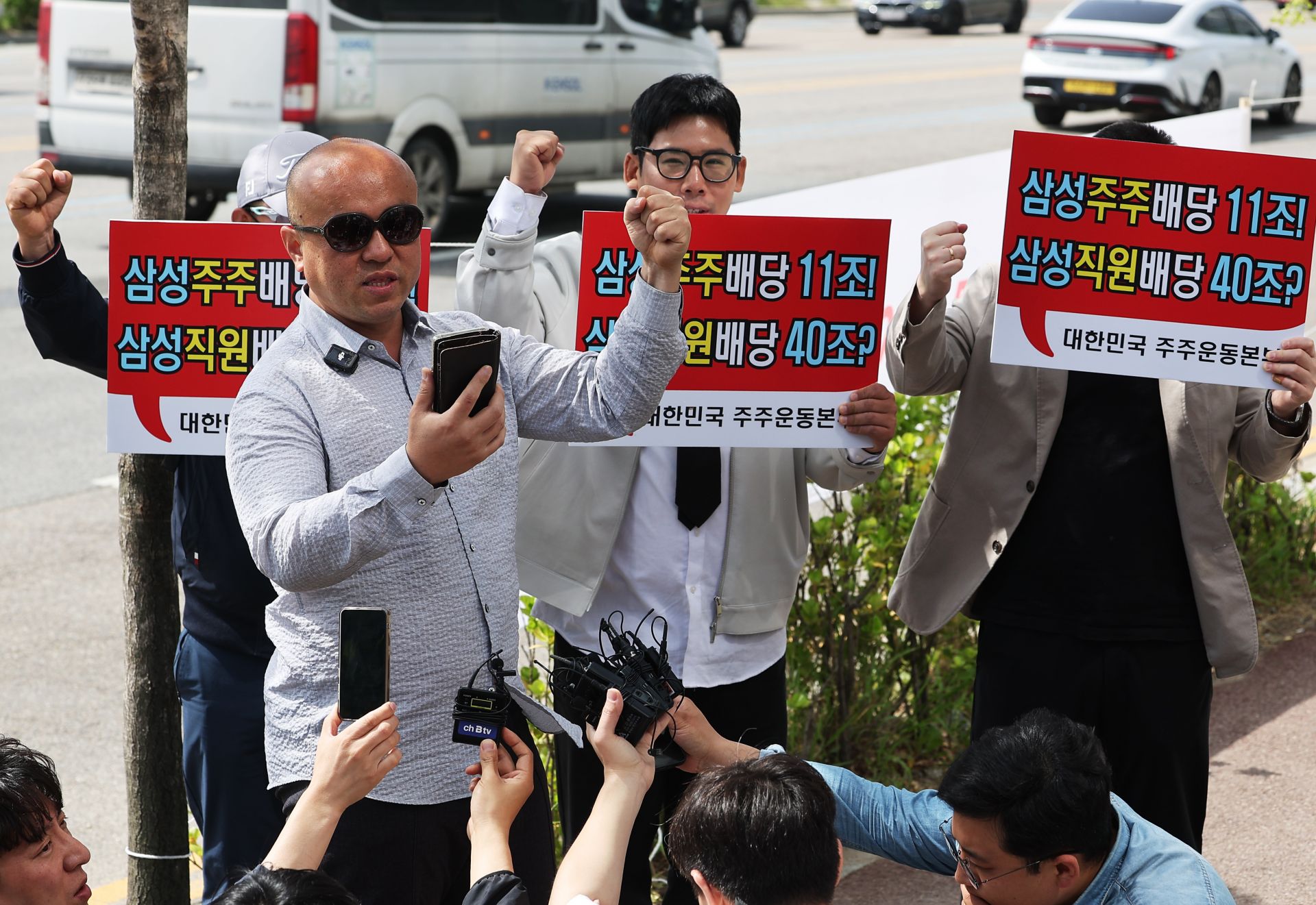
On the same day, the 'Korea Shareholders Movement Headquarters' also announced a counter-protest against the union's strike movement. However, since the number of participants is small and the counter-protest is expected to disperse before the union rally begins, the possibility of direct physical confrontation is considered low.
Samsung Union Joint Struggle Headquarters Rally
Demand for Transparent Performance Bonus Calculation System and Abolition of Upper Limit
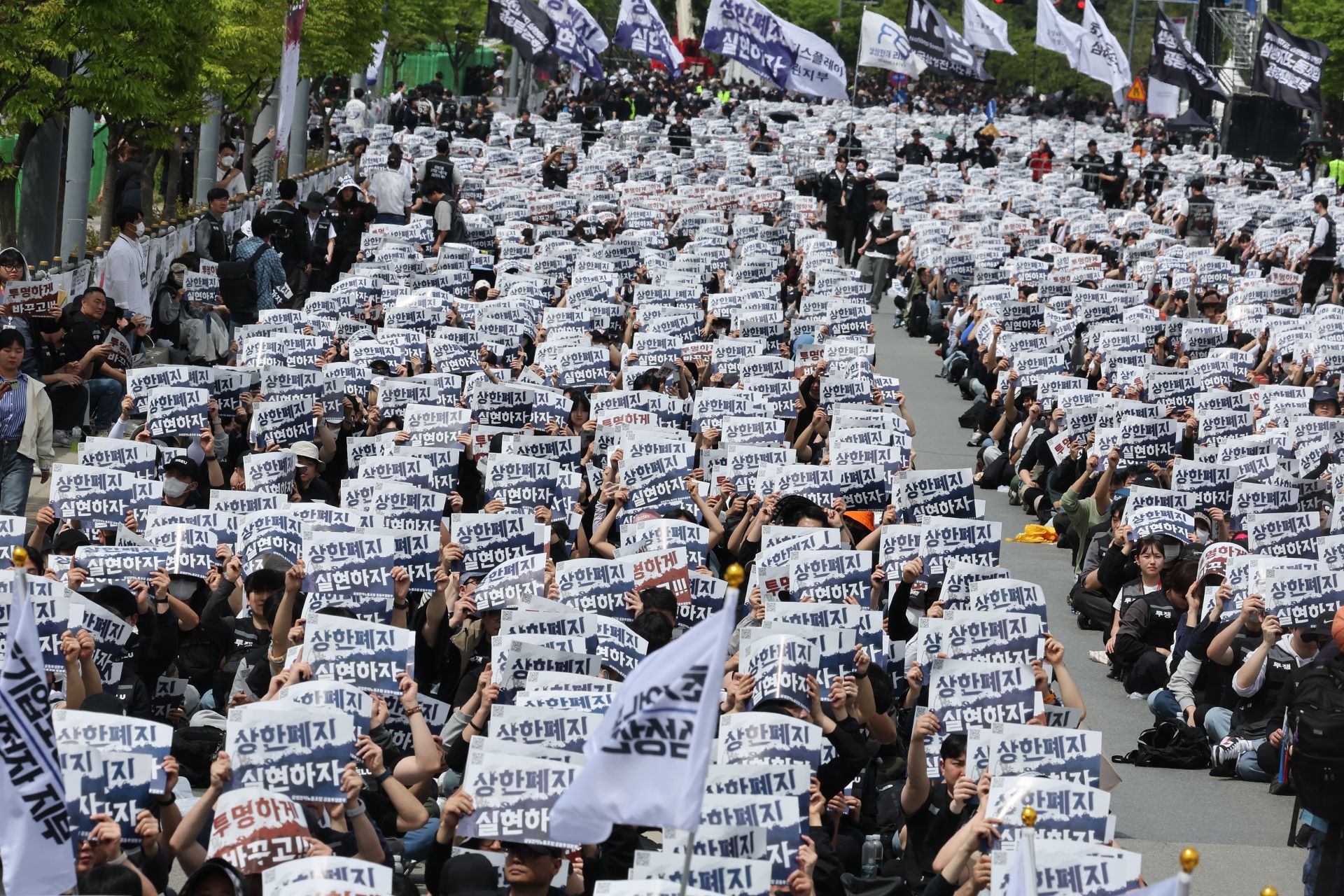
Tensions between labor and management at Samsung Electronics have reached their peak as the labor union entered into a large-scale struggle rally at the Samsung Electronics Pyeongtaek Campus on April 23. With over 30,000 union members expected to gather for this rally alone, it is projected to be the largest collective action in Samsung Electronics' history. Industry insiders are concerned that if the union's collective action escalates into a general strike in May, it could result in economic losses and a decline in market credibility.
On this day, the Samsung Electronics Union Joint Struggle Headquarters held a large-scale rally under the slogan "Make It Transparent and Realize the Abolition of the Upper Limit" at the Pyeongtaek plant at 1 p.m. The schedule included a preliminary rally from 1 p.m. to 2 p.m., followed by the main rally from 2 p.m. to 3 p.m. The event featured solidarity speeches, viewing of activity videos, and a large-scale card section program.
The union's core demands are the transparency of the performance bonus calculation system and the abolition of the upper limit. Specifically, they are calling for performance bonuses to be paid without an upper cap, with 15% of operating profit set aside as the bonus resource. Previously, the management had proposed that if the Device Solutions (DS) division achieves the No. 1 position in domestic sales and operating profit, it would offer additional rewards that exceed the performance bonus upper limit through special incentives. However, the union has insisted on a permanent abolition of the cap through a system change, and the two sides have not been able to reach an agreement.
The union anticipated that approximately 37,000 members would gather at the rally site that day. Accordingly, the police plan to completely block vehicle traffic on the eight-lane road near the Pyeongtaek Campus to prevent accidents and ensure the event proceeds smoothly.
If labor and management fail to reach an agreement after this rally, the union plans to launch an 18-day general strike from May 21 to June 7. The union estimates that if Samsung Electronics' semiconductor lines come to a halt, the losses could amount to about 1 trillion won per day. This estimate is based on Samsung Electronics' projected annual operating profit of about 300 trillion won this year. In fact, the Pyeongtaek plant suffered a loss of about 50 billion won when operations were suspended for about 28 minutes due to a blackout in 2018. When converted to a daily basis, this equates to about 2.6 trillion won per day.

At the rally declaring a three-day general strike on July 8, 2024, held in front of the main gate of Samsung Electronics Hwaseong Plant in Hwaseong, Gyeonggi Province, members of the National Samsung Electronics Labor Union, the largest union of Samsung Electronics, are shouting slogans. Photo by Yongjun Cho jun21@
원본보기 아이콘
At the rally for the three-day general strike declared by the National Samsung Electronics Labor Union, the largest union at Samsung Electronics, held on July 8, 2024, in front of the main gate of Samsung Electronics Hwaseong Plant in Hwaseong, Gyeonggi Province, the battle flag was brought in. Photo by Yongjun Cho jun21@
원본보기 아이콘The industry is also concerned that a strike could severely disrupt the entire semiconductor supply chain, especially given the intense competition for leadership in next-generation markets such as high bandwidth memory (HBM).
A Samsung representative explained, "If production lines stop, the first to be affected are the partner companies whose deliveries are disrupted, as well as non-regular, dispatched, and service workers employed there," adding, "It is estimated that each production line at Samsung Electronics Pyeongtaek Campus creates about 30,000 jobs, including those at partner firms."
If the strike leads to a failure to meet supply contract terms with clients, there is also a risk that this could escalate into issues of breach of contract and liability for damages. If major clients such as Nvidia begin to perceive the strike at Samsung as a long-term risk, there is also the possibility of brand reputation damage and client attrition.


An industry insider in the semiconductor sector pointed out, "Failing to supply promised volumes on schedule sends a signal equivalent to 'termination of transactions' in a global market that prioritizes supply chain resilience above all else," and added, "If illegal industrial actions cause a sharp drop in production, losing global leadership status is only a matter of time."
In this regard, Lee Chanhee, Chairman of the Samsung Compliance Committee, stated, "Samsung is regarded not just as a private corporation, but as 'the people's company,'" and added, "The union should also be more prudent, taking into consideration shareholders, investors, and all the people who are directly and indirectly connected."
-

Reporter Kim Jinyeong camp@asiae.co.kr
-
Edit Kim Hyunhee faith100@asiae.co.kr
© The Asia Business Daily(www.asiae.co.kr). All rights reserved.