'State Visit to India' President Lee: "Summit Will Elevate Bilateral Relations to an Entirely New Level"
Expressing Willingness to Expand Cooperation at Meeting with Korean Residents
Strengthening the "Special Strategic Partnership"
"India Is a Crucial Partner in Overcoming the Middle East Crisis"
Referring to the First Generation of Koreans in Indi
President Lee Jaemyung, currently on a state visit to India, stated that the Korea-India summit will mark a complete transformation of bilateral relations. He emphasized that India is a crucial partner in overcoming the global energy supply chain crisis caused by the Middle East war, and expressed his intention to actively expand cooperation between the two countries.
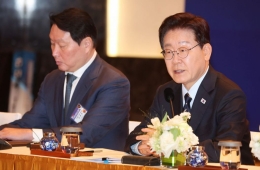
On April 19 (local time), President Lee held a meeting with Korean residents at a hotel in New Delhi, India, and said, "India is no longer just a consumer market—it has become a key country leading global production and supply chains. However, the level of Korea-India cooperation remains low compared to India's vast potential." He added that Indian authorities share this view, referencing his closed-door meeting with the Indian Minister of Foreign Affairs immediately after his arrival. The Korean community in India is known to number around 12,000 people, with about 760 Korean enterprises operating locally.

President Lee particularly stressed that India is an important partner for jointly overcoming global supply chain instability caused by the Middle East war. He highlighted the need for collaboration in energy, supply chains, and production bases, stating, "With supply chain instability and economic crises becoming constant in the aftermath of the Middle East war, Korea and India will be extremely important strategic partners to each other." He further stated, "Your experiences, networks, and understanding of the local environment will be invaluable assets as Korea and India move forward in cooperation. The government will also provide full support so that our companies and compatriots can realize their full potential in a more stable environment."
President Lee also personally mentioned the history of the Korean community in India, adding significance to the occasion. He said, "When people think of India, they think of an economic powerhouse with the world's largest population, but for me, the novel 'The Square' by Choi Inhoon comes to mind first." He discussed those who, in the aftermath of the Korean War and the tragedy of national division, chose to go to a third country—India—rather than South or North Korea, noting that India is a country closely connected to the pains of modern Korean history.
Mentioning the first-generation Koreans who settled in India after the Korean War, President Lee said, "Having overcome colonial rule, division, war, and military dictatorship, the Republic of Korea has now achieved both economic development and democratization. I will do my utmost to prevent such horrific events from ever occurring again." He continued, "The passion and dedication of the first generation laid the foundation for today’s Korean community in India. Recently, the spirit of mutual assistance has been shining, as the Korean Association has raised funds for surgeries to support compatriots in need."
President Lee promised to actively address the suggestions of the Korean community in India. He said, "I asked the Korean community to submit problems, points for improvement, and suggestions through the embassy, and about 40 items have been collected so far." He added, "Globally, about 1,400 submissions have been received, with issues such as Korean schools, visas, and voting rights being the most common."

Earlier, Cho Sanghyun, President of the Korean Association in India, said in his welcome address, "The vast majority of overseas Koreans have not been able to sleep peacefully even for a day since witnessing the crisis of democracy in our homeland triggered by the December 3, 2024 night martial law. It is truly an honor and a source of gratitude that you have wisely overcome the rebellion on the side of the overwhelming majority of the people and visited India not as a president to be embarrassed by overseas Koreans, but as a president to be proud of."
President Cho also stated, "Although India was somewhat late compared to other countries, the rapid spread of K-pop, dramas, and food has led to growing consumption of Korean culture among the young generation. The formerly conservative and rigid atmosphere in India is also changing quickly, and Korean enterprises and small business owners are achieving greater results in this trend." He added, "With this visit as a turning point, we hope that India, with its 1.5 billion people, will be clearly recognized as an economic territory for Korea to expand into. We expect that the synergy of government policy, businesses, and the Korean community will lead to tangible outcomes."
Hot Picks Today
 Chilling Timing "Did They Know Again?"... $640 ...
- Trump: "Iran in a Crazy Situation... Orders to Fire on Mine-Laying Vessels in th...
- "I Spent Money in a Truly Meaningful Way"... How an SK hynix Employee Donated 10...
- "If You Have This at Home, Remove It Immediately"... 'This Item' Is as Harmful a...
- Foreign Vessels Once Swept Up the Seas Every Season... Now Face Fines of Up to 1...
Meanwhile, President Lee’s state visit to India is scheduled for two nights and three days, from April 19 to 21. On April 20, President Lee will attend the official welcome ceremony, offer flowers at the Gandhi Memorial, hold both small and expanded meetings with Prime Minister Narendra Modi, participate in an MOU exchange ceremony, joint press announcement, official luncheon, Korea-India business dialogue, business forum, and attend a state dinner hosted by President Droupadi Murmu. This visit marks the first state visit by a Korean president to India in eight years, at the invitation of Prime Minister Narendra Modi.
© The Asia Business Daily(www.asiae.co.kr). All rights reserved.