Trump Convenes White House Situation Room Amid Hormuz Strait Crisis
Iranian Military Announces Re-blockade of Strait of Hormuz
Tensions Escalate After Attacks on Oil Tankers
Senior Officials Including JD Vance Hold Meeting at the White House

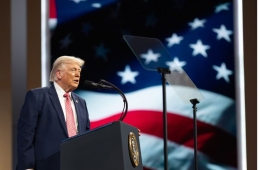
Tensions rose again as the Iranian military announced the re-blockade of the Strait of Hormuz, prompting U.S. President Donald Trump to convene a meeting in the White House Situation Room.
According to Axios on April 18 (local time), President Trump convened the Situation Room meeting at the White House to discuss Iran's re-blockade of the Strait of Hormuz and the ongoing ceasefire negotiations with Iran.
Until the previous day, President Trump had told reporters at the White House that a second round of ceasefire talks could take place "around this weekend," adding, "If the talks are held, I think an agreement could be reached within a day or two."
However, it appears that the meeting was called after the Iranian military declared the renewed blockade of the Strait of Hormuz and launched attacks on some oil tankers, escalating tensions once again.
Axios reported that participants at the Situation Room meeting included Vice President JD Vance; Secretary of State Marco Rubio; Secretary of Defense Pete Hegseth; Secretary of the Treasury Scott Bessent; White House Chief of Staff Susie Wiles; Special Envoy Steve Witkoff; CIA Director John Ratcliffe; and Chairman of the Joint Chiefs of Staff Dan Kane.
Quoting sources familiar with the negotiation process, Axios noted that the latest tension erupted after the two sides had made progress in narrowing their differences over Iran's uranium enrichment and stockpiles.
Meanwhile, the Iranian military stated that after announcing the re-blockade of the Strait of Hormuz, it was reviewing a new proposal from the United States related to the second round of ceasefire negotiations.
On this day, Iran's Supreme National Security Council (SNSC) issued a statement in the name of its secretary, explaining that the first round of negotiations between the U.S. and Iran, held in Pakistan on April 11-12, broke down because "the U.S. side raised new excessive demands during the process," and added, "If the adversary withdraws these excessive demands and brings forth requests that match the realities on the ground, talks will resume."
The statement continued, "Recently, the Pakistani military commander, who visited Tehran as a mediator, relayed that the United States had made a new proposal. Iran is currently reviewing it and has not yet responded."
Hot Picks Today
 "Over 20 Times More Than Overseas": 104.5 Milli...
- "Only the Top 1% Winning Big in Stocks Smile... '300 Million Won Splurges' or '1...
- Applied Just for Skin Soothing...Study Finds It Suppresses Antibiotic Resistance
- "If an Accident Happens, Teachers Go to Jail"... The Real Reason Behind Fewer Sc...
- "Please Launch It in Korea!" After All the Hype... This Coffee Finally Arrives i...
The SNSC warned, "As long as the adversary obstructs the passage of ships to Iran or enforces measures such as a maritime blockade, Iran will consider this a violation of the ceasefire and will not allow any conditional or limited reopening of the Strait of Hormuz."
© The Asia Business Daily(www.asiae.co.kr). All rights reserved.