KOSPI Pauses at 6,000... Eyes 7,000 on Potential US-Iran Ceasefire
Profit Forecasts for Samsung Electronics and SK hynix Surge by 108 Trillion Won in Three Months
540 Trillion Won Expected This Year, 672 Trillion Won Next Year
SK hynix’s Earnings Announcement on April 23 in the Spotlight
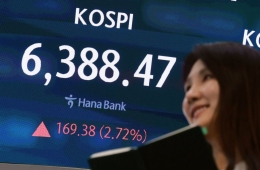
The KOSPI index has paused for breath ahead of reaching an all-time high. The prospect of a ceasefire agreement between the United States and Iran is expected to be a decisive turning point for another leap in the stock market. As geopolitical risks subside and the semiconductor industry outlook improves, the consensus is that it is only a matter of time before the previous record high is surpassed.

On April 17, the KOSPI opened at 6,227.33, up 0.02% from the previous trading day, and recorded 6,209.34 at 9:55 a.m. During the same period, the KOSDAQ was trading at 1,166.31, up 0.29%. The KOSPI's all-time closing high stands at 6,307.27 on February 26, and its intraday record is 6,347.41 on February 27.
Overnight, all three major U.S. stock market indices closed higher. On the New York Stock Exchange (NYSE), the Dow Jones Industrial Average rose by 115.00 points (0.24%) to 48,578.72. The S&P 500 climbed 18.33 points (0.26%) to 7,041.28, while the Nasdaq gained 86.69 points (0.36%) to finish at 24,102.70. Both the S&P 500 and Nasdaq indices renewed their highs for the second consecutive day, following the highest levels in three and six months, respectively, set the previous day. The Nasdaq has now risen for 12 consecutive trading sessions, setting the longest winning streak since 2009.
Optimism in the Korean stock market is grounded in the strengthening fundamentals of the domestic market. The current 12-month forward price-to-earnings ratio (PER) for the KOSPI is around 7.55 times. This is due to a sharp rise in forward earnings per share (EPS), which has substantially reinforced the market's fundamentals. If a forward PER of 8 times is applied, the KOSPI could be calculated to reach the 6,600 level. According to Daishin Securities, even after hitting all-time highs, the KOSPI remains in undervalued territory. This reflects a significant gap between corporate earnings and the market's valuation. The analysis suggests that unless there is a sharp economic downturn or a substantial downward revision of earnings forecasts, the undervalued valuation is likely to normalize.

According to FnGuide, the combined operating profit forecast for Samsung Electronics and SK hynix has recently been revised sharply upward to 540 trillion won for this year and 672 trillion won for next year, up 42 trillion won and 66 trillion won, respectively, from projections three months ago. In particular, the first-quarter earnings results of SK hynix, scheduled for release on April 23, are expected to be a key determinant for further index gains. Following Samsung Electronics’ earnings guidance surprise, SK hynix’s operating profit forecast has risen to around 40 trillion won. If SK hynix exceeds this level, the KOSPI’s annual earnings outlook and valuation appeal are expected to further strengthen.
The continued rally in semiconductor stocks is based on robust supply-demand dynamics and structural changes. Shipments of artificial intelligence (AI) servers have increased by 28% year-on-year, more than doubling the overall server market growth rate, while memory inventories have dropped to historical lows, with only one to two weeks’ worth left. This supply shortage has driven up DRAM and NAND flash prices by up to 250% and 190% year-on-year, respectively, and is expected to be a powerful driver for Samsung Electronics and SK hynix to claim the top and third spots globally in operating profit next year.
The evolution of Korea’s semiconductor industry towards a “foundry-based” business model is a key factor in the valuation re-rating. Samsung Electronics and SK hynix are expanding long-term supply agreements (LTAs) of three to five years or more with major customers, shifting away from being swayed by past industry cycles and moving toward a stable, order-based production system.
Hot Picks Today
 "Over 20 Times More Than Overseas": 104.5 Milli...
- "Only the Top 1% Winning Big in Stocks Smile... '300 Million Won Splurges' or '1...
- Applied Just for Skin Soothing...Study Finds It Suppresses Antibiotic Resistance
- "If an Accident Happens, Teachers Go to Jail"... The Real Reason Behind Fewer Sc...
- "Please Launch It in Korea!" After All the Hype... This Coffee Finally Arrives i...
Ji-yong Han, a researcher at Kiwoom Securities, analyzed, “The first-quarter earnings season is now shifting into a contest of expectations. Good results are essentially the baseline, and the key is whether companies can instill confidence that strong results will continue in the second quarter and beyond.” He added, “Even if there are intermittent price adjustments in semiconductor stocks due to profit-taking, it is appropriate not to revise the overweight strategy. The profit growth cycle driven by favorable market conditions remains unchanged.”
© The Asia Business Daily(www.asiae.co.kr). All rights reserved.