[Good Morning Market] KOSPI Expected to Open Higher on Anticipation of Second Round of US-Iran Talks

On April 14, the KOSPI is expected to open higher, buoyed by optimism surrounding the second round of follow-up negotiations between the United States and Iran.
On the previous day, the Dow Jones Industrial Average closed at 48,218.25, up 301.68 points (0.63%) from the previous session. The S&P 500 ended at 6,886.24, up 69.35 points (1.02%), while the tech-heavy Nasdaq Composite finished at 23,183.74, up 280.84 points (1.23%).
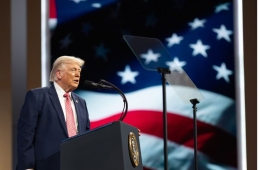
In early trading, the New York stock market was weighed down by the breakdown of the first round of U.S.-Iran negotiations. However, comments from U.S. President Donald Trump suggesting that "Iran wants an agreement" revived hopes for a deal. Additionally, bargain hunting into artificial intelligence (AI)-related stocks that had seen large declines, such as Microsoft (MS, up 3.6%) and Oracle (up 12.7%), helped the indexes recover and close higher.
The market is still being influenced by developments in the U.S.-Iran negotiations, but one notable trend is that daily stock price volatility has gradually decreased in recent days. This suggests that, much like in past wartime scenarios, investors have developed a certain degree of resilience and adaptability to geopolitical risks.
However, due to concerns over a potential double blockade of the Strait of Hormuz, West Texas Intermediate (WTI) crude oil prices have remained highly volatile, fluctuating around $100 per barrel. This has fueled concerns about a prolonged period of high oil prices, similar to the situation during the Russia-Ukraine war in 2022. Nevertheless, unlike that period, the pressure for energy price increases to translate into inflation appears to be more limited this time. For example, looking at the Break-Even Inflation (BEI, nominal yield minus inflation-linked bond yield), the average for the one-year BEI in March-April 2022 was 5.2%, and the ten-year was 2.8%. Currently, those figures remain at 3.5% and 2.4%, respectively.
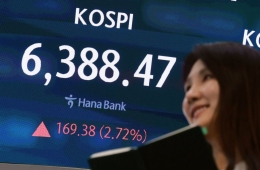
Today, the domestic stock market is expected to open higher on the back of a rebound in the U.S. market driven by hopes for the second round of U.S.-Iran talks, a 3.2% rise in KOSPI night futures, and a decline in the won-dollar exchange rate to the 1,470 won level. There is also an outlook for the KOSPI to attempt to re-enter the 5,900-point range.
From a supply-demand perspective, changes in the trading patterns of foreign investors have emerged as a major variable. In the fifth week of last month, foreign investors recorded net selling of 13.3 trillion won, which decreased to 5.9 trillion won in the first week of this month. In the second week, there was a shift to net buying of 5 trillion won. Although there was a net sell-off of 450 billion won yesterday, the reduction from the 800 billion won range during intraday trading is seen as a positive sign.
Ji-Young Han, a researcher at Kiwoom Securities, analyzed, "Foreign investors, who had posted net selling of 27 trillion won in the semiconductor sector during March, shifted to net buying of about 3.8 trillion won in April, suggesting a possible change in their view of leading stocks."
This improvement in market supply-demand is largely attributable to the strengthening of KOSPI earnings momentum. Since April, the consensus for KOSPI operating profit and net profit in 2026 has been revised upward by 20% and 18%, respectively, to 772 trillion won and 607 trillion won, compared with the end of March. In addition, the won-dollar exchange rate has fallen from the 1,500 won range to the upper 1,400 won range, easing the burden of foreign exchange losses for foreign investors.
Hot Picks Today
 "Over 20 Times More Than Overseas": 104.5 Milli...
- "Only the Top 1% Winning Big in Stocks Smile... '300 Million Won Splurges' or '1...
- Applied Just for Skin Soothing...Study Finds It Suppresses Antibiotic Resistance
- "If an Accident Happens, Teachers Go to Jail"... The Real Reason Behind Fewer Sc...
- "Please Launch It in Korea!" After All the Hype... This Coffee Finally Arrives i...
The researcher added, "Now that the first quarter earnings season has officially begun, there is room for further upward revisions of earnings forecasts, and as the peak of war-related uncertainty passes, upward pressure on the exchange rate is also likely to be limited. Unless there is an extreme scenario where U.S.-Iran negotiations completely break down, it is unlikely that we will see a repeat of the massive net selling by foreign investors and the sharp stock market declines experienced in March."
© The Asia Business Daily(www.asiae.co.kr). All rights reserved.