Five Countries, Including South Korea, China, and Japan, Respond Cautiously to Trump's Request to Dispatch Warships
UK Think Tank: "Even France, the Most Supportive, Only Mentions Defensive Measures"
Significant Risks Involved in Escorting Ships Through the Strait of Hormuz

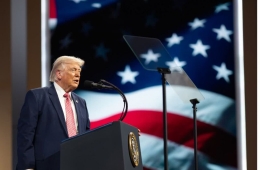
US President Donald Trump is boarding Air Force One at Joint Base Andrews on the 13th (local time). Photo by AP
View original imageAccording to reports from NBC and The New York Times on the 15th (local time), five countries, including South Korea, China, and Japan, have shown cautious responses after being asked by US President Donald Trump to dispatch warships to the Strait of Hormuz.
Japan, which is the United States' key ally in the Indo-Pacific region, has not yet issued an official statement. The Japanese Ministry of Foreign Affairs told NHK that "Japan makes its own decisions on how to respond, and independent judgment is our fundamental principle," making it clear that there are no immediate plans to dispatch naval vessels. This issue is likely to be discussed at the summit between President Trump and Prime Minister Sanae Takaichi of Japan, which is scheduled to be held in Washington, D.C. on the 19th.
Takayuki Kobayashi, chairman of the Liberal Democratic Party's Policy Research Council, also appeared on NHK and did not rule out the possibility of sending warships, but said, "The legal threshold is very high," according to reports from Kyodo News and others. The Policy Research Council chairman is one of the three key positions in the Liberal Democratic Party, except for the prime minister, overseeing policies and legislation.
China has not issued an official response to President Trump's request to dispatch warships, and is only calling for stability in the Middle East. The spokesperson for the Chinese Embassy in the US told CNN, "China urges the immediate cessation of hostilities," without directly addressing President Trump's request.
In South Korea's case, the presidential office stated, "We will review and carefully consider the situation in close communication with the United States." The Blue House also emphasized that the safety of international maritime routes and freedom of navigation are subjects of protection under international law.

France has also not provided a clear answer. Although President Emmanuel Macron previously mentioned the possibility of escorting ships in the Strait of Hormuz in the future, the French Ministry of Foreign Affairs stated the previous day via the social networking service X (formerly Twitter) that French naval vessels will maintain a defensive posture in the eastern Mediterranean region.
The United Kingdom is in a similar situation. Ed Miliband, Secretary of State for Energy Security, said in a BBC interview that "safe passage through the Strait of Hormuz is important" and added, "There are various ways we can contribute, including mine-detection drones." However, he avoided commenting on any options currently under government review.
A spokesperson for the UK Ministry of Defence also said, "We are discussing various options with allies and partners to ensure the safety of maritime transportation in the region." Earlier, UK Prime Minister Keir Starmer spoke with President Trump by phone to discuss the situation in the Middle East. The UK Prime Minister's Office stated that the two leaders agreed on the importance of reopening the Strait of Hormuz to resolve global shipping disruptions.
On the 14th, President Trump wrote on Truth Social that he hopes countries such as China, France, Japan, South Korea, and the United Kingdom will dispatch warships to keep the strait open and secure. President Trump specifically mentioned South Korea, along with China, France, Japan, and the United Kingdom, as "the five countries affected by this artificial constraint (the closure of the Strait of Hormuz)," and pressed his case for a multinational force.
NBC noted that while it remains to be seen what actions each country will ultimately take, the lukewarm responses so far appear to fall short of President Trump's expectations for a swift resolution of the Strait of Hormuz crisis.
H.A. Hellyer, a senior associate fellow at the Royal United Services Institute (RUSI), a UK think tank, told NBC, "It is quite significant that all the countries Trump mentioned are remaining silent." He added that while France is "the closest to agreeing," even President Macron is only mentioning measures "purely on a defensive basis."
Experts also warn that military escort operations in the Strait of Hormuz could entail significant risks. This is because the narrowest part of the Strait of Hormuz, which connects the Persian Gulf and the open sea, is only about 39 kilometers wide.
Hot Picks Today
!["Stock Set to Double: This Company Smiles Every Time a Data Center Is Built [Click e-Stock]"](https://cwcontent.asiae.co.kr/asiaresize/93/2026050416112750184_1777878687.jpg) "Stock Set to Double: This Company Smiles Every...
"Stock Set to Double: This Company Smiles Every...
- "Is Yours Just Gathering Dust at Home? Millennials & Gen Z Rediscover Digicams O...
- Trump: "Possible Agreement Before China Visit... Enriched Uranium to Be Sent to ...
- "Continuous Groundwater Pumping Causes Mexico City to Sink 24cm Annually... 'Gia...
- “She Shouted, ‘The Rope Isn’t Tied!’... Chinese Woman Falls from 168m Cliff ...
Michael Horowitz, a geopolitical and security analyst, told NBC, "Protecting ships is a very big gamble," and explained, "From an operational perspective, deploying military assets in such a narrow strait could give Iran opportunities for close-range attacks." He also pointed out that deterring such threats may require not only air and naval power, but also the deployment of ground forces in coastal areas.
© The Asia Business Daily(www.asiae.co.kr). All rights reserved.