"Name Your Price": Economy Ticket Soars to 12.5 Million Won... Airfares Jump 900% [US-Iran War]
Due to the war between the United States and Iran, airspace over the Middle East has been closed, causing airline ticket prices to surge by around 900%.

According to Bloomberg on March 5 (local time), major airlines such as Emirates and Qatar Airways suspended operations due to the Middle Eastern airspace closure, which has benefited Asian carriers such as Cathay Pacific and Singapore Airlines.
Following the U.S. airstrike on Iran, Asian airlines have emerged as a key option for passengers seeking to leave the Middle East, resulting in a significant increase in ticket prices. Middle Eastern airports serve as vital hubs connecting Europe and Asia. However, with these airports closed, rival airlines capable of offering direct connections along these routes are enjoying windfall gains.
In particular, European passengers are paying large sums to secure seats on flights to Asia that circumvent the Middle East. According to Bloomberg, as of this day, a one-way economy class ticket on Singapore Airlines from London Heathrow to Singapore costs 66,767 Hong Kong dollars (approximately 12.5 million won), a rise of 900% compared to the end of the same month. On the same day, a flight to Hong Kong was priced at 26,737 Hong Kong dollars, which is more than 370% higher than the fare a few weeks later, which is 5,670 Hong Kong dollars.
However, Bloomberg noted that it is uncertain whether such a sharp price increase will persist. If the conflict is prolonged, high fares may be sustained for a longer period. However, given the importance of the Middle East in global travel and trade flows, there is a strong possibility that airlines in the region will swiftly resume operations once the conflict is resolved.
!["Name Your Price": Economy Ticket Soars to 12.5 Million Won... Airfares Jump 900% [US-Iran War]](http://www.asiae.co.kr/news/img_view.htm?img=2026030609322164173_1772757141.png)
Linus Benjamin Bauer, founder of aviation consultancy BAA & Partners, said, "Asian airlines may benefit in the short term from higher ticket prices, strong cargo rates, and a limited increase in market share," but added, "Fundamentally, this is simply a redistribution of demand, rather than a structural reshaping of the global airline network."
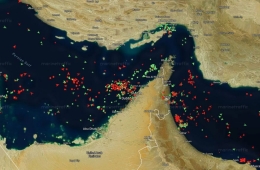
According to aviation data analytics firm Cirium, more than 23,000 flights have been canceled as of this date. While some evacuation flights departing from the UAE have been permitted on a limited basis, general commercial flights remain suspended in the airspace of Gulf countries such as Qatar, Iran, and Iraq.
Hot Picks Today
 Chilling Timing "Did They Know Again?"... $640 ...
- Trump: "Iran in a Crazy Situation... Orders to Fire on Mine-Laying Vessels in th...
- "I Spent Money in a Truly Meaningful Way"... How an SK hynix Employee Donated 10...
- "If You Have This at Home, Remove It Immediately"... 'This Item' Is as Harmful a...
- Foreign Vessels Once Swept Up the Seas Every Season... Now Face Fines of Up to 1...
Middle Eastern hub airports such as Dubai, Abu Dhabi, and Doha play a crucial role as stopover points for long-haul flights. According to consulting firm Roland Berger, major airports in the Gulf region handle about one-third of the approximately 125 million travelers who fly annually between Europe and Asia.
© The Asia Business Daily(www.asiae.co.kr). All rights reserved.