U.S. Unveils "MASGA Action Plan"... Korean Shipbuilders Caught Between Hope and Tension
Bridge Strategy Allocates Volumes to Korea and Other Allies
Expectations Grow for Visible Benefits to K-Shipbuilding
Concerns Persist Over Unclear Paths to Bypassing Regulations
The United States administration has abruptly announced "America's Maritime Action Plan," centered on cooperation with its allies, raising expectations in Korea's shipbuilding industry. As the United States has decided, through a "bridge strategy," to allocate initial shipbuilding volumes to allies such as Korea, it appears increasingly likely that "K-shipbuilding" will benefit. However, some observers note that it is still too early to regard this solely as positive news, as it remains unclear how Washington intends to circumvent existing regulatory laws.

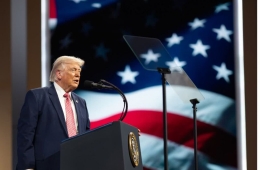
Trump Donald, President of the United States, is delivering a special summit address at the 2025 Asia-Pacific Economic Cooperation CEO Summit (APEC CEO Summit) held at the Gyeongju Arts Center in North Gyeongsang Province on October 29 last year. Photo by Kang Jinhyung
View original imageOn the 19th, the shipbuilding industry in Korea was closely monitoring developments following the announcement of the U.S. action plan. An industry insider said, "It is highly significant in that it reaffirms the United States' commitment to rebuilding its shipbuilding sector," adding, "It is clear that volumes will be allocated to Korea."
Earlier, on the 13th, the United States officially released the action plan on the White House's official website, stating that it would rebuild its domestic shipbuilding industry by utilizing allied shipyards in countries such as Korea and Japan. This is the first official document to follow President Donald Trump's reference to "Make American Shipbuilding Great Again (MASGA)." Specifically, it stipulates that when ordering a large number of vessels under the bridge strategy, the initial volumes will be built at allied shipyards, and that the remaining volumes should then be shifted to local production by simultaneously investing in and modernizing facilities at U.S. shipyards.
The Korean shipbuilding industry believes that even if technology is transferred, the United States will not pose a major threat, given that its share of the global shipbuilding market is currently below 1%. Analysts also point out that high labor costs in the United States will make it difficult for U.S. yards to catch up with Korean and Chinese shipbuilders in the short term. Instead, there is a growing view that Korean companies will be able to secure profitability by leveraging domestic infrastructure and technological capabilities, and then use this as an opportunity to enter the North American market.

Containers piled up at Busan Port's Sin Gamman Pier and Gamman Pier on the 28th of last month. Yonhap News
View original imageHowever, some in the industry are expressing concern that the current action plan is still nothing more than a blueprint. This is because it remains unclear how the plan will circumvent the Jones Act and the Burns-Tollefson Amendment, the regulatory laws that have long hindered entry into the U.S. shipbuilding market.
Hot Picks Today
!["Stock Set to Double: This Company Smiles Every Time a Data Center Is Built [Click e-Stock]"](https://cwcontent.asiae.co.kr/asiaresize/93/2026050416112750184_1777878687.jpg) "Stock Set to Double: This Company Smiles Every...
"Stock Set to Double: This Company Smiles Every...
- "Is Yours Just Gathering Dust at Home? Millennials & Gen Z Rediscover Digicams O...
- International Oil Prices Plunge Over 7% on Hopes for US-Iran Deal...Largest Drop...
- "Continuous Groundwater Pumping Causes Mexico City to Sink 24cm Annually... 'Gia...
- “She Shouted, ‘The Rope Isn’t Tied!’... Chinese Woman Falls from 168m Cliff ...
Meanwhile, the shipping industry has voiced concern over the proposed creation of a new "Maritime Security Trust Fund." The U.S. government simultaneously announced a plan to raise up to 1.5 trillion dollars (about 2,170 trillion won) in reconstruction-related funds by imposing a fee of 1 to 25 cents per kilogram of cargo on all foreign-built commercial vessels calling at U.S. ports.
Since most of the world's commercial vessels are built outside the United States, logistics costs for the shipping industry are expected to increase. A shipping industry official said, "If this is implemented, it is likely to trigger a second and third round of tariff wars on a global scale."
© The Asia Business Daily(www.asiae.co.kr). All rights reserved.