Korea-Japan Chamber Leaders Gather in Jeju, Call for Stronger Economic Solidarity in AI and More
Korea-Japan Chamber of Commerce Presidents' Meeting Held at Shilla Hotel Jeju
22 Business Leaders Including Chey Tae-won Attend
Joint Statement: "Strengthening Cooperation in AI, Semiconductors, and Energy"
Joint Solutions for Low Birth Rate and Aging Population... Expanded Cultural Exchange
Experts Present Vision to Broaden Cooperation into Economic Solidarity
Business leaders from Korea and Japan gathered on Jeju Island to address shared challenges facing both countries and, marking the 60th anniversary of the normalization of diplomatic relations, agreed to further strengthen economic solidarity.

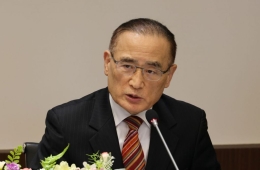
On the 8th, businesspeople from Korea and Japan are seated preparing for the Korea-Japan Chamber of Commerce Presidents' Meeting held at Shilla Hotel Jeju. Photo by Kim Hyungmin
View original imageThe Korea Chamber of Commerce and Industry held the 14th Korea-Japan Chamber of Commerce Presidents' Meeting together with the Japan Chamber of Commerce and Industry at Shilla Hotel Jeju on the 8th. The two chambers alternate hosting the meeting each year. This year, it was Korea's turn, so the event was held in Jeju. Next year's meeting will be held in Sendai, Japan.
The meeting was attended by 22 business leaders from both countries. From Korea, participants included Chey Tae-won, Chairman of the Korea Chamber of Commerce and Industry and Chairman of SK Group, as well as chairpersons of regional chambers, Park Seunghee, President of Samsung Electronics, and Lee Hyunghee, Vice Chairman of SK Group. From Japan, Kobayashi Ken, Chairman of the Japan Chamber of Commerce and Industry and Senior Advisor at Mitsubishi Corporation, and others visited Korea for the event.
In a joint statement, the two chambers announced their agreement to strengthen cooperation in future industries such as artificial intelligence (AI), semiconductors, and energy, and to jointly address the challenges of low birth rates and an aging population. They also agreed to expand cultural exchanges.
Specifically, both sides recognized that future industries such as AI, semiconductors, and energy are key sectors that determine the competitiveness of their economies. Based on this understanding, the two countries agreed to jointly establish a stable investment environment and supply chain, and to cooperate in maintaining a free and open international economic order. They also acknowledged that low birth rates and population decline are critical challenges faced by both countries and agreed to work together to find solutions. As both governments have already begun related discussions, it is expected that the private sector will also share policy and research experience to enable practical cooperation. Additionally, the business communities of both countries noted the increase in mutual visits due to the expansion of direct flights, and agreed to broaden the foundation for exchange in diverse fields such as the economy, tourism, and culture.
During a special discussion session, experts from both countries presented a vision to elevate the framework of cooperation to the level of economic solidarity. As the industrial and trade structures of both countries are being reorganized, Korea and Japan are facing new challenges that cannot be addressed by existing methods alone, so cooperation must also evolve in new directions. Specifically, they proposed shifting from being "rule takers" to "rule setters." They also emphasized that through Korea-Japan economic solidarity, both countries can expand their external reach as a joint market.
Furthermore, there were calls for cooperation that leverages each country's strengths, such as physical AI collaboration and the joint establishment of multimodal AI platforms in the fields of AI and semiconductors. In the startup sector, there was consensus on the need to build a joint Korea-Japan ecosystem that goes beyond the limitations of a single country.
The Incheon Chamber of Commerce and Industry and the Aomori Chamber of Commerce and Industry were selected as outstanding chambers for their contributions to regional cooperation between Korea and Japan at this meeting. The main business directions of the two chambers were also shared. Han Sangwon, Chairman of the Gwangju Chamber of Commerce and Industry, introduced the achievements of the Asia-Pacific Economic Cooperation (APEC) CEO Summit, the Mega Sandbox, and social value creation projects. Following this, Fujisaki Saburosuke, Chairman of the Sendai Chamber of Commerce and Industry in Japan, proposed joint research and development (R&D) and supply chain cooperation based on the strengths of regional semiconductor materials, parts, and equipment companies.
Outside the meeting, business leaders from both countries also toured a special exhibition highlighting 60 years of Korea-Japan economic cooperation, and shared various cases of collaboration such as technology exchanges, joint investments, and joint responses to future industries, further strengthening their relationships.
Hot Picks Today
 "Now Our Salaries Are 10 Million Won a Month" Record High... Semiconductor Boom Drives Performance Bonuses at Major Electronic Component Firms
- Living the Homebody Dream? "I Was Shocked by My Spending" How to Cut Costs to 5,000 Won for Essentials [The Principles of Benefits]
- Is It Really Like an Illness? "I Can't Wait to Go Again"—Over 1 Million Visited in Q1, Now 'Busanbyeong' Takes Hold [K-Holic]
- "Heading for 2 Million Won": The Company the Securities Industry Says Not to Doubt [Weekend Money]
- Experts Already Watching Closely..."Target Price Set at 970,000 Won" Only Upward Momentum Remains [Weekend Money]
Yoon Chulmin, Executive Director of International Trade at the Korea Chamber of Commerce and Industry, stated, "This year's presidents' meeting was a meaningful occasion to reflect on the achievements of the past 60 years, especially as the atmosphere of cooperation has expanded with the restoration of shuttle diplomacy between the two countries' leaders. The Korea Chamber of Commerce and Industry will work closely with the Japan Chamber of Commerce and Industry to strengthen Korea-Japan economic solidarity."
© The Asia Business Daily(www.asiae.co.kr). All rights reserved.